Demand for these partnerships keeps climbing. The global CDMO market hit $136.6 billion in 2024 and is projected to reach $191.6 billion by 2029, growing at a 7.0% CAGR, according to BCC Research. Rising biologics complexity, tighter compliance expectations, and pressure to launch faster are all driving that growth.
This article breaks down the three main types of pharmaceutical contract manufacturing, how they differ, and what to weigh before picking a partner.
TL;DR
- Contract manufacturing outsources production to CMOs/CDMOs instead of building in-house capacity
- It supports cost control, faster launches, scalability, and regulatory compliance
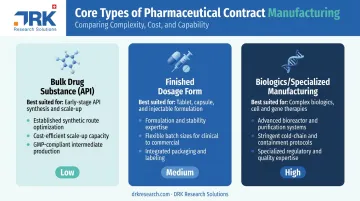
- Three core types exist: Bulk Drug Substance (API), Finished Dosage Form, and Biologics/Specialized manufacturing
- The right choice depends on product stage, complexity, target regulatory markets, and scale
- A global CDMO/CRO partner like DRK Research Solutions bridges development and manufacturing gaps
What Is Pharmaceutical Contract Manufacturing?
Pharmaceutical contract manufacturing is an arrangement where a drug company outsources production of its product to a third party under a formal contract. That contract spells out the formula, quality specifications, and financial terms.
It shows up across nearly the entire drug value chain:
- API synthesis — producing the raw active ingredient
- Formulation — turning that ingredient into a usable drug product
- Fill-finish — filling vials, syringes, or blister packs
- Packaging and labeling — preparing the product for market
This applies to both small-molecule drugs and biologics. Two terms get used interchangeably, but they're not the same:
| Term | What It Covers |
|---|---|
| CMO (Contract Manufacturing Organization) | Executes manufacturing for a formula the sponsor has already developed |
| CDMO (Contract Development and Manufacturing Organization) | Adds development work, process optimization, and often regulatory support, before manufacturing begins |
Sponsors treat contract manufacturing as a strategic tool used throughout a drug's lifecycle, calling on it repeatedly from early development through commercial launch and beyond.
Why Is It Important in the Pharmaceutical Industry?
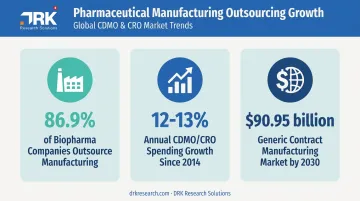
Outsourcing isn't a niche tactic anymore. A 2022 industry survey found that 86.9% of biopharma companies outsourced at least some manufacturing activity, up from 84.8% the year before, per Outsourced Pharma's BioPlan-based research. CRO/CDMO spending has also grown 12-13% annually since 2014, nearly double the pace of overall pharma R&D spending.
Without the right outsourcing structure, things break down fast:
- Capacity bottlenecks delay clinical supply or commercial launch
- Non-compliance findings trigger warning letters or halted production
- Inconsistent quality damages both patient safety and regulatory standing
- Launch timelines slip, sometimes by months
Avoiding these pitfalls starts with choosing the right manufacturing partner. The industry is leaning harder on CDMOs to support generics and hybrid products, categories that depend heavily on flexible, specialized manufacturing capacity. Generic-focused contract manufacturing alone is forecast to reach $90.95 billion by 2030, growing at nearly 10% annually, with API production as the largest segment, according to Grand View Research.
This shift matters for expanding treatment access in underserved and low- and middle-income markets, where local manufacturing capacity is often limited. That said, outsourcing execution doesn't remove sponsor accountability. FDA guidance is clear: the product owner's quality unit remains legally responsible for final release, regardless of who runs the equipment.
Types of Pharmaceutical Contract Manufacturing
Contract manufacturing isn't one-size-fits-all. The right type depends on where your product sits in development, what dosage form it needs, and how complex the molecule is.
Some types focus purely on raw ingredient production, while others handle sterile fill-finish for advanced cell and gene therapies. Here's how the three main categories break down.
Bulk Drug Substance (API) Manufacturing
This type focuses on producing the active pharmaceutical ingredient itself, before any formulation happens. It typically runs through one of two routes:
- Chemical synthesis: multistep reactions, purification, and process optimization
- Fermentation: using microbial systems like E. coli or Pichia pastoris to grow biomolecules, sometimes at scales up to 1,000 liters
API manufacturing is a distinct discipline from formulation. It demands specialized process chemistry expertise and rigorous documentation, including Drug Master Files (DMFs) in the US or Active Substance Master Files (ASMFs) in the EU. These filings protect the manufacturer's proprietary process while giving regulators what they need to review it.
Best suited for: generic drug manufacturers and sponsors needing bulk API supply from clinical through commercial scale.
Strengths:
- Cost efficiency at scale
- Specialized synthesis or fermentation capability
- Consistent purity and yield across batches
Trade-offs: It doesn't cover the finished product. You'll still need a separate drug product partner, and DMF/ASMF documentation adds regulatory complexity that some sponsors underestimate.
Finished Dosage Form (Drug Product) Manufacturing
This is where the API becomes an actual product patients can take, whether that's a tablet, capsule, injectable, or cream. The work centers on formulation, filling, and packaging rather than raw ingredient synthesis.
Finished dosage manufacturing operates under strict frameworks like 21 CFR Part 211 in the US, which governs everything from written production controls to component and packaging documentation. Serialization requirements, like unique product identifiers under FDA's DSCSA rules, add another layer sponsors need their partner to handle correctly.
Best suited for: companies with an approved formulation ready for commercial-scale production, including generics and hybrid product launches.
Strengths:
- Faster time to market once formulation is locked
- Established packaging and serialization capability
- Quality-controlled fill-finish processes
Trade-offs: Quality here depends heavily on the API you supply. If the formulation itself needs redevelopment, a pure finished-dose CMO won't have the flexibility to help. That's typically where a CDMO's development services become necessary instead.
Biologics & Specialized Manufacturing
This category covers the most technically demanding work: proteins, monoclonal antibodies, vaccines, cell and gene therapies, plus specialized forms like sterile injectables and high-potency APIs (HPAPIs).
The infrastructure requirements are steep. Biologics manufacturing partners need:
- Cell-line development capability: cGMP bioreactor capacity often spans 50 to 5,000 liters
- Cleanroom and aseptic processing: HEPA-filtered air, environmental controls, and physical isolation to prevent contamination
- Containment systems for HPAPIs: calibrated to exposure limits and cross-contamination risk
- Segregated, closed processing for cell and gene therapies: facility arrangements distinct from conventional biologics
Real-world capacity expansions illustrate the scale involved: AGC Biologics, for example, added 2,000-liter single-use bioreactors in a recent Copenhagen expansion, more than doubling its local mammalian capacity.
Best suited for: biopharma companies developing biologics, advanced therapies, or high-potency injectable drugs.
Strengths:
- Access to niche technical expertise unavailable in-house
- Capital-intensive infrastructure without the upfront investment
- Regulatory experience navigating complex advanced-therapy guidelines
Trade-offs: Highest cost, longest lead times, a genuinely limited pool of qualified partners, and technology transfer that's far more complex than small-molecule work.
How to Choose the Right Type of Pharmaceutical Contract Manufacturing
Choosing the right partner means matching capability to your product's actual stage, complexity, and regulatory targets. Size and brand recognition rarely tell the full story.
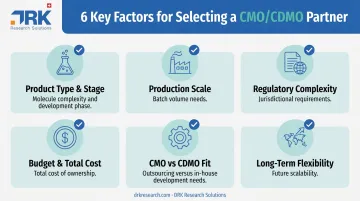
Key factors to weigh:
- Product type and development stage: API, finished dose, or biologic each need different technical expertise
- Production scale and batch size requirements: a partner built for commercial-scale runs may not fit early clinical supply needs
- Regulatory complexity and target markets: US FDA, EMA, WHO-PQ, and emerging-market authorities each carry different documentation and inspection expectations
- Budget and total cost of ownership: including technology transfer, validation, and audit fees that don't show up in the initial quote
- CMO versus CDMO fit: do you need pure manufacturing, or development support too?
- Long-term flexibility: can the partner scale with you geographically as you expand into new markets?
That last point matters more than sponsors often realize. A partner with reach across both regulated and emerging markets can save a second search later.
DRK Research Solutions, for instance, combines CRO and CDMO capabilities for generics and hybrid product development. The company connects sponsors with EU- and US-approved manufacturing partners while managing formulation, analytical method development, technology transfer, and eCTD dossier preparation (Modules 2-5) in-house.
It's an orchestration model rather than owned manufacturing, giving sponsors flexibility without locking them into one facility's capacity limits.
What to Check Before Finalizing Your Partner
A few common mistakes trip up sponsors during selection:
- Overbuying capability: choosing an advanced, biologics-capable partner when a simpler API or finished-dose CMO would do the job at lower cost
- Ignoring lead times and minimum batch sizes: these can quietly derail a launch timeline
- Overlooking regulatory coverage gaps: a partner strong in EU markets may lack WHO-PQ experience your LMIC strategy needs
- Underestimating hidden costs: technology transfer fees, validation runs, and audit requirements add up fast
- Choosing on brand familiarity alone: genuine fit with your product's regulatory and scale needs matters more than name recognition
Conclusion
Pharmaceutical contract manufacturing has become essential to scaling drug production efficiently and compliantly. The three core types—API, finished dosage form, and biologics/specialized manufacturing—each serve distinct needs. Mixing them up wastes time and money.
Understanding these differences puts sponsors in a stronger position to choose confidently. Working with an experienced, globally connected CDMO/CRO partner like DRK Research Solutions can help companies navigate that decision and move therapies toward patients faster. This support proves especially valuable across regulated and underserved markets alike.
Frequently Asked Questions
What are the types of contract manufacturing?
Contract manufacturing types can be categorized by structure (private label, subcontracting, full-service), by industry specialization, or by production stage (API, finished dose, biologics). Pharmaceutical companies most often use the production-stage classification.
What are the types of manufacturing in the pharmaceutical industry?
The core categories are bulk API manufacturing, finished dosage form manufacturing, biologics/specialized manufacturing, and packaging/labeling. Each addresses a different stage of turning a molecule into a market-ready product.
What are the 4 types of validation?
The four types are prospective, concurrent, retrospective, and revalidation. Prospective and concurrent validation occur before and during production, revalidation reconfirms compliance on existing systems, and retrospective validation, based on historical data, is rarely used today.
What is the difference between a CMO and a CDMO?
A CMO manufactures a product the sponsor has already developed. A CDMO adds development services, like formulation work and regulatory support, before manufacturing starts. The distinction matters most when your formulation isn't finalized yet.
How do I choose the right pharmaceutical contract manufacturing partner?
Match the partner to your product stage, target regulatory markets, required scale, and technical expertise. Track record and site-verified quality history matter more than reputation alone.
What is the difference between contract manufacturing and in-house manufacturing?
Contract manufacturing outsources production to reduce upfront capital investment and access existing infrastructure. In-house manufacturing means building and controlling your own facility, which offers more control but requires significant capital and time.