Individually, each of these conditions affects only a handful of patients. Collectively, they add up fast. More than 300 million people worldwide live with a rare disease, according to a 2025 WHO Executive Board report, and more than 95% of these conditions still have no effective treatment.
Orphan drugs exist to close that gap. This article breaks down what they are, the laws that make their development possible, real examples already helping patients, and the growing role specialized research partners play in getting these therapies to underserved populations faster.
Key Takeaways
- Rare diseases affect over 300 million people globally, yet most remain untreated
- US, EU, Japan, and Australia offer tax credits and exclusivity periods to fund orphan drug R&D
- Orphan designation isn't market approval; only a fraction of designated drugs reach patients
- Global orphan drug sales are projected to hit $300 billion by 2028, outpacing standard drug growth
- Low- and middle-income countries face the widest access gaps, where specialized CROs can help close them
What Are Orphan Drugs? Defining Rare Diseases and Orphan Designation
An orphan drug treats a rare, or "orphan," disease. The name reflects the core problem: with so few patients, these conditions get "orphaned" by conventional drug development. Companies typically pursue treatments where large patient populations promise a return on investment. Rare diseases don't offer that math, which is exactly why humanitarian need, not commercial opportunity, drives most orphan drug programs.
What Is a Rare Disease?
Definitions vary by region, and the gap matters for sponsors planning global trials:
- European Union: affects no more than 1 in 2,000 people (equivalent to 5 in 10,000)
- United States: affects fewer than 200,000 Americans, regardless of percentage
- Disease count: WHO cites over 7,000 identified rare diseases, while the FDA estimates more than 10,000
Taken together, rare diseases affect an estimated 3.5% to 5.9% of the global population. That's roughly 300 million people, and the figure likely undercounts totals since it excludes rare cancers and rare infectious diseases.
What Is an Orphan Drug?
The FDA defines an orphan drug simply as a treatment developed for a rare disease or condition. But the term "orphan disease" has historically carried a broader meaning. Some researchers use it to describe conditions that are medically neglected regardless of prevalence, including diseases like tuberculosis, cholera, and malaria that receive limited R&D investment in wealthier markets despite significant global burden. This usage isn't a standardized regulatory category like "rare disease"; it's a descriptive term used in public health literature.
Orphan Designation vs. Marketing Authorization
Getting orphan designation and getting a drug approved are two different milestones. Designation makes a sponsor eligible for incentives, protocol support, and fee waivers. It does not guarantee the drug will ever reach patients.
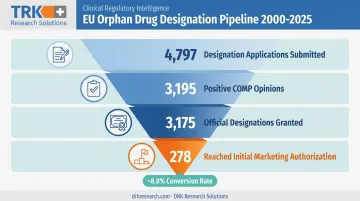
The numbers make this gap visible. Between 2000 and 2025, the EMA received 4,797 orphan designation applications, issued 3,195 positive COMP opinions, and granted 3,175 official designations. Of those, only 278 went on to receive initial marketing authorization, according to EMA's orphan medicines figures report. That's a crude cumulative ratio of roughly 8.8%, though many recent designations are still in active development and haven't had time to convert.
The Economics Behind Orphan Drug Development
Rare disease R&D carries a brutal math problem. Clinical-stage development costs for an approved orphan drug average around $166 million in out-of-pocket terms, based on a peer-reviewed analysis of orphan drug economics. That figure covers clinical trials alone, not the full discovery-to-launch pipeline.
Small patient pools amplify every risk in the process:
- Recruiting enough participants for statistically meaningful trials takes longer
- Patients are often scattered across continents, not concentrated in one region
- A single dropout can meaningfully affect trial power
Orphan drugs actually succeed in Phase 3 trials at a slightly higher rate than average, 66.9% versus 60.1% for all indications, according to a peer-reviewed clinical development review. The bigger risk is financial, not scientific: without help, there's often no commercial case for pursuing a treatment that might serve a few thousand patients globally.
That's the gap legislation was built to fill.
Global Legislation Driving Orphan Drug Development
Governments recognized decades ago that market forces alone wouldn't produce treatments for small patient populations. Several major frameworks emerged as a result.
United States – The Orphan Drug Act (1983)
The Orphan Drug Act defines a rare disease as one affecting fewer than 200,000 Americans. In exchange for pursuing these conditions, sponsors receive:
- A tax credit for qualified clinical trial expenses (originally 50%, reduced to 25% in 2017)
- Waived FDA application fees
- Protocol assistance during development
- Up to seven years of market exclusivity after approval
European Union – Regulation (EC) No 141/2000
The EU sets its threshold at no more than 5 in 10,000 people (1 in 2,000). The Committee for Orphan Medicinal Products (COMP) evaluates designation applications and typically issues its opinion within 90 days.
Approved sponsors receive:
- Reduced-fee protocol assistance throughout development
- Regulatory fee reductions on marketing applications
- 10 years of market exclusivity, extendable by two years upon completing an agreed pediatric investigation plan
Japan, Australia, and Emerging Markets
Japan launched its Orphan Product Development Support Program in 1993, offering subsidies of up to 50% of research costs plus priority review. Australia followed in 1997-1998 with fee waivers for designation, evaluation, and registration.
| Region | Threshold | Key Incentive |
|---|---|---|
| United States | <200,000 patients | 7-year exclusivity, tax credit |
| European Union | ≤5 in 10,000 | 10-year exclusivity |
| Japan | Typically <50,000 | Up to 50% research subsidy |
| Australia | Historically ≤2,000 | Fee waivers |
Many low- and middle-income countries still lack comparable frameworks. That absence creates real access disparities, a gap CROs like DRK Research Solutions help close by supporting clinical trials and regulatory pathways across underserved regions in Africa, Asia, and the Middle East.
Real-World Examples of Orphan Drugs
Legislation only matters if it produces actual treatments. Here are three that show what's possible.
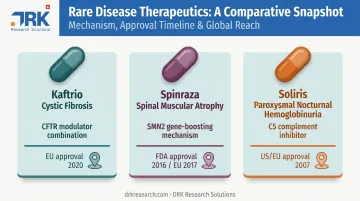
Kaftrio (Elexacaftor/Tezacaftor/Ivacaftor) for Cystic Fibrosis
Cystic fibrosis affects roughly 1 in 5,000 births in Europe. Kaftrio combines three active compounds: elexacaftor and tezacaftor increase the amount of CFTR protein reaching the cell surface, while ivacaftor improves how well that protein functions. The EU authorized Kaftrio in August 2020, less than two years after its orphan designation.
Spinraza (Nusinersen) for Spinal Muscular Atrophy
Spinraza became the first-ever approved treatment for spinal muscular atrophy, a rare and often devastating neuromuscular disorder. The FDA approved it in December 2016, with EU authorization following in May 2017. It works by helping a backup gene, SMN2, produce more functional SMN protein, the protein patients with SMA critically lack.
Soliris (Eculizumab) for Paroxysmal Nocturnal Hemoglobinuria
PNH is an extremely rare blood disorder, affecting roughly 1 to 4 people per 100,000. Soliris blocks a complement protein called C5, preventing the immune-driven destruction of red blood cells that defines the condition. It received approval in both the US and EU in 2007 and continues to treat PNH patients worldwide nearly two decades later.
The Growing Impact of Orphan Drugs on Global Healthcare
The orphan drug market has moved well beyond a niche corner of the pharmaceutical industry. It now ranks among the sector's fastest-growing segments.
Analysts at Evaluate project the global orphan drug market will reach $300 billion by 2028, growing at close to 12% annually compared to roughly 7% for the broader prescription drug market. That growth reflects genuine medical progress, but it comes with real tension.
Pricing remains the central challenge. IQVIA data lays out just how steep that tension has become:
- Nearly 39% of orphan-indicated drugs cost more than $100,000 annually
- The average orphan treatment costs around $32,000 a year
- US orphan-indication spending reached $58 billion in 2019, roughly 11% of total invoice spend
That tension gets sharper in lower-income settings, where health systems often lack the infrastructure orphan drugs require. A WHO Bulletin study of 70 orphan drugs on the WHO Model Lists in 2021 found:
- 42 drugs (60%) required specialist diagnostics, monitoring, or training many resource-limited systems don't have
- High prices compounded the access gap even further
The result: patients in LMICs often wait far longer, if they gain access at all, for treatments already available in wealthier regions.
How Specialized CROs and CDMOs Accelerate Orphan Drug Development
Rare disease trials break the standard clinical trial playbook. When your patient population numbers in the hundreds or low thousands globally, you can't recruit from a single country or a handful of sites. Sponsors need protocols designed around dispersed, small patient pools, plus recruitment strategies that stretch across multiple continents simultaneously.
This is where experienced CROs earn their value. Multi-regional clinical trials (MRCTs) let sponsors pool eligible patients across multiple regions rather than competing for a handful of participants in one market.
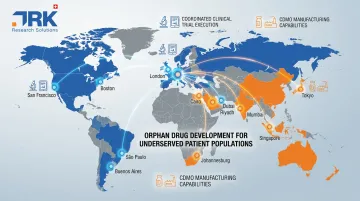
DRK Research Solutions has built its MRCT capabilities around this challenge, with operational hubs and local-language teams across five regions:
- Europe
- Middle East
- Asia
- Africa
- Americas
Every additional enrolled patient meaningfully strengthens a rare disease trial, making this geographic reach a genuine advantage.
DRK's reach doesn't stop at clinical execution. Its CDMO division, introduced in 2022, focuses on generics and hybrid product development for regulated markets. Capabilities include:
- Formulation development and analytical method validation
- Technology transfer to approved manufacturing partners
- Commercial batch manufacturing through EU- and US-approved facilities
For orphan drugs approaching patent cliffs or requiring cost-efficient follow-on production, this pathway matters. It's part of what makes therapies more affordable once approved, not just faster to develop.
That mission-driven focus runs through the company's history. DRK began as a patient advocacy organization before evolving into a full-service CRO and CDMO. Its current footprint across LMICs in Asia, Africa, and the Middle East reflects a continued commitment to underserved populations rather than only regulated Western markets.
For pharmaceutical and biopharmaceutical companies developing orphan therapies, that means one partner can support the entire journey, from first-in-human studies through Phase II-IV trials, regulatory dossier preparation, and commercial launch. If you're planning a rare disease program and need a partner who understands both the science and the access challenge, DRK Research Solutions is worth the conversation.
Frequently Asked Questions
What are orphan drugs, with examples?
Orphan drugs are treatments developed for rare diseases; governments typically support their development with incentives because commercial potential is limited. Examples include Kaftrio for cystic fibrosis, Spinraza for spinal muscular atrophy, and Soliris for paroxysmal nocturnal hemoglobinuria.
What are orphan drugs in the US?
Under the Orphan Drug Act of 1983, a US orphan drug treats a condition affecting fewer than 200,000 Americans. Sponsors receive incentives including tax credits, waived FDA fees, and up to seven years of market exclusivity.
Is ibuprofen an orphan drug?
No. Ibuprofen is a widely used, commercially viable medication treating common conditions like pain and inflammation. It doesn't meet orphan drug criteria unless regulators designate a specific rare-disease formulation separately.
How many orphan drugs are currently approved?
The EMA has granted 278 initial orphan marketing authorizations plus 64 indication extensions since 2000. In the US, IQVIA data through 2019 counted 838 orphan indications across 564 distinct approved drugs.
What is the difference between a rare disease and an orphan disease?
Prevalence thresholds define a rare disease, such as affecting fewer than 200,000 Americans. Public health literature uses "orphan disease" more loosely, sometimes covering neglected conditions with limited research investment regardless of prevalence.
How long does it take to get orphan drug designation?
Designation review moves faster than full drug approval. The EMA's COMP typically issues an opinion within a maximum of 90 days, and the FDA aims to respond to designation requests within that same window.