The consequences of getting it wrong are severe. In February 2023, the FDA warned consumers against EzriCare and Delsam Pharma's Artificial Tears after an outbreak of extensively drug-resistant Pseudomonas aeruginosa. The CDC linked 55 patients across 12 states to the contaminated product, with hospitalizations, one death from bloodstream infection, and permanent vision loss reported. The manufacturer's deficiencies included inadequate microbial testing and a multidose formulation lacking proper preservative protection.
This guide covers ophthalmic product types, formulation and manufacturing challenges, FDA's quality expectations, container closure system requirements, and how sponsors can navigate development with the right partner.
Key Takeaways
- Sterility failures make ophthalmic products legally adulterated under FDA regulations
- Multidose formulations need effective preservatives or validated preservative-free packaging
- FDA ophthalmic impurity limits are stricter than general ICH Q3B(R2) thresholds
- Container closure design directly affects contamination risk, dosing accuracy, and shelf stability
- Aligning with FDA, EMA, and regional regulators demands specialized development expertise
What Are Ophthalmic Products? Types, Uses, and Applications
Ophthalmic drug products are sterile preparations applied to the eyelid, instilled directly in the eye, or delivered via intra- or periocular injection for therapeutic or diagnostic purposes. FDA's 2023 draft guidance on topical ophthalmic drug products defines the scope broadly: solutions, suspensions, emulsions, gels, ointments, and creams delivered topically in and around the eye.
Common Dosage Forms of Ophthalmic Products
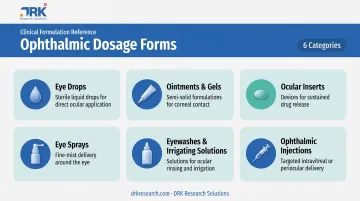
Manufacturers work across a wide range of formats, each with distinct manufacturing and stability demands:
- Eye drops - solutions, suspensions, and emulsions instilled directly onto the ocular surface
- Ointments and gels - semisolid formats that extend contact time with the eye
- Ocular inserts - solid or semisolid devices placed in the conjunctival sac for sustained release
- Eye sprays - a less common delivery route for periocular application
- Eyewashes and irrigating solutions - sterile fluids for cleansing or flushing the eye
- Ophthalmic injections - including intravitreal, intracameral, subconjunctival, and sub-Tenon routes, administered directly into or around ocular tissue
Areas of Application and Active Ingredient Classes
Ophthalmic actives span several therapeutic categories, each tied to specific conditions:
- Anti-infectives treat bacterial, viral, or fungal eye infections
- Antiallergics and antiphlogistics manage allergic reactions and inflammation
- Miotics and mydriatics control pupil size, often for glaucoma management or eye exams
- Local anesthetics numb the ocular surface for procedures
- Diagnostic dyes highlight corneal defects during examination
- Tear replacement fluids address dry eye disease
These ingredient classes carry very different regulatory paths depending on intended use. OTC ophthalmic products fall under 21 CFR Part 349, covering astringents, demulcents, emollients, hypertonicity agents, vasoconstrictors, and eyewashes. Anything outside these narrow monograph categories, including most prescription anti-infectives and glaucoma medications, requires full NDA approval.
Formulation and Manufacturing Considerations in Ophthalmic Development
The core formulation challenge is maximizing ocular bioavailability at the lowest effective dose and frequency. Because tears clear most instilled volume within minutes, formulators often increase viscosity using hydrophilic polymers or oily carriers. This commonly results in a moderate viscosity range that slows precorneal drainage and extends contact time.
Sterile Manufacturing Approaches
Beyond viscosity control, ensuring product sterility introduces its own set of manufacturing challenges. Two accepted sterility-assurance methods dominate ophthalmic manufacturing:
- Terminal sterilization (typically moist heat): preferred when the formulation can tolerate it, offering the highest sterility assurance
- Aseptic processing: required for heat-sensitive formulations, involving sterile filtration through filters no larger than 0.22 microns, followed by filling under Grade A conditions
Blow-Fill-Seal (BFS) technology has become a preferred aseptic method for ophthalmics. It forms, fills, and seals containers in one continuous, largely automated sequence, which minimizes human intervention and contamination risk. BFS supports both single-dose and preservative-free multidose formats, though polymer compatibility and extractables still require thorough evaluation.
Preservative Strategy and Preservative-Free Systems
Benzalkonium chloride (BAK) remains the most common multidose preservative, appearing in roughly 70% of ophthalmic formulations, according to a peer-reviewed review of ocular BAK exposure. The same research documents corneal and conjunctival cytotoxicity with repeated exposure, driving industry interest in alternatives.
Preservative-free systems increasingly rely on specialized container closure designs, such as one-way valve multidose dispensers, that block air and contaminant entry without antimicrobial agents. Notably, FDA's draft guidance specifically cautions against silver-based preservatives due to risks including argyria and granular corneal deposits.
FDA Quality Considerations: Microbiological Safety and Contamination Control
FDA treats sterility as a Critical Quality Attribute for ophthalmic products. Under 21 CFR 200.50(a)(1), ophthalmic preparations should be sterile, and nonsterile products may be considered adulterated under the FD&C Act.
This sterility requirement extends to multidose products, which must contain a suitable preservative or demonstrate inherent antimicrobial activity, unless paired with a validated preservative-free container closure system. Manufacturers must support this claim with antimicrobial effectiveness testing under USP <51> across the full shelf life.
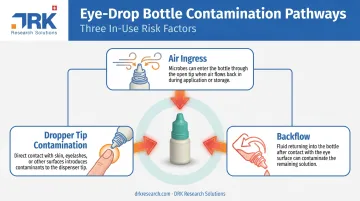
FDA highlights three common in-use contamination pathways:
- Air ingress into the container after each use
- Dropper tip contamination from contact with nonsterile surfaces (fingers, lashes, skin)
- Backflow of previously dispensed drops into the product reservoir
Beyond microbial risk, visible particulate matter must meet USP <771> standards. For opaque containers where visual inspection isn't feasible, FDA recommends alternative methods such as X-ray spectroscopy.
Container closure systems also require extractables and leachables assessment, following frameworks in USP <1663>/<1664>. FDA's draft guidance recommends specific safety thresholds:
| Threshold Type | Level |
|---|---|
| Reporting | 1 ppm |
| Identification | 10 ppm |
| Qualification | 20 ppm |
Impurities, Degradation Products, and In Vitro Testing Strategies
FDA applies stricter impurity thresholds to ophthalmic products than the general ICH Q3B(R2) framework. Because these products contact ocular tissue directly, even small amounts of unspecified impurities can reach concerning local concentrations.
For unspecified degradation products, FDA recommends identification and qualification at:
- 0.1% for products with strengths between 0.1% and 1%
- 1% or 1 ppm, whichever is higher, for products at or below 0.1% strength
| Threshold Basis | FDA (Ophthalmic) | ICH Q3B(R2) (General) |
|---|---|---|
| 0.1%–1% strength | 0.1% | 0.10%–1.0% (dose-dependent) |
| ≤0.1% strength | 1% or 1 ppm, whichever is higher | 0.10%–1.0% (dose-dependent) |
These threshold differences explain why complementary testing methods matter. In vitro release and dissolution testing offers an optional but valuable quality control strategy for ophthalmic suspensions, emulsions, and semisolids, helping confirm batch-to-batch consistency without invasive clinical testing.
DRK Research Solutions supports these efforts through analytical method development for ophthalmic formulations.
Ophthalmic biologics carry additional complexity. Product-related substances and charge variant profiles, assessed through methods such as isoelectric focusing, must be characterized alongside traditional impurities, with acceptance criteria tied to clinical and manufacturing-consistency data.
Container Closure System (CCS) Design and Stability Testing Requirements
Container closure design directly affects contamination risk and patient usability. FDA's recommendations include:
- Tamper-evident packaging with secure retention rings
- Single-step tip-opening mechanisms to reduce hand contact with the dispensing tip
- Appropriate torque specifications balancing accessibility for elderly users against cap retention during distribution
- Standardized cap color-coding per American Academy of Ophthalmology guidelines, such as tan for anti-infectives and turquoise for prostaglandin analogues
Beyond closure design, dosing volume standards keep exposure and waste in check:
| Format | Maximum Volume |
|---|---|
| Unit-dose liquids | 0.5 mL |
| Unit-dose ointments/gels | 1 g |
| Multidose drop size | 20-70 microliters |
Suspension products also require dose-uniformity testing to confirm consistent active ingredient delivery across the container's life.
Beyond dosing consistency, stability programs must address several ophthalmic-specific variables:
- Container orientation testing - upright versus inverted or horizontal storage
- Water loss testing for semipermeable container systems
- Freeze/thaw cycling for emulsions and suspensions, typically three cycles between temperature extremes
- In-use stability studies supporting post-opening labeling claims
Why Partner with an Experienced CDMO for Ophthalmic Product Development
Ophthalmic sponsors rarely target a single market. Navigating overlapping FDA, EMA, and regional frameworks, each with its own sterility, labeling, and container closure expectations, requires specialized expertise most in-house teams don't maintain alone.
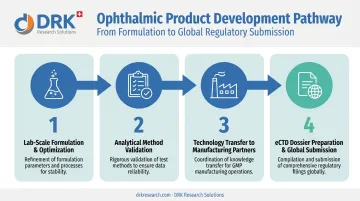
DRK Research Solutions supports ophthalmic sponsors through its integrated CRO and CDMO model. Our Product Development team manages the full development pathway, from formulation bench to global submission:
- Conducts lab-scale formulation development and optimization
- Validates analytical methods to ICH and USP standards
- Transfers technology to EU- and US-approved manufacturing partners for exhibit and commercial batch production
- Prepares eCTD dossiers across Modules 2-5 for global regulatory submission
This model applies to generics and hybrid product development for regulated markets, an area particularly relevant for ophthalmic formulations given their well-established regulatory pathways in the US and EU.
That regulatory alignment matters most when sponsors operate across borders. DRK's footprint spans Europe, the Middle East, Asia, Africa, and the Americas, with regional teams providing localized regulatory proficiency in each market. For sponsors managing complex quality, formulation, and compliance requirements across multiple regions simultaneously, that combination of global reach and local knowledge shortens the distance between formulation bench and regulatory approval.
Frequently Asked Questions
What are ophthalmic products?
Ophthalmic products are sterile preparations, including drops, ointments, gels, inserts, and injections, applied to or around the eye for therapeutic or diagnostic purposes. Sterility and formulation precision are non-negotiable given direct ocular contact.
What is ophthalmic used for?
Ophthalmic products treat infections, allergies, dryness, glaucoma, and inflammation. They're also used diagnostically, such as dyes applied during eye exams to detect corneal damage.
What are some ophthalmic medications?
Common categories include anti-infectives, antihistamines, lubricating artificial tears, glaucoma medications like prostaglandin analogues, and corticosteroids for inflammation. Specific choice depends on diagnosis and condition severity.
What eye drops do ophthalmologists recommend?
Recommendations vary by condition: preservative-free artificial tears for dry eye, antibiotic drops for bacterial infections, and prescription glaucoma medications for pressure control. Always follow a professional diagnosis rather than self-selecting.
What quality standards must ophthalmic products meet?
Ophthalmic products must meet cGMP requirements, USP compendial standards, and FDA-specific guidance covering sterility, particulate matter, impurity thresholds, and container closure system design.
Why is sterility critical in ophthalmic drug products?
Because these products contact highly sensitive ocular tissue, microbial contamination can cause serious infection, permanent vision loss, or even systemic bloodstream infection.