Introduction
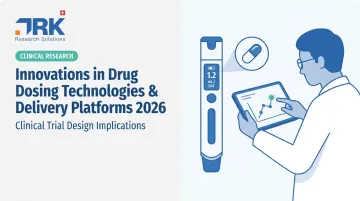
Drug dosing technologies and delivery platforms are the systems, devices, and algorithms that decide how, when, and in what form a therapeutic actually reaches a patient. In the 2026 pharma and biopharma landscape, that decision has gotten a lot more sophisticated than "take two tablets daily."
Traditional one-size-fits-all dosing still dominates most treatment regimens, and it shows. Adherence to long-term therapy for chronic disease has hovered around 50% in developed countries, according to the World Health Organization, with worse outcomes typical in developing markets.
Medication errors, many tied to standardized dosing that ignores individual variability, cost health systems an estimated $42 billion globally every year.
This piece covers the five innovations reshaping dosing and delivery through 2026, the forces accelerating adoption, what it means operationally for pharma companies, and the signals worth watching next.
Key Takeaways
- AI, biosensors, 3D printing, microneedles, and long-acting injectables are driving true dosing precision, not standardization.
- Regulatory momentum, cost pressure, and patient demand for fewer clinic visits are accelerating adoption.
- Manufacturing is shifting toward flexible, small-batch production, reshaping how sponsors staff and partner.
- Sponsors partnering early with specialized CRO/CDMO teams gain a real head start to market.
Top Innovations in Drug Dosing & Delivery Platforms for 2026
Five platforms stand out as the most significant shifts transforming pharmacological therapy right now. Each tackles a different piece of the same problem: getting the right amount of drug to the right patient at the right time.
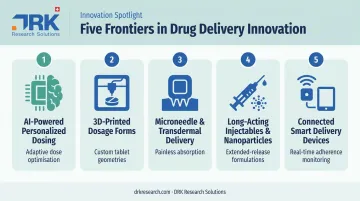
AI-Powered Personalized Dosing Platforms
Instead of relying on population-average dosing charts, AI-powered platforms pull in real-time biometric and wearable sensor data, then calculate an individualized dose for that specific patient, on that specific day.
A strong example is CURATE.AI, developed by the National University of Singapore and National University Cancer Institute Singapore. In a pilot run at National University Hospital between August 2020 and April 2022, the platform generated dose recommendations for 10 patients with advanced solid tumors, mostly metastatic colorectal cancer.
Clinicians accepted 96.7% of the AI's dose recommendations, and every recommendation arrived within the required clinical timeframe. Recommended chemotherapy doses came in roughly 20% lower on average than standard protocols, with patient adherence to those personalized doses at 80%, according to researchers at the National University of Singapore.
This matters because standardized dosing often means either overtreating patients who don't need the full amount or undertreating those who need more. The FDA logged over 100 drug and biologic submissions containing AI/ML components in 2021 alone, with clinical development the most common use case. It's still early-stage feasibility evidence rather than proof of improved survival, but the trajectory is unmistakable.
3D-Printed & On-Demand Dosage Forms
3D printing lets manufacturers build tablets layer by layer, combining multiple drugs into one pill or fine-tuning release rates that are nearly impossible with conventional compression. Some pharmacies are even piloting point-of-care printing, producing a dose on-site instead of shipping it from a centralized plant.
Spritam (levetiracetam), an epilepsy medication, became the first FDA-approved 3D-printed drug in 2015. Its ZipDose technology creates a porous tablet that dissolves quickly with a sip of liquid, supporting strengths up to 1,000 mg in a single dose, useful for patients who struggle to swallow multiple pills.
The bigger significance is what this unlocks over time:
- Reduced waste from producing exact-dose tablets instead of over-manufacturing standard strengths
- Faster iteration on formulation without retooling entire production lines
- Decentralized production potential, an idea now formalized in the UK's 2025 point-of-care manufacturing framework
Regulators are catching up too. The EMA's March 2026 guidance treats pharmaceutical 3D printing as a non-standard process requiring its own printer qualification, process validation, and batch release controls. That's a sign this is moving from novelty to a regulated manufacturing category.
Microneedle & Transdermal Delivery Systems
Microneedle patches deliver vaccines, insulin, and biologics through tiny, often painless projections that penetrate just the outer skin layers, skipping the syringe entirely.
Micron Biomedical's Phase 1/2 measles-rubella microarray patch trial in The Gambia enrolled 45 adults, 120 toddlers, and 120 infants. Day-42 seroprotection landed between 93.2% and 100% with the patch, compared with 89.8% to 100% for the standard subcutaneous injection. No allergic reactions or treatment-related serious adverse events were reported, and more than 90% of parents said they preferred the patch over a needle.
The bigger benefit here goes beyond comfort. WHO's target product profile for a future measles-rubella patch sets a stability goal of 40°C for at least 3 days, with an optimal target of 2 months, compared with the current 2–8°C cold-chain requirement for the injectable vaccine. If manufacturers hit those targets, clinics without reliable refrigeration could reach far more children with fewer wasted doses.
Long-Acting Injectables & Nanoparticle-Based Controlled Release
Long-acting injectables and nanoparticle formulations keep therapeutic drug levels steady for weeks or months instead of hours, cutting how often a patient needs to show up for treatment.
Invega Hafyera, a six-month paliperidone palmitate injection for schizophrenia, showed 92.5% of recipients relapse-free at 12 months in its Phase 3 trial, close to the 95% rate seen with the existing three-month version.
On the oncology side, Abraxane, an albumin-bound nanoparticle paclitaxel, is dosed every three weeks for metastatic breast cancer rather than weekly, cutting the number of infusion visits considerably.
Perhaps the clearest adherence win comes from HIV prevention: WHO recommended twice-yearly injectable lenacapavir in July 2025, specifically citing its value for people facing adherence, stigma, or health-access barriers, a population where daily pills often fail. That's exactly the kind of underserved-market impact these formulations are built for, even though WHO noted access outside trials remained limited at the time.
Connected & Smart Drug Delivery Devices
Digital pills, smart inhalers, and closed-loop wearables now automate parts of the dosing decision itself, rather than simply reminding a patient to take a dose.
Omnipod 5, cleared by the FDA in August 2024 as the first tubeless automated insulin-delivery system for adults with type 2 diabetes, links directly to a glucose sensor and adjusts insulin delivery automatically. Insulet's SECURE-T2D trial reported an average 0.8 percentage-point A1C reduction, rising to 2.1 points among participants who started above 9%, plus nearly 5 additional hours per day in target glucose range.
Not every connected device delivers on its promise yet, though. Abilify MyCite, which pairs an antipsychotic with an ingestible sensor, carries FDA labeling stating its ability to improve compliance or guide dosage changes has not been established, and detection can lag more than two hours.
Real-time adherence tracking is genuinely useful for chronic conditions and could eventually help with reminders for elderly patients on complex regimens. The technology, though, is still maturing case by case.
What's Driving These Dosing & Delivery Trends
A mix of technology maturity, patient expectations, and regulatory change is pushing dosing and delivery innovation forward all at once.
Technology advances. AI, biosensor miniaturization, and IIoT-enabled manufacturing equipment have all matured enough to move from research labs into commercial pipelines. In Deloitte's survey of 150 life-sciences executives, about 60% named generative AI or digital transformation a key trend. Deloitte also estimates AI could unlock value equal to 11% of revenue across biopharma functions.
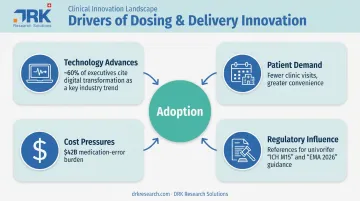
Patient demand. Beyond the technology itself, patients are driving change by demanding fewer clinic visits and less friction in treatment. That preference showed up clearly in the measles-rubella patch trial, where over 90% of parents chose the patch. It also underlies WHO's framing of long-acting lenacapavir as a tool for people who struggle with daily adherence.
Cost pressures. These patient preferences carry real financial weight: poor dosing accuracy contributes to a broader medication-error burden estimated at $42 billion annually worldwide. Health systems and payers are increasingly unwilling to absorb costs tied to preventable hospitalizations and wasted product.
Regulatory influence. Regulators are responding to this same pressure, actively building frameworks that support these platforms:
- FDA's final ICH M15 guidance on model-informed drug development, issued June 2026
- EMA's March 2026 quality and GMP Q&A for pharmaceutical 3D printing
- FDA's Novel Excipient Review Pilot, supporting review of excipients not previously used in approved drugs
How These Trends Are Impacting the Pharma & Biopharma Industry
These innovations aren't staying confined to R&D labs. They're reshaping how companies operate, invest, and hire.
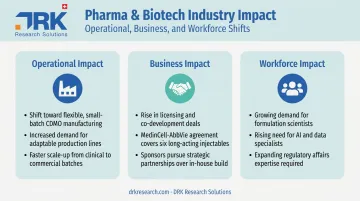
Operational Impact
Manufacturing is shifting away from large, uniform production runs toward flexible, small-batch, precision formulation workflows. Building that capability in-house is expensive, so many sponsors are turning to specialized CDMO partners for generics and hybrid dosage form development instead of building new facilities from scratch.
Firms like DRK Research Solutions support this shift through lab-scale formulation development and analytical method development against ICH and USP standards. Their technology transfer work carries a formulation from bench to commercial batch without the sponsor owning the plant.
Business Impact
Licensing and partnership deals are replacing some of the capital sponsors once spent building novel-delivery capacity internally. MedinCell's 2024 co-development and licensing agreement with AbbVie, covering up to six long-acting injectables, illustrates the model well. Sponsors gain platform access and share development risk, all while skipping the multi-year buildout. Out-licensing structures, whether bundled with product supply, a technical documentation package, or a fully approved dossier, let sponsors choose the level of involvement that fits their strategy and budget.
Workforce Impact
None of this works without people who understand both the science and the regulatory path. Demand is climbing for:
- Formulation scientists comfortable working with novel excipients and controlled-release systems
- Data and AI specialists who can validate algorithm-driven dosing decisions
- Regulatory experts able to navigate EU GMP, MHRA, WHO PQ, and US FDA requirements simultaneously for a single hybrid product
Future Signals for Drug Dosing & Delivery Platforms
Watch these early indicators over the next one to three years as the field keeps evolving.
- Adaptive dosing built into trial protocols. FDA discussion papers already document expanding AI/ML use in clinical development, with dynamic, protocol-embedded dose adjustments emerging as the logical next step.
- Decentralized, point-of-care manufacturing. The UK's Modular Manufacture and Point of Care regulations, effective July 2025, license products that can only be 3D printed at the point of care, signaling that regulators expect this model to scale.
- Digital twin modeling for individual dosing. IQVIA cites drug-efficacy simulation as a current digital-twin use case, and Deloitte notes Sanofi already applies twins to cut R&D time from weeks to hours. Simulating one patient's dose next seems like the logical progression.
Conclusion
AI-driven personalization, 3D printing, microneedles, controlled-release injectables, and connected devices are collectively rewriting how drugs get dosed and delivered. None of them work in isolation, and most patients will eventually encounter more than one.
Companies that adapt early are positioned to bring these innovations to patients across regulated and underserved markets alike. Strategic CRO/CDMO partnerships make this possible, providing access to formulation expertise and regulatory pathways without a massive capital outlay. Getting there requires foresight in regulatory strategy, operational flexibility, and a workforce that understands both the science and the systems around it.
Frequently Asked Questions
What are the new technologies in pharmacy?
The biggest emerging technologies include AI-driven personalized dosing, 3D-printed medications, microneedle patches for vaccines and biologics, and connected smart devices like automated insulin pumps and digital pills.
What are the three systems of measurement for medications?
Medications are measured using the metric system (mg, mL), the apothecary system (grains, drams, minims), and the household system (teaspoons, cups). Metric is now the standard for most clinical dosing.
What is the difference between drug dosing and drug delivery?
Dosing refers to the amount and frequency of medication a patient receives. Delivery refers to the method or platform used to administer it, such as oral, injectable, or transdermal routes.
How is AI improving the accuracy of drug dosing?
AI platforms analyze real-time biometric and wearable sensor data to calculate individualized doses instead of relying on population averages. Pilot programs like CURATE.AI show that clinicians accept most AI-generated dose recommendations in early trials.
What role do CDMOs play in developing new drug delivery technologies?
CDMOs support formulation development, analytical method validation, technology transfer, and eCTD dossier preparation. Partners like DRK Research Solutions help sponsors scale generics and hybrid products for regulated markets without building in-house manufacturing.
Are 3D-printed medicines currently approved for use?
Yes. Spritam, an epilepsy medication, was the first FDA-approved 3D-printed drug in 2015. More products are moving through clinical and regulatory pipelines as agencies like the EMA build formal quality frameworks for 2026 and beyond.