Introduction
A single mislabeled plasma sample can quietly unravel months of clinical work. Behind every dosing decision, safety signal, and regulatory filing sits one deceptively simple question: how much drug is actually in a patient's bloodstream? Bioanalytical testing answers that question, and its accuracy determines whether a therapy moves forward or stalls.
Sponsors that rush method validation don't just risk bad data. They risk the submission itself. The FDA specifically flags missing bioanalytical method validation and assay-performance information as a deficiency serious enough to support a Refuse to File decision on an NDA or BLA. That determination arrives within 60 days of filing.
This article breaks down what bioanalytical testing involves, why validation is non-negotiable, and how labs actually execute it step by step, from method development through incurred sample reanalysis. You'll know what to expect and where things typically go wrong.
Key Takeaways
- Bioanalytical testing quantifies drugs, metabolites, and biomarkers in biological matrices
- FDA and ICH M10 standards make that validation data credible for regulatory submissions
- Validation covers selectivity, accuracy, precision, stability, and incurred sample reanalysis
- An experienced CRO partner helps sponsors avoid oversights that stall regulatory timelines
What Is Bioanalytical Testing?
Bioanalytical testing identifies and measures drugs, metabolites, or biomarkers within biological matrices, including blood, plasma, serum, cerebrospinal fluid, urine, and saliva. It's the science that turns "we gave a patient a dose" into "here's exactly how much drug reached circulation, and for how long."
This work spans the entire drug development lifecycle:
- Discovery: non-GLP screening assays rank candidate compounds before they advance
- Preclinical: GLP toxicokinetic (TK) studies establish dose-exposure relationships in animal models
- Clinical: GxP-compliant sample analysis supports pharmacokinetics, safety, and efficacy assessments across Phase I through IV
Types of Bioanalytical Methods
Two platforms dominate this field, and picking the right one shapes everything downstream.
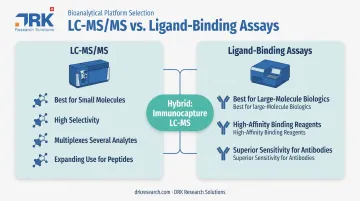
LC-MS/MS (liquid chromatography-tandem mass spectrometry) is the standard choice for small molecules, prized for its selectivity and ability to multiplex several analytes in one run. It's increasingly applied to peptides and other complex modalities too.
Ligand-binding assays (LBAs) are the conventional choice for large-molecule biologics, such as monoclonal antibodies, where high-affinity binding reagents deliver the sensitivity mass spectrometry alone can struggle to match. A hybrid approach, immunocapture LC-MS, combines both worlds and is gaining traction for large-molecule PK work.
Method selection also depends on:
- Molecule structure and calibration range required
- Biological matrix and anticoagulant used, since EDTA plasma behaves differently than heparin plasma
- Regulatory rigor level required, whether GLP-grade (preclinical safety studies and clinical-grade data, governed under 21 CFR Part 58) or lighter non-GLP qualification for early discovery screening
Why Bioanalytical Method Validation Is Critical
Without a validated method, PK and TK data simply can't be trusted for dosing decisions, let alone a regulatory filing. Real validation is what separates a defensible dataset from a liability, not a box-checking exercise.
Here's what proper validation buys a development program:
- Ensures data accuracy for FDA, EMA, and ICH M10-aligned submissions
- Reduces the risk of dosing errors, unexpected toxicity, or missed efficacy signals
- Supports smoother IND/NDA review by closing off a known deficiency category
- Enables data comparability across multi-regional, multi-site clinical trials
- Builds audit and inspection readiness, so a regulator's visit doesn't trigger a scramble
- Prevents costly repeat studies caused by assay performance that can't hold up under scrutiny
Skip any one of these, and the consequences don't show up immediately. They show up months later, when a reviewer asks a question the data can't answer.
How Bioanalytical Method Validation Works – Step by Step
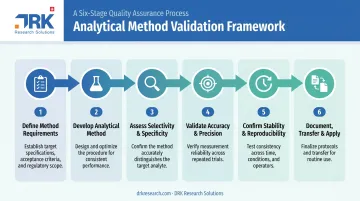
FDA and ICH M10 don't define an official "six-stage" validation process. What follows is a practical crosswalk of how labs actually structure the work, built around the specific characteristics regulators expect to see documented. Common oversights—skipped matrix-effect checks, underestimated stability testing, or a rushed incurred sample reanalysis—tend to surface here first.
Step 1 – Define Method Requirements & Context of Use
Before any bench work starts, the team pins down the analyte, matrix, calibration range, and intended use, whether PK, TK, biomarker, or immunogenicity, based on the drug's expected dose and therapeutic index. This scoping call determines assay sensitivity requirements and whether the method needs full validation or a lighter, fit-for-purpose qualification.
Step 2 – Develop the Analytical Method
Next comes platform selection (LC-MS/MS or ligand-binding assay), sample preparation and extraction protocols, and sourcing of reference standards. The choices made here set a ceiling on specificity, sensitivity, and early reproducibility that later steps can only confirm, not fix.
Step 3 – Assess Selectivity & Specificity
Analysts test whether the method can distinguish the target analyte from matrix components, metabolites, or co-administered drugs. ICH M10 guidance calls for testing at least six independent matrix sources for chromatographic methods, with interference capped at 20% of the analyte response at the lower limit of quantification.
Skipping this check is one of the most common shortcuts labs take under deadline pressure, and it directly raises false-positive and false-negative risk.
Step 4 – Validate Accuracy, Precision & Linearity
Replicate analyses run across low, mid, and high QC levels to confirm results meet acceptance criteria:
- Chromatographic methods: accuracy within ±15% of nominal value (±20% at the LLOQ)
- Ligand-binding assays: wider windows, typically ±20% (±25% at the LLOQ/ULOQ), reflecting their inherent biological variability
This step gets the closest regulatory scrutiny because it's where data reliability either holds up or falls apart.
Step 5 – Confirm Stability & Reproducibility
Analyte stability gets tested under storage conditions, freeze-thaw cycles, and bench-top exposure, alongside incurred sample reanalysis (ISR), which reruns a subset of real study samples to confirm results reproduce.
A 32-laboratory survey found ISR failures in 54 of 3,951 regulated studies, roughly 1.4%, with human error the leading cause. Small number, but it's exactly the kind of problem routine QC samples never catch.
Step 6 – Document, Transfer & Apply the Method
Finally, the validation report gets compiled per ICH M10/FDA guidance, the method transfers into full sample analysis, and ongoing performance gets monitored. This is the step that determines whether an audit goes smoothly or turns into a fire drill.
Bioanalytical Method Validation – Example Case Walkthrough
Consider a common scenario: a sponsor needs to validate an LC-MS/MS method for a small-molecule oral drug in human plasma ahead of a first-in-human Phase I PK study.
From Calibration to ISR: A Four-Step Validation Sequence
- Set the calibration range. The team anchors it around the anticipated Cmax at the planned starting dose, leaving enough headroom for dose escalation without losing sensitivity at the low end.
- Run selectivity testing. Testing across six plasma lots uncovers matrix interference from a proton pump inhibitor many participants in the study population take alongside their regular medications. The chromatographic separation needs re-optimizing before it passes.
- Avoid the common shortcut. Under timeline pressure, teams often defer ISR (incurred sample reanalysis) until after dosing begins. That decision raises credibility questions during regulatory review, months after the data already exists.
- Apply the fix. Run ISR alongside pilot sample analysis from day one, catching reproducibility issues before a full-scale study locks in a flawed method.
The payoff: a validated method that produces PK data the study team can actually stand behind, supporting a confident, evidence-based dose-escalation decision instead of a delayed one.
How DRK Research Solutions Can Help
Getting bioanalytical validation right takes more than one lab. It takes coordination across method scientists, regulatory specialists, and clinical teams working from the same playbook. That's the role DRK Research Solutions plays for sponsors.
DRK integrates CRO and CDMO expertise, coordinating bioanalytical method development and validation through its global network spanning Europe, the Americas, Asia, the Middle East, and Africa. This alignment keeps GxP compliance consistent, whether a sponsor is running a Phase II–IV trial or developing a generic or hybrid product for a regulated market.
What sets DRK's approach apart:
- Global network, local proficiency: regulatory teams across five operating regions understand local requirements without losing sight of FDA/ICH M10 harmonization
- Decade-plus track record: over 100 professionals bring more than a decade of clinical development experience, including multi-regional trial support since DRK's 2018 global expansion
- End-to-end coordination: method validation connects directly through to full clinical data delivery instead of sitting in a separate silo
- Patient-centric reach: DRK's roots as a patient advocacy organization still shape its focus on expanding trial access in underserved and low- and middle-income country markets
- Scientific leadership: Chief Scientific Officer Dr. Vipan Dhall oversees scientific strategy across development programs, keeping methodology aligned with FDA and ICH M10 standards

Sponsors planning a PK study or a multi-regional trial can reach DRK's team at info@drkresearch.com to scope validation requirements early, before they become a filing risk.
Frequently Asked Questions
What is bioanalytical testing?
Bioanalytical testing identifies and quantifies drugs, metabolites, or biomarkers in biological matrices like plasma, serum, or urine. It generates the data behind pharmacokinetic and toxicokinetic studies throughout drug development.
What are the 5 stages of drug testing?
FDA's framework covers discovery and development, preclinical research, clinical research (Phases I-III), FDA review, and post-market safety monitoring. Bioanalytical testing generates the pharmacokinetic and safety data required at nearly every stage after discovery.
What is GLP bioanalytical method validation?
GLP validation follows 21 CFR Part 58 standards, requiring documented quality systems, protocols, audits, and traceable raw data. It's required for regulatory-grade preclinical and clinical bioanalytical work.
What are the key parameters assessed in bioanalytical method validation?
Core parameters include selectivity, specificity, matrix effect, accuracy, precision, calibration range, carryover, dilution integrity, and stability. Ligand-binding assays also assess parallelism and dilution linearity.
How long does bioanalytical method validation typically take?
Timelines vary by molecule complexity, platform choice, and matrix, with no universal industry benchmark. Partnering with an experienced lab typically shortens the cycle by avoiding rework from missed validation steps.
What's the difference between GLP and non-GLP bioanalysis?
Non-GLP bioanalysis supports early discovery and exploratory screening, where full regulatory rigor isn't required. GLP bioanalysis applies to preclinical toxicokinetic studies and clinical-grade data intended for regulatory submission.