For decades, intermediates sat in the background of pharma conversations, treated as a routine procurement line item. That's changing. As cost pressure rises and regulators scrutinize every synthesis step, intermediates have become a frontline concern for quality and operations teams alike.
This article looks past the textbook definition. We'll cover where intermediates actually create or destroy value in day-to-day manufacturing, measured in yield, purity, and speed-to-market.
Key Takeaways
- Intermediate quality is a leading indicator of final API purity and patient safety
- Staged synthesis through intermediates reduces batch failure risk versus single-step reactions
- The global pharmaceutical intermediates market is projected to reach $68.37 billion by 2031
- Poor intermediate sourcing directly causes recalls, cost overruns, and supply chain fragility
- Continuous supplier oversight protects long-term production value more reliably than one-time qualification
What Are Drug Intermediates?
A drug intermediate is a chemical compound produced partway through a multi-step synthesis process, an interim step on the path to an Active Pharmaceutical Ingredient (API).
Intermediates sit between raw materials and the finished API in the manufacturing value chain. They generally fall into two categories:
- Bulk drug intermediates - produced at scale, often standardized across multiple API routes
- Fine/specialty chemical intermediates - lower-volume, higher-complexity compounds built for specific molecules
An intermediate has no therapeutic effect on its own; its entire value comes from what it enables downstream: a stable, pure, and scalable API. That downstream outcome is the true measure of an intermediate's value.
Key Advantages of Drug Intermediates in Pharmaceutical Manufacturing
The value of intermediates isn't theoretical. It shows up in numbers that manufacturing and procurement teams already track: cost per batch, yield consistency, time-to-approval. Each advantage below maps to a specific KPI.
Enabling Complex, Multi-Step API Synthesis
Complex APIs can't be built in one reaction. Intermediates let chemists break synthesis into controllable, verifiable stages instead of gambling on a single unpredictable process.
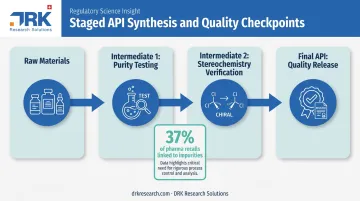
This staged approach gives manufacturers checkpoints. At each intermediate, teams can verify purity, confirm stereochemistry, and correct reaction conditions before committing to full-scale production.
Why this matters: Catching a problem at an intermediate stage is far cheaper than catching it after the API is made.
A 2024 peer-reviewed analysis of FDA recall data found that 37% of 3,718 recall events from 2012 to 2023 were attributed to impurities or contaminants. Staged synthesis with intermediate checkpoints is one of the few practical tools available to intercept that risk before it reaches the finished product.
KPIs impacted:
- Yield consistency
- Batch failure/rejection rate
- Time-to-troubleshoot
- First-pass quality rate
When it matters most: Chiral compounds, biologics-adjacent intermediates, and oncology APIs. A single-step synthesis for these molecules would be commercially unviable, and the margin for error is thin.
Driving Cost-Effective, Scalable Production
Intermediates let manufacturers standardize and scale specific synthesis steps independently of the final API process. Sourcing intermediates, rather than building every reaction step in-house, frees up capital for the high-value final stages where differentiation actually happens.
Bulk intermediate production spreads fixed costs across larger volumes. That lowers the per-unit cost of the eventual API, particularly for high-volume generics.
Market scale: Mordor Intelligence projects the global pharmaceutical intermediates market will grow from $48.65 billion in 2026 to $68.37 billion by 2031, a 7.05% CAGR. Bulk-drug intermediates alone account for roughly 48% of that market. That's the scale of cost efficiency being captured industry-wide.
KPIs impacted:
- Cost per API kilogram
- Raw material utilization rate
- Overall manufacturing margin
When it matters most: High-volume generics manufacturing, and any market where price sensitivity determines whether patients can access treatment at all.
Safeguarding Quality, Safety, and Regulatory Readiness
Intermediate purity is a leading indicator of whether the final API will meet safety and efficacy standards. Rigorous testing at the intermediate stage, using chromatography and spectroscopy, catches contamination before it propagates further down the synthesis chain.
Skipping this step is expensive. FDA's 2018 warning letter to Zhejiang Huahai Pharmaceutical documented valsartan intermediate batches that failed an unknown-impurity specification.
The manufacturer reprocessed and released those batches without establishing a root cause. A 2011 process change meant to improve yield was never properly evaluated for mutagenic impurity formation, a gap that eventually contributed to a global valsartan recall.
KPIs impacted:
- Batch rejection rate
- Regulatory inspection findings
- Recall frequency
When it matters most: FDA/EMA-governed products, and companies developing generics or hybrid products that must demonstrate bioequivalence and consistent quality batch after batch.
What Happens When Intermediate Quality Is Overlooked
Treat intermediates as a low-priority commodity purchase, and the consequences compound quickly. Five downstream effects show up again and again:
- Inconsistent API purity, leading to unpredictable drug efficacy
- Higher batch rejection and recall rates driven by impurity carryover
- Reactive firefighting during regulatory inspections, instead of proactive compliance readiness
- Rising per-unit production costs from rework, retesting, and material waste
- Supply chain fragility when sourcing depends on a single, unvetted intermediate supplier
None of these show up overnight. They build up one skipped audit or unqualified supplier at a time, until a recall or inspection finding forces the issue into the open.
How to Get the Most Value from Drug Intermediates
Intermediates deliver their full value only when sourcing, testing, and process control are treated as an ongoing discipline, not a one-time procurement decision made at project kickoff and forgotten.
A few practices separate manufacturers who avoid recurring quality issues from those who don't:
- Build relationships with intermediate suppliers or CDMOs that offer traceable sourcing and documented GMP-aligned quality systems
- Establish dual-supplier arrangements where feasible, to reduce dependency on a single source for critical intermediates
- Review outcomes continuously through batch consistency data and supplier audits, rather than assuming a supplier stays qualified indefinitely
- Treat analytical method development as a live checkpoint, not a formality, so in-process materials are verified against specification before advancing
Companies developing generics and hybrid products for regulated markets get more value from partnering with an integrated CRO/CDMO that oversees quality across the entire development pathway, not just at the final API stage.
DRK Research Solutions' CDMO services support this integrated oversight, spanning formulation development, analytical method validation, and technology transfer across Europe, the Middle East, Asia, Africa, and the Americas.
Achieving this requires continuous verification of intermediate quality, well beyond the initial qualification review.
Conclusion
Drug intermediates carry no therapeutic effect of their own. Their real value lies in the control and consistency they bring to API synthesis, plus the cost efficiencies reflected in yield, purity, and how smoothly a product clears regulatory review.
These advantages compound over time. Better intermediate discipline today means fewer recalls and lower rework costs, translating into less regulatory friction for years of production ahead. Skipping that discipline early tends to cost far more later, usually at the worst possible moment.
Intermediate quality management works best as an ongoing practice, tied closely to a company's broader development and manufacturing strategy, not treated as a checkbox on a procurement form.
Frequently Asked Questions
What are intermediates in pharmaceutical manufacturing?
Intermediates are chemical compounds produced during the multi-step synthesis of an API. They act as precursors that require further processing before becoming part of a therapeutic drug.
What are some examples of drug intermediates?
Common examples include 4-aminophenol (used in paracetamol synthesis), protected lactone intermediates (used in statin synthesis), and substituted benzimidazole intermediates (used in proton pump inhibitors like pantoprazole).
What is the difference between an API and a pharmaceutical intermediate?
An API has direct therapeutic effect and requires stringent regulatory approval as the active ingredient in a drug product. An intermediate is a precursor compound with no therapeutic action of its own.
Are pharmaceutical intermediates subject to regulatory approval like APIs?
Intermediates face lighter regulatory scrutiny than finished APIs. However, ICH Q7 still requires specifications, testing, and quality-unit release once they cross the designated starting-material point, since their quality directly affects API safety.
Why do pharmaceutical companies outsource intermediate manufacturing?
Outsourcing reduces cost, provides access to specialized synthesis expertise, and allows manufacturers to scale production flexibly without heavy in-house capital investment in reaction infrastructure.
How does intermediate quality affect the final drug product?
Impurities or inconsistencies introduced at the intermediate stage carry through into the API. This directly affects drug potency, safety, and whether the product passes regulatory review.