This explanation is written for pharmaceutical, biopharmaceutical, and CDMO teams working on generic dermatology submissions. Getting this right matters for regulatory approval, cost control, and patient access to affordable skin treatments for conditions like psoriasis, acne, and rosacea.
Terms like Q1/Q2/Q3 sameness, IVRT, and IVPT come up constantly in this space, yet they're often poorly understood at an operational level outside regulatory and formulation science teams. This article covers what the process is, why it exists, how it works step-by-step, where it applies, what affects it, and when it isn't the right approach.
Key Takeaways
- Topical generics must replicate the reference drug's formulation, not just its label claim
- FDA increasingly favors IVRT/IVPT and Q1/Q2/Q3 sameness over lengthy clinical bioequivalence trials
- Success depends on formulation microstructure, manufacturing control, and current FDA product-specific guidance
- Complex reference formulations may require a hybrid/505(b)(2) pathway instead of a straight ANDA
What Is Generic Development of Topical Dermatologic Products?
Generic development of topical dermatologic products is the formulation, characterization, and regulatory demonstration of pharmaceutical and bioequivalence between a proposed generic topical drug and its Reference Listed Drug (RLD). Sponsors typically submit this work through an Abbreviated New Drug Application (ANDA).
The intended outcome is simple: a product that behaves the same way on the skin as the branded version, at a lower cost, without needing to re-establish safety and efficacy from scratch. The FDA already made that determination for the RLD. The generic sponsor's job is to prove sameness, not prove the drug works.
How This Differs from Innovator (NDA) Development
Innovator development under a New Drug Application requires clinical safety and efficacy data for a genuinely new molecule or new indication. There's no existing approved reference to lean on.
Generic development skips that burden entirely by referencing an already-approved product's safety and efficacy findings.
Generic vs. Hybrid (505(b)(2)) Pathways, Briefly
A hybrid pathway allows formulation deviations from the RLD, supported by additional bridging studies. This matters more than most sponsors expect:
- ANDA route: requires Q1/Q2 sameness (same inactive ingredients, same concentrations within a tight tolerance)
- Hybrid route: permits formulation differences but demands bridging data to justify them
- Full NDA route: needed only when the product is truly novel
We'll come back to this distinction later, because misjudging it is one of the most common — and costly — mistakes sponsors make.
Why Generic Development Is Used in the Pharmaceutical Industry
Topical drugs treat common, chronic, and expensive dermatologic conditions. The market reflects that demand: MarketsandMarkets valued the global topical drug-delivery market at $268.4 billion in 2025, projecting growth to nearly $409 billion by 2030.
That figure spans more than dermatology semisolids, but the direction is clear. Demand for affordable topical alternatives isn't slowing down.
What the Industry Actually Needs from Generics
A generic topical product has to deliver Q1/Q2/Q3 sameness — matching look, feel, spreadability, and site-of-action performance, not just the same active ingredient on paper. Patients and prescribers expect the generic to apply the same way the branded product did.
What Happens Without Robust Generic Competition
The consequences of weak generic pipelines are well documented. A JAMA Dermatology analysis of 116 generic topical dermatology formulations found that products with only one or two manufacturers saw a median price increase of 12.7% between 2013 and 2016. Products with more than six manufacturers saw prices drop by a median of 20.5%.
Nine formulations rose more than 500% in that window, five of them clobetasol products. Three climbed even further, exceeding 900%:
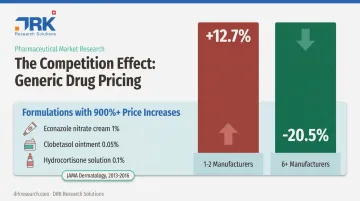
- Econazole nitrate cream 1%
- Clobetasol ointment 0.05%
- Hydrocortisone solution 0.1%
That's the cost of limited competition playing out in real prescriptions.
Why Regulators Pushed Toward In Vitro Pathways
The FDA's GDUFA II framework classified emulsions, gels, and locally acting dermatologic products as complex generics, then built infrastructure specifically to reduce reliance on resource-intensive clinical endpoint bioequivalence studies. The goal was faster, cheaper generic entry without compromising equivalence standards.
This regulatory shift is exactly why specialized CDMO and CRO partners matter now more than ever. DRK Research Solutions works with sponsors on generics and hybrid product development across regulated global markets. The team helps navigate formulation science and regulatory strategy in parallel rather than sequentially, which shortens overall development timelines.
How the Generic Development Process Works
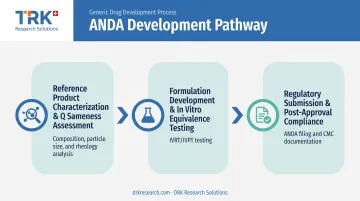
At a high level, the process starts with deconstructing the reference product, moves through formulation matching and equivalence testing, and ends with regulatory filing and approval.
Inputs needed before formulation work begins:
- RLD samples for physical and chemical characterization
- API and excipient selection aligned to the target product profile
- A clearly defined target product profile documenting what "sameness" needs to look like
The core transformation is iterative: formulators adjust prototypes until they hit Q1 (same components), Q2 (same concentrations), and Q3 (matching physicochemical/microstructural properties). Control comes from analytical testing, IVRT/IVPT data, and, where the product-specific guidance demands it, comparative clinical or pharmacodynamic studies.
Step 1: Reference Product Characterization & Q Sameness Assessment
The RLD gets analyzed for composition, particle size, rheology, and microstructure. This establishes the target profile the generic must match.
FDA's Q3 guidance calls out several attributes worth characterizing:
- Appearance, phase state, structural organization, and particle-size distribution
- Crystal habit and polymorphic form
- Rheology, pH, and density
Rheometry work typically covers full flow curves, yield stress, and viscoelastic response where relevant. Miss this step and everything downstream gets harder to defend.
Step 2: Formulation Development & In Vitro Equivalence Testing
Prototype formulations are optimized, then tested using IVRT to compare drug release rates and IVPT to compare permeation through excised human skin. This step often eliminates the need for a clinical endpoint study entirely, though not always.
One caution worth flagging here: equivalent IVRT release does not guarantee in vivo bioequivalence. IVRT isn't considered biorelevant, and it's not expected to correlate directly with in vivo performance. It's one piece of evidence, not the whole case.
Step 3: Regulatory Submission & Post-Approval Compliance
Equivalence data gets compiled into an ANDA aligned with the current product-specific guidance for that molecule. Some guidances, like acyclovir cream 5%, allow either Q3 characterization plus IVRT/IVPT or a clinical-endpoint study. Others require a specific in vivo approach regardless of how well the formulation matches on paper.
After approval, compliance doesn't stop. CMC documentation, manufacturing controls, and ongoing quality reporting continue for the life of the product.
DRK Research Solutions supports sponsors through this pathway, pairing formulation development and analytical method development with eCTD dossier preparation for generic topical filings.
Where the Process Is Applied & Key Factors That Affect It
Where the Process Applies
Generic topical development spans creams, gels, ointments, lotions, foams, and transdermal-adjacent products across dermatology therapeutic areas. It occurs at several lifecycle points:
- Pre-ANDA formulation development and target profile setting
- Bioequivalence study design (in vitro or clinical)
- Scale-up and technology transfer to commercial manufacturing
- Post-approval variations under SUPAC-SS
Common triggers include a branded dermatologic drug's patent expiry or sustained high pricing that opens the door for generic market entry.
Key Factors That Affect the Process
| Factor | Why It Matters |
|---|---|
| API particle size | Directly influences Q3 physicochemical sameness |
| Excipient sourcing | Small supplier changes can shift microstructure |
| Mixing speed/temperature | Shapes emulsion type and product microstructure |
| Scale-up from lab to commercial | Can alter rheological properties if not carefully controlled |
| Regulatory classification | Complex generics under GDUFA III face added scrutiny |
Beyond the table above, manufacturing parameters deserve the closest scrutiny: semisolid microstructure shifts with addition order, homogenization time, and heating/cooling rates—variables that often escape early lab-scale testing. Scale-up experiments should use equipment representative of the eventual commercial line, with rheology and IVRT testing built in to catch drift before it becomes a filing problem. CDMO partners experienced in technology transfer, such as DRK Research Solutions, help identify these risks before they reach regulatory review.
Common Misconceptions and When the Generic Pathway May Not Be Appropriate
Common Issues and Misconceptions
Misconception #1: Q1/Q2 sameness alone guarantees bioequivalence. It doesn't. Q3 physicochemical differences (crystal form, globule size, viscosity) can still affect how the drug performs clinically, even when the ingredient list matches perfectly.
Misconception #2: Systemic PK logic applies here the way it does for oral generics. Topical products act locally at the site of application, not systemically. Standard plasma pharmacokinetic comparisons often don't reflect what's actually happening in the skin.
Misconception #3: "Generic" and "hybrid" are interchangeable. They're not. If a sponsor's formulation isn't truly Q1/Q2 identical to the RLD, it isn't eligible for the standard ANDA route, no matter how similar it looks.
When the Generic Pathway May Not Be Appropriate
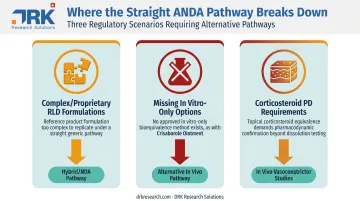
A straight generic pathway starts to break down in a few predictable scenarios:
- Complex or proprietary RLD formulations that can't be replicated at Q1/Q2 level — these push sponsors toward a hybrid or full NDA route
- Missing in vitro-only options: some products, like crisaborole ointment 2%, have no in vitro-only pathway in their product-specific guidance at all
- Corticosteroid PD requirements: topical corticosteroids often still need an in vivo vasoconstrictor study, even with strong Q1/Q2/Q3 matching
Sponsors trying to run this in-house without dedicated topical formulation science, IVRT/IVPT capability, or regulatory expertise often lose time reformulating after a failed submission rather than getting it right the first time.
That's usually where partnering with an experienced generics and hybrid product development CDMO pays for itself. DRK Research Solutions supports sponsors through formulation development, analytical method validation, and eCTD dossier preparation, working alongside GMP-compliant manufacturing partners across FDA, EMA, and other regulated markets.
Final Thoughts
Generic development of topical dermatologic products comes down to matching formulation science with the right regulatory pathway. Replicating the active ingredient is the easy part. Proving the product performs identically on skin, at scale, under the guidance FDA actually applies to that molecule, is where programs succeed or stall.
Frequently Asked Questions
What is generic product development?
Generic product development is the process of creating a pharmaceutically equivalent version of an approved drug, demonstrating sameness in active ingredient, strength, and performance without repeating full clinical trials.
What is topical product development?
It involves formulating drugs like creams, gels, and ointments applied to skin or mucous membranes for local action, requiring careful attention to skin permeation, stability, and vehicle design.
What is the difference between Q1, Q2, and Q3 sameness in topical generics?
Q1 means the same inactive ingredients. Q2 means the same concentrations, within a tight tolerance. Q3 means matching physicochemical and microstructural properties that affect how the product performs on skin.
Do generic topical drugs always require clinical bioequivalence studies?
Not always. Many now qualify through an in vitro-only pathway combining Q1/Q2/Q3 with IVRT/IVPT. Some complex formulations, like certain corticosteroids, still require clinical endpoint or vasoconstriction studies.
How long does it take to develop a generic topical dermatologic product?
Timelines vary based on formulation complexity and whether the in vitro or clinical bioequivalence pathway applies. Partnering with an experienced CDMO like DRK Research Solutions can shorten this timeline by aligning formulation and regulatory strategy from day one.
What is the difference between a generic and a hybrid (505(b)(2)) topical product?
A generic must closely match the RLD's formulation at the Q1/Q2 level. A hybrid product allows formulation differences, supported by additional bridging or clinical data.