Formulation is the science of turning an active pharmaceutical ingredient (API) into something a patient can actually take safely and effectively. It sits at the hinge point between drug discovery and market launch, and early missteps here tend to cause the most expensive delays later. According to Pharmaceutical Technology's analysis of early development strategies, formulation problems that surface during development are a leading cause of approval delays and product failure.
This article covers the core formulation strategies that reduce that risk, the challenges sponsors run into most often, real dosage form examples, and how working with an experienced CDMO partner changes the equation.
Key Takeaways
- Formulation transforms an API into a safe, stable, patient-ready dosage form
- Pre-formulation profiling, excipient selection, and bioavailability enhancement drive formulation success
- Poor solubility, scale-up variability, and multi-market regulatory demands are the biggest obstacles
- An experienced CRO/CDMO partner shortens timelines and absorbs technical risk sponsors can't manage alone
Understanding Product Formulation in Drug Development
Product formulation is the science of combining an API with excipients, inactive ingredients such as binders, fillers, and stabilizers, to create a functional, stable, bioavailable dosage form. It's distinct from the earlier discovery stages, where the focus is identifying and optimizing the molecule itself, not delivering it.
Once a candidate molecule is selected, formulation decisions take over almost everything that determines whether the product succeeds:
- Efficacy — how well the drug is absorbed and reaches its target
- Safety profile — whether excipients introduce new risks or interactions
- Patient compliance — dosing frequency, taste, size, and ease of administration
- Manufacturability — whether the formula can be produced consistently at commercial scale
Get any of these wrong, and even a molecule with strong clinical data can underperform in the real world.
What Is a Product Formulation Statement?
A product formulation statement is the documented qualitative and quantitative composition of a drug product: the active ingredients, excipients, dosage form, and strength, all specified precisely.
It's not a formality. This document sits at the center of regulatory submissions, including NDAs, ANDAs, and WHO prequalification dossiers. Reviewers use it to verify that what's described on paper matches what's manufactured, batch after batch.
Under the WHO's multisource prequalification requirements, a finished pharmaceutical product dossier must specify full composition, API-excipient compatibility data, and packaging suitability alongside this statement.
Core Formulation Strategies for Successful Drug Development
A systematic, staged approach to formulation reduces the odds of late-stage surprises. Sponsors who front-load the right studies typically move through development with fewer redesigns and more predictable timelines.
Pre-Formulation Studies & Physicochemical Profiling
Before any real formulation work begins, the API needs a full physicochemical workup. This means assessing:
- Solubility across physiological pH ranges
- pKa and ionization behavior
- Polymorphism and solid-state form
- Particle size and morphology
Skipping or rushing this step is where many formulation problems originate. A peer-reviewed review in Expert Opinion on Drug Delivery describes pre-formulation characterization as decisive to selecting the right salt form or polymorph. That decision is nearly impossible to reverse once a formulation moves downstream. Get the solid form wrong at this stage, and you may be reformulating months later at a much higher cost.
Dosage Form & Route of Administration Selection
Not every molecule belongs in a tablet. The choice between oral, injectable, topical, or other delivery routes depends on:
- The therapeutic goal (systemic versus localized effect)
- The target patient population (pediatric, geriatric, hospital versus home use)
- API stability under different administration conditions
A drug that degrades in gastric acid, for instance, may need an injectable route or an enteric-coated oral form. This decision shapes nearly every downstream formulation choice that follows.
Excipient Selection & Compatibility Testing
Excipients aren't inert filler; they actively influence stability, release rate, and how well the product can be manufactured at scale. The wrong binder or preservative can trigger degradation that only shows up months into a stability study.
That's why drug-excipient compatibility testing happens before scale-up, not after. Skipping it risks discovering incompatibilities only once commercial batches are already in production, a far more expensive place to find a problem.
Bioavailability Enhancement Techniques
A large share of drug candidates in development pipelines today are poorly water-soluble, often falling into BCS Class II or IV. For these compounds, standard formulation approaches often aren't enough to achieve therapeutic absorption levels.
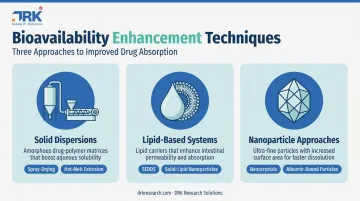
Modern techniques used to improve absorption include:
- Solid dispersions: created via spray drying, hot-melt extrusion, or coprecipitation
- Lipid-based systems: solid-lipid nanoparticles, liposomes, self-emulsifying drug-delivery systems
- Nanoparticle approaches: nanocrystals, albumin-bound particles, homogenization-based systems
A 2022 review in Pharmaceutics by Bhalani and colleagues catalogues this full range of bioavailability enhancement platforms, underscoring how varied the toolkit has become for poorly soluble molecules.
Stability & Shelf-Life Optimization
Stability testing determines shelf life, storage conditions, and packaging, and it's governed by ICH guidelines that specify exact conditions. Under ICH Q1A(R2), long-term testing typically runs at 25°C/60% RH or 30°C/65% RH, with accelerated testing at 40°C/75% RH.
Submissions normally require 12 months of long-term data and 6 months of accelerated data, using at least three primary batches, two of which are pilot scale. This isn't a box-ticking exercise; it's what determines whether a product survives its labeled shelf life once it leaves controlled lab conditions.
Common Challenges in Drug Product Formulation
Formulation development runs into the same obstacles across most programs, regardless of therapeutic area.
- Poor aqueous solubility. Many new chemical entities simply don't dissolve well enough in biological fluids, capping bioavailability before a single stability study even begins.
- Scale-up risk. Lab-scale batches don't always behave the same at commercial volume. Holding one parameter, like impeller-tip velocity, constant doesn't guarantee consistent particle size once bowl size changes.
- Regulatory complexity across markets. A single formulation may need to satisfy FDA, EMA, and WHO-prequalified requirements simultaneously, each with distinct dossier expectations.
| Regulator | Formulation-related requirement |
|---|---|
| FDA (ANDA) | CTD Module 3.2.P sections cover composition, pharmaceutical development, excipient controls, and stability data |
| EMA (hybrid/generic) | Bioequivalence data required; hybrids need extra data when strict generic criteria aren't met |
| WHO PQ | Full composition, API-excipient compatibility, and comparative bioavailability data required in dossier |
- Cost and timeline pressure. Formulation work competes for budget against clinical development, pushing sponsors toward phased or parallel development tracks to avoid delays.
- Stability and degradation during storage. Products shipped into hot, humid, or resource-limited markets face conditions far outside standard climate zones, raising real risk of degradation in transit.
Formulation Examples Across Different Dosage Forms
Formulation strategy looks different depending on the dosage form. Some of the most common categories include:
| Dosage form | Examples | Key formulation considerations |
|---|---|---|
| Oral solids | Tablets, capsules | Compression, disintegration, dissolution rate |
| Oral liquids | Solutions, suspensions, syrups | Taste masking, homogeneity, microbial stability |
| Topical/transdermal | Creams, gels, patches | Skin permeation, vehicle compatibility |
| Injectables/parenterals | IV solutions, lyophilized powders | Sterility, isotonicity, container-closure integrity |
| Modified/controlled-release | Extended-release tablets, depot injections | Release kinetics, matrix or coating design |
Formulation strategy also shifts depending on the regulatory pathway:
- Generic products must match the innovator's dosage form, strength, and bioequivalence profile closely enough to rely on the reference product's safety and efficacy data.
- Hybrid applications need additional supporting data when strict generic criteria can't be met, such as changes in strength, route, or indication from the reference product.
- New chemical entities have no such shortcut: every formulation decision needs its own supporting dataset built from the ground up.
Why Partner with a CDMO for Formulation Development
Building in-house formulation capability from scratch means investing in lab infrastructure, analytical instrumentation, and specialized staff long before a product generates any revenue. For most sponsors, particularly smaller biotech companies, that math doesn't work.
An experienced CRO/CDMO partner brings formulation expertise, lab infrastructure, and regulatory know-how without the upfront capital investment. This is where DRK Research Solutions SA operates as a combined CRO and CDMO, offering end-to-end support from pre-formulation through commercial product launch.
DRK's product development services span:
- Lab-scale formulation development across oral solids, liquids, injectables, ophthalmics, and nasal sprays
- Analytical method development validated to ICH and USP standards
- Technology transfer, including scale-up studies and on-site support at manufacturing partner facilities
- eCTD dossier preparation covering Module 2–5 documentation for global regulatory submission
The company's particular strength lies in generics and hybrid product development for regulated markets, backed by regulatory experience across EU GMP, US FDA, MHRA, PIC/S, and WHO PQ frameworks. DRK's operational footprint across Europe, the Middle East, Asia, Africa, and the Americas also means sponsors get support navigating diverse regulatory pathways at once, rather than managing each market separately.
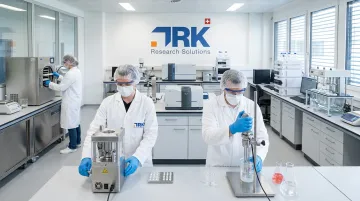
That global reach is especially valuable for programs targeting underserved and low- and middle-income country markets, where distribution conditions and regulatory expectations both add complexity to formulation planning.
Frequently Asked Questions
What is a product formulation statement?
A product formulation statement is the documented qualitative and quantitative composition of a drug product, covering active ingredients, excipients, dosage form, and strength. Regulators use it to verify manufacturing consistency and support submissions like NDAs and ANDAs.
What are some examples of formulations?
Common examples include tablets, capsules, oral liquids, topical creams, injectables, and controlled-release systems. Each requires distinct formulation approaches based on how the drug needs to reach its target.
What is the difference between formulation and manufacturing in drug development?
Formulation designs the composition and delivery method, deciding what goes into the product and how it's structured. Manufacturing then scales and produces that design consistently at commercial volume.
How long does drug formulation development typically take?
Timelines vary widely by complexity. Simple generic formulations may take a matter of months, while novel delivery systems or hybrid products can take several years. Extra bioequivalence or clinical data requirements often add to that timeline.
Why is pre-formulation important in drug development?
Pre-formulation identifies physicochemical risks, like poor solubility or polymorphism, before they become expensive late-stage problems. Catching these issues early prevents costly formulation redesigns down the line.
What role does a CDMO play in formulation development?
A CDMO provides specialized lab infrastructure, formulation expertise, and regulatory support that most sponsors can't cost-effectively build in-house. This helps develop and scale formulations more efficiently while reducing overall program risk.