
Introduction
Pharmaceutical contract manufacturing, the practice of outsourcing drug production to a third-party CMO or CDMO, has moved from a cost-saving tactic to a core supply chain strategy. Sponsors today weigh speed, compliance, and specialized science as heavily as raw capacity.
The stakes are large. The global pharmaceutical CDMO market reached $166.0 billion in 2025 and is projected to hit $293.6 billion by 2033, a 7.4% CAGR, according to a 2026 Grand View Research report. Fortune Business Insights pegs the broader CMO market even higher, at $181.29 billion in 2026.
Understanding where this growth is concentrated in biologics, emerging markets, and AI-driven production helps pharma and biopharma leaders choose the right partners and stay ahead of shifting regulations.
Key Takeaways
- Biologics, ADCs, and GLP-1 therapies are straining fill-finish capacity across the industry
- Asia-Pacific now claims roughly 28.6% of the global CMO market, nearing North America
- AI and continuous manufacturing are cutting operating costs by as much as 50%
- Integrated "one-stop-shop" CDMOs are replacing single-service manufacturers
- Tariff policy and regulatory complexity are pushing sponsors toward diversified sourcing
Key Trends Shaping Pharma Contract Manufacturing in 2026
Outsourcing has evolved well beyond simple overflow capacity. It's now a strategic, technology-enabled partnership model that touches everything from molecule selection to market access.
Trend 1: Surge in Biologics, ADCs, and GLP-1 Manufacturing Demand
Rising R&D activity in monoclonal antibodies, antibody-drug conjugates, and GLP-1 therapies is stretching biologics fill-finish (FDF) capacity worldwide. Sponsors are booking manufacturing slots years in advance just to secure supply.
Samsung Biologics illustrates the scale of this demand. In October 2024, the company signed a $1.24 billion manufacturing contract running through 2037, while bringing its Plant 5 online with an additional 180 kL of capacity, pushing its total across five plants to 784 kL.
The numbers back up why this matters: the biologics contract manufacturing segment is projected to grow from $19.1 billion in 2024 to $34.7 billion by 2030, a 10.5% CAGR. That growth rate outpaces most other pharma manufacturing segments.
Trend 2: Expansion of Small Molecule, Generics, and Radiopharmaceutical Outsourcing
High-potency APIs, peptides, oligonucleotides, and radiopharmaceuticals are creating new outsourcing niches even as biologics dominate headlines. These categories require specialized handling that few sponsors want to build in-house.
The numbers tell the story:
- HPAP contract manufacturing: $9.7 billion in 2026, growing to $21.2 billion by 2033 (11.8% CAGR)
- Peptide and oligonucleotide CDMO market: $3.5 billion in 2026, reaching $8.1 billion by 2033
- Radiopharmaceutical CDMO market: $3.57 billion in 2026, with North America holding 49% share
Generics manufacturers are scaling fast to catch patent-cliff volume. Sandoz, for example, cites more than $650 billion in branded medicine sales coming off patent within the decade, backing that with $1.1 billion in planned production investment by 2029.
Small molecules remain the CDMO industry's steady revenue base. They're stable, orally bioavailable, and far cheaper to manufacture at scale than biologics.
Trend 3: Geographic Diversification into Emerging Markets and LMICs
Sponsors are spreading manufacturing partnerships across Asia-Pacific, the Middle East, and Africa to balance cost, capacity, and patient access. This isn't just about lower labor costs anymore. It's about supply chain resilience.
Asia-Pacific held 28.60%, or $48.2 billion, of the global CMO market in 2025, trailing North America's 31.90% share but closing the gap fast, per Fortune Business Insights.
Meanwhile, the WHO reports that 56% of African countries faced essential-medicine shortages, prompting a 2025-2035 regional roadmap focused on local manufacturing and pooled procurement.
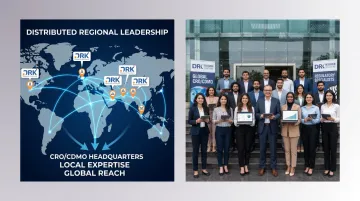
This is where localized proficiency matters. DRK Research Solutions, a CRO/CDMO operating across Europe, the Middle East, Asia, Africa, and the Americas, maintains regional hubs in the UK, USA, UAE, Malaysia, Pakistan, and Nepal.
Each office pairs regulatory expertise (MHRA, US FDA, EU GMP) with on-the-ground language support, a structure built specifically to serve sponsors targeting both regulated markets and underserved LMIC populations.
Trend 4: Technology-Driven Manufacturing (AI, Automation, Continuous Processing)
Single-use bioprocessing and continuous manufacturing are replacing traditional batch production, and AI is now embedded in quality monitoring rather than being a side experiment.
Samsung Biologics, for instance, has implemented digital bioprocess monitoring that uses multivariate data analysis and explainable AI to track batch trajectories and predict titer, viability, and process risk in real time.
The payoff is measurable. An ISPE case study of one pharma company's shift to continuous manufacturing found:
- 50% lower operating costs
- 33% less production waste
- 80% shorter manufacturing and testing cycle time
- 66% shorter testing-to-release time
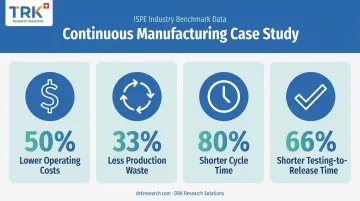
Those numbers explain why the technology shift is accelerating rather than plateauing. It directly cuts cost-of-goods and shortens development timelines, two pressures every sponsor is fighting simultaneously.
Trend 5: Consolidation and the Rise of Integrated "One-Stop-Shop" CDMO Models
Single-service CMOs are giving way to end-to-end CDMOs that handle development through commercial-scale manufacturing under one roof.
Lonza's 2023 acquisition of Synaffix (EUR100 million upfront, plus up to EUR60 million in milestone payments) is a clear example, adding payload and linker technology to Lonza's ADC platform to cover discovery through commercialization.
Sponsors increasingly prefer this single-partner structure because it reduces technology transfer risk. Every handoff between separate vendors introduces delay and data-integrity questions. DRK Research Solutions applies this same logic by integrating CRO and CDMO functions, running everything from first-in-human trials through formulation development, technology transfer, and eCTD dossier preparation within one organizational structure.
What's Driving These Pharma Contract Manufacturing Trends
A mix of scientific, economic, and regulatory forces is accelerating outsourcing adoption, and it's showing up directly in market growth figures across every segment covered above.
- Technology advances: AI/ML, automation, and process analytical technology are enabling faster, smarter production with fewer deviations
- Disease burden: Noncommunicable diseases caused at least 43 million deaths in 2021, or 75% of non-pandemic deaths globally, per the WHO, driving sustained demand for higher drug volumes
- Cost pressures: Avoiding capital expenditure on in-house facilities lets sponsors redirect capital toward core R&D
- Regulatory complexity: FDA guidance requires documented quality agreements between sponsors and manufacturers, pushing companies toward CDMOs with established compliance systems
- Trade instability: As of 2025, roughly 53% of patented pharmaceuticals sold in the US were manufactured abroad, while only 15% of patented APIs by volume were domestically produced
- Tariff policy shifts: New April 2026 US tariff policy sets a default 100% duty on covered patented drugs and APIs, with reduced rates for approved onshoring plans, reshaping where sponsors choose to build supply chains
How These Trends Are Impacting the Pharma Industry
These shifts are reshaping how sponsors plan, budget, and staff their manufacturing programs, with measurable operational, business, and workforce consequences.
Operational Impact
Facilities are shifting from batch to continuous manufacturing, with heavier investment flowing into biologics FDF capacity. Lonza's Stein, Switzerland fill-finish facility, an approximately CHF500 million investment completing in 2026, exemplifies this trend toward integrated drug-substance-to-drug-product capability.
Sponsors also lean harder on structured technology transfer processes to close the gap between development and commercial launch. Fortune Business Insights notes that transferring even one product between sites can take several years.
Business Impact
Long-term CDMO partnerships and M&A-driven capacity acquisition are winning out over building new facilities from scratch. Investment priority is also shifting toward emerging-market manufacturing hubs, a direct response to supply chain diversification pressure covered in Trend 3.
Workforce Impact
Demand for specialized talent in biologics, regulatory affairs, and multi-regional clinical-to-commercial transitions is climbing. CROs and CDMOs with distributed, localized teams are becoming more competitive hiring destinations.
DRK Research Solutions, for example, has built regional leadership roles specifically for this purpose:
- Regional Head for USA & Africa
- Regional Head for Southeast Asia
- Country Head for the UK
Each role combines global regulatory knowledge with on-ground market expertise.
Future Signals for Pharma Contract Manufacturing Beyond 2026
These trends will keep evolving. Here's what's worth watching over the next one to three years:
- Cell and gene therapy manufacturing continues its steep climb, from $7.3 billion in 2022 toward a projected $47.1 billion by 2030 (26.3% CAGR), as more pipelines mature into commercial-stage viral vector production.
- GenAI adoption widens for real-time quality control and predictive maintenance, though ISPE frames this as gradual rather than sudden, dependent on evolving GxP guidance.
- Tariff and reshoring incentives reshape sourcing decisions, with approved US onshoring plans receiving reduced duty rates (20% instead of 100%) and select participants eligible for zero duty through January 2029.
Conclusion
Biologics growth, emerging-market expansion, AI adoption, and CDMO consolidation are collectively redefining pharma contract manufacturing heading into 2026. None of these trends are operating in isolation. They compound each other: faster tech adoption funds emerging-market expansion, which in turn feeds the consolidation wave.
Pharma and biopharma companies that adapt their sourcing strategies now gain a real edge in speed-to-market and cost efficiency later. Partnering with an experienced, globally networked CRO like DRK Research Solutions can help sponsors navigate these shifts with confidence.
With operational hubs spanning Europe, the Middle East, Asia, Africa, and the Americas, DRK supports sponsors' regulatory strategy and product development work, expanding access to innovative therapies for populations that need them most.
Frequently Asked Questions
What is contract manufacturing in the pharmaceutical industry?
Contract manufacturing means outsourcing drug production to a third-party CMO or CDMO instead of building in-house facilities. Sponsors use it to access specialized capacity, expertise, or cost efficiencies they cannot easily replicate internally.
What is the difference between a CDMO and contract manufacturing?
A CMO manufactures a drug strictly to the sponsor's specifications. A CDMO goes further, adding development services like formulation and analytical method development on top of manufacturing, through to commercial-scale production.
How big is the pharmaceutical contract manufacturing market expected to be in 2026?
Grand View Research puts the pharmaceutical CDMO market at $166.0 billion in 2025, growing to $293.6 billion by 2033 at a 7.4% CAGR. Fortune Business Insights estimates the broader CMO market at $181.29 billion in 2026.
Which region leads the global pharma contract manufacturing market?
North America leads with roughly 31.90% market share, driven by regulatory infrastructure and biologics investment. Asia-Pacific follows closely at 28.60%, fueled by lower-cost production and expanding local manufacturing capability.
What are the biggest challenges pharma companies face when outsourcing manufacturing?
Quality control and regulatory compliance top the list, since both the sponsor and manufacturer share FDA accountability. IP protection and supply chain resilience, especially during multi-year technology transfers, are close behind.
How is AI transforming pharmaceutical contract manufacturing?
AI supports predictive quality monitoring, tracking batch trajectories and flagging deviations before they cause failures. It also accelerates development timelines by reducing manual work in process analytics and documentation.