Why Choosing the Right API Intermediates Supplier Matters
Every tablet, capsule, and injectable starts as a chemical intermediate long before it becomes a finished medicine. These building blocks determine the safety, purity, and eventual efficacy of the drug that reaches a patient's hands.
Global pharma supply chains have grown increasingly fragile. Manufacturers now navigate geopolitical tension and tightening regulatory scrutiny, all while the pool of suppliers able to deliver consistent, high-purity material on schedule keeps shrinking.
The global API-intermediate market was valued at $137.3 billion in 2022 and is projected to reach $237.7 billion by 2030, according to KBV Research's 2023 market analysis. That growth signals opportunity, but it also means more buyers competing for the same trusted capacity.
This guide breaks down what API intermediates actually are, how they differ from finished APIs, and what separates a dependable, GxP-compliant supplier from a liability waiting to disrupt your development timeline.
Key Takeaways
- API intermediates are precursor chemicals whose purity directly shapes final drug quality.
- Intermediates face lighter regulatory scrutiny than APIs, yet impurities carry into the final product.
- Trustworthy suppliers provide full documentation: GMP certificates, COAs, DMF/CEP filings, and audit history.
- Supply chain concentration in a few regions creates real disruption risk for sourcing teams.
- Partnering with a CDMO with multi-regional regulatory expertise reduces cross-border sourcing risk.
What Are API Intermediates?
An API intermediate is a chemical compound produced during the multi-step synthesis of an Active Pharmaceutical Ingredient. It serves as a stepping stone toward that final compound, not the finished therapeutic substance itself.
The ICH Q7 guideline defines an intermediate as material that must undergo further molecular change or purification before it becomes the API. Some intermediates are isolated and tested independently; others pass through the reaction sequence without ever being separated out.
This distinction matters directly to procurement teams: the intermediate's purity and consistency set the ceiling for everything downstream. A contaminated intermediate can't be "fixed" later in the process. The impurity simply travels forward.
Real-World Examples
Two well-documented examples make the concept concrete:
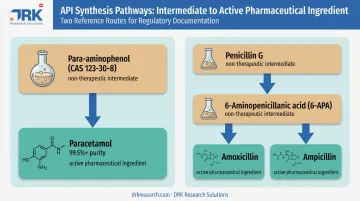
Para-aminophenol (CAS 123-30-8) serves as a key intermediate in paracetamol synthesis, typically supplied at 99.5%+ purity for downstream API manufacturing. Penicillin G offers a second example: it converts into 6-aminopenicillanic acid (6-APA), the intermediate used to manufacture amoxicillin and ampicillin.
Neither compound has therapeutic value on its own. Both determine whether the finished antibiotic or analgesic meets pharmacopoeial standards.
API vs. Pharmaceutical Intermediate: What's the Difference?
An API is the final active component that delivers a pharmacological effect. A pharmaceutical intermediate is a non-therapeutic precursor used somewhere earlier in that synthesis.
Regulatory scrutiny reflects that distinction, but only partially. Intermediates face lower direct regulatory burden than APIs, yet strict quality control still applies because any impurity generated at the intermediate stage doesn't disappear. It carries through to the finished drug.
| Attribute | API | Intermediate |
|---|---|---|
| Definition | Final active substance providing therapeutic effect | Precursor compound requiring further processing |
| Regulatory approval | Subject to full DMF/CEP review and marketing authorization scrutiny | Lower direct scrutiny, but quality still traced through the API dossier |
| Manufacturing stage | End product of the synthesis route | Mid-process compound, isolated or non-isolated |
What Is an API Supplier and Why Does Their Role Matter?
An API supplier is a manufacturer or contract development and manufacturing organization (CDMO) that produces, tests, and delivers APIs or intermediates to pharmaceutical companies for formulation and commercial production.
Supplier reliability carries direct timeline risk: a single batch failure at the intermediate stage can stall an entire production line, push back a launch date, or trigger a shortage notification.
Core Responsibilities a Trusted Supplier Should Fulfill
A dependable supplier typically delivers on four fronts, and gaps in any one of them create risk further down your supply chain:
- Consistent batch quality — reproducible yields and impurity profiles across every production run
- Complete regulatory documentation — DMF or CEP filings that support your own regulatory submission
- Scalable production capacity — the ability to move from pilot batch to commercial volume without renegotiating terms
- Traceability — a documented chain from raw material through finished intermediate
Why Outsourcing Makes Sense
Building all four capabilities in-house is rarely practical for a single sponsor. The API-CDMO market reached an estimated $128.26 billion in 2025 and is projected to grow to $210.53 billion by 2031, according to Mordor Intelligence.
That growth reflects a simple economic reality: building a dedicated multipurpose synthesis plant can cost well over $50 million. Outsourcing converts that fixed capital burden into a variable cost tied to actual production volume.
Outsourcing to a specialized CDMO/CRO partner lets a pharmaceutical company redirect internal resources toward drug discovery and clinical strategy, while the sourcing and quality assurance work happens elsewhere, under contract, with clear accountability.
DRK Research Solutions' CDMO division supports generics and hybrid product development for regulated markets, working through partnerships with EU- and US-approved manufacturing facilities. That structure gives sponsors a vetted pathway from early formulation through technology transfer and commercial batch production, without requiring an in-house synthesis operation.
Common Types of APIs and Intermediates Used in Manufacturing
Not all APIs are built the same way, and matching supplier expertise to your specific molecule type matters more than most procurement checklists suggest.
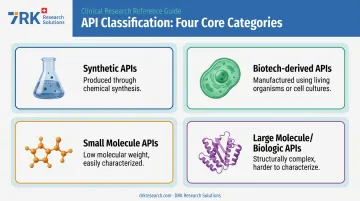
Broadly, APIs fall into four categories:
- Synthetic APIs — produced through chemical synthesis, the most common route for small-molecule drugs
- Biotech-derived APIs — manufactured using living organisms or cell cultures
- Small molecule APIs — low molecular weight, chemically defined, and typically easier to characterize
- Large molecule/biologic APIs — structurally complex, derived from biological sources, and generally harder to fully characterize
According to ICH Q11, drug substances are officially classified along two production routes: chemical entities and biotechnological/biological entities. Small versus large molecule is a separate axis describing molecular complexity, not production method.
Intermediates, by contrast, are usually classified by therapeutic application area rather than molecule size — such as cardiovascular, anti-infective, or oncology intermediates.
That's a practical distinction for procurement teams: a supplier skilled in antibiotic intermediate chemistry may not have the same depth in oncology impurity control. Matching expertise to your pipeline avoids costly trial-and-error sourcing.
Key Criteria for Identifying a Trusted API Intermediates Supplier
Not every supplier that claims GMP compliance actually delivers it consistently. Here's what separates genuine reliability from marketing language.
Regulatory and quality compliance. Verify current GMP certifications (FDA, EMA, WHO-GMP), documented impurity profiles, and the supplier's demonstrated ability to file DMF or CEP submissions on your behalf.
Technical competence. A capable supplier can optimize synthetic routes, control impurity levels at the parts-per-million level, and reproduce results batch after batch, not just once in a validation run.
Manufacturing scalability. Ask about reactor capacity, prior scale-up experience, and safety protocols for hazardous or high-potency intermediates. A supplier that thrives at kilogram scale may struggle at metric-ton volume.
Supply chain resilience. This is where many sourcing relationships fail. During the COVID-19 disruption, a WHO survey of Indian antiretroviral manufacturers found that at least one manufacturer saw capacity drop to 20-30% of normal due to intermediate and active-ingredient shortages. Others with diversified sourcing or in-house API stock felt only marginal impact. Diversified raw material sourcing protects you when disruptions hit.
Documentation and transparency. Request full Certificates of Analysis, Material Safety Data Sheets, stability data, and audit history before signing anything. A supplier that hesitates to share this is a red flag, not an oversight.
Navigating Global Supply Chain & Regulatory Compliance Challenges
Pharmaceutical manufacturing has long depended on a small number of geographic hubs. That concentration creates real exposure.
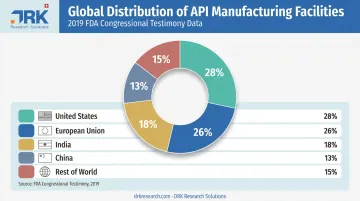
As of 2019, FDA testimony to Congress placed API manufacturing facilities at roughly 28% in the US, 26% in the EU, 18% in India, and 13% in China, with the remainder spread across the rest of the world. FDA itself noted it couldn't precisely determine how much material entering the US actually originated in China, a gap that underscores just how opaque these supply chains can be.
Regulatory divergence compounds the problem:
- The FDA's Drug Master File system is voluntary and reference-based
- The EU requires written confirmation of GMP-equivalent status for imported active substances since 2013
- Emerging market authorities often layer additional local requirements on top of both
Harmonization efforts like PIC/S, now spanning 57 participating authorities, have narrowed some of these gaps by aligning GMP principles across jurisdictions. But harmonized principles don't eliminate the practical need to file differently in each market.
Paperwork alone doesn't close this gap — local regulatory presence does. A regulatory consulting partner with teams physically present across multiple continents can navigate these divergent filing requirements far more effectively than one relying solely on remote documentation review.
How DRK Research Solutions Supports Pharmaceutical Manufacturers Globally
DRK Research Solutions has operated for over a decade, with a footprint spanning Europe, the Middle East, Asia, Africa, and the Americas. That geographic spread isn't incidental. It's what allows the company to navigate FDA, EMA, MHRA, WHO PQ, and PIC/S requirements without treating each region as a separate, disconnected project.
The company's CDMO division focuses specifically on generics and hybrid product development for regulated markets. Quality-assured sourcing and GxP compliance sit at the foundation of that work, supported by:
- Technology transfer management, including process documentation and scale-up studies at manufacturing partner sites
- Analytical method development aligned with ICH and USP standards
- eCTD dossier preparation covering Modules 2 through 5 for global regulatory submission
- Exhibit and commercial batch manufacturing coordinated through EU- and US-approved facilities
Beyond these technical capabilities, DRK's roots as a patient advocacy organization still shape how the company operates. The focus on underserved, low- and middle-income markets isn't just a marketing footnote. It's woven into how DRK structures partnerships and prioritizes regulatory pathways for clients working in regions that larger CDMOs often overlook.
Pharmaceutical companies often weigh whether to build internal sourcing capability or partner with a specialized CDMO. For those still deciding, reaching out directly is often the fastest way to map out which regulatory pathway and manufacturing partnership fits a specific product pipeline.
Frequently Asked Questions
What are API intermediates?
API intermediates are precursor chemical compounds generated during Active Pharmaceutical Ingredient synthesis. They have no direct therapeutic effect on their own, but their purity and consistency determine the final API's quality.
What is an API supplier?
An API supplier is a manufacturer or CDMO responsible for producing, testing, and delivering APIs or intermediates that meet regulatory and quality standards required for pharmaceutical formulation and commercial manufacturing.
What are the most common types of APIs?
The primary categories are synthetic APIs, biotech-derived APIs, small molecule APIs, and large molecule/biologic APIs. Synthetic and biotech APIs describe the production route; small versus large molecule describes structural complexity.
How do I verify if an API intermediate supplier is GMP-compliant?
Request current GMP certificates, DMF or CEP filings, and recent third-party audit reports before finalizing any sourcing agreement. A credible supplier will provide these without delay.
Why do pharmaceutical companies outsource API intermediate sourcing to CDMOs?
Outsourcing reduces capital investment in dedicated manufacturing infrastructure, provides access to specialized synthesis expertise, and typically shortens development timelines compared to building in-house production capacity from scratch.
What documentation should a trusted API supplier provide?
Essential documents include a Certificate of Analysis (COA), Material Safety Data Sheet (MSDS), stability data, a documented impurity profile, and applicable GMP or ISO certifications relevant to the specific intermediate.