Get it wrong, and you're facing blown budgets, stalled tech transfers, and regulatory setbacks that can delay a launch by months.
The financial stakes are steep. Bringing a single new medicine to market carries a median capitalized R&D investment of $985.3 million, according to a JAMA study of 355 FDA approvals between 2009 and 2018. Every dollar wasted on a mismatched manufacturing partner compounds that risk.
Meanwhile, demand for outsourced development and manufacturing keeps climbing. The global CDMO market is projected to grow from $199.27 billion in 2025 to $419.93 billion by 2034. More choice also means more room to choose wrong.
This article covers what a CDMO actually does, the factors separating a strong partner from a risky one, and how to build a relationship built to last.
Key Takeaways
- A CDMO handles both development and manufacturing; a CMO only manufactures, a CRO only researches
- The right partner drives speed-to-market, product quality, regulatory success, and total cost
- Evaluate technical expertise, compliance history, scalability, communication, and global reach
- A strong CDMO relationship works as an ongoing partnership, not a one-off vendor transaction
What Is a CDMO?
A Contract Development and Manufacturing Organization (CDMO) provides integrated services spanning drug development through commercial-scale manufacturing. Sponsors bring a molecule; the CDMO handles formulation, scale-up, and production under one roof.
That's different from a CMO, which sticks to manufacturing, or a CRO, which focuses on research and clinical trial execution. Confusing the three often leads sponsors to outsource the wrong scope of work at the wrong stage.
| Entity | Core focus | Typically excludes |
|---|---|---|
| CDMO | Development + manufacturing, end-to-end | — |
| CMO | Manufacturing only | Formulation, process development |
| CRO | Research and clinical trial management | Manufacturing, commercial production |
Core Services CDMOs Typically Offer
A capable CDMO usually covers:
- Formulation and process development to optimize drug substance stability, bioavailability, and dosage form design before a molecule reaches clinical trials
- Clinical trial material manufacturing for Phase I through Phase III supply needs, matched to shifting batch-size requirements as a program advances
- Analytical testing, stability studies, and regulatory documentation support that produce the data packages regulators expect alongside a filing
- Commercial-scale manufacturing and supply chain/packaging coordination, moving from exhibit batches to full commercial volumes without a drop in quality
- Generics and hybrid product development for regulated markets, a growing focus as sponsors seek faster, lower-cost entry into the EU, US, and other regulated jurisdictions
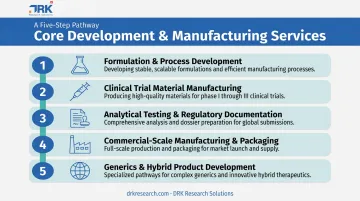
DRK Research Solutions, for example, built its CDMO offering around this last point, pairing formulation and analytical method development with eCTD dossier preparation for complex generics and hybrid products.
Why the Pharma Industry Relies on CDMOs
Building in-house manufacturing capacity is expensive and slow. Outsourcing to a CDMO addresses that directly, giving sponsors:
- Lower capital investment than building dedicated facilities
- Access to specialized formulation and analytical expertise
- Faster time-to-market through parallel workstreams
- Scalable production without a fixed in-house footprint
This reliance keeps intensifying. BioPlan's 22nd annual survey found 57.8% of biopharma developers now outsource up to half of their mammalian-cell production, up from 29.0% in 2009. Microbial production outsourcing followed a similar climb, from 24.0% to 53.7% over the same period.
With that much outsourcing volume, a single partner selection can determine whether a molecule reaches patients on schedule. The next section breaks down exactly what to evaluate before signing that partner.
What to Consider When Choosing the Right CDMO Partner
These factors connect a CDMO's technical capabilities to measurable business outcomes: timeline, cost, and regulatory risk. Treat this as a working checklist, not a formality.
Experience and Technical/Therapeutic Expertise
A proven track record in your specific dosage form, molecule type, or therapeutic area reduces development risk. A CDMO that's transferred your molecule class a dozen times will catch problems you haven't thought of yet.
Ask for:
- Number of successful technology transfers in your modality
- Batch success rates for similar products
- Years specializing in your therapeutic area or dosage form
Industry guidance recommends running at least two engineering batches before committing to full-scale production. Confirm this during due diligence, not after the contract is signed.
Regulatory Compliance and Quality Systems
cGMP adherence, audit history, and inspection readiness directly shape how quickly your product clears the FDA, EMA, or other agencies. A single unresolved warning letter can add months to a filing timeline.
Request:
- Recent audit findings and classifications (NAI, VAI, or OAI)
- Any outstanding warning letters or observations
- Certifications held, such as EU GMP, WHO PQ, or PIC/S
- History supporting filings in your target markets
Regulatory responsibility doesn't transfer to the contract facility. FDA guidance is explicit that both the product owner and the CDMO retain cGMP accountability, so this diligence protects you directly.
Capacity, Scalability, and Facility Infrastructure
Scaling from a clinical batch to commercial volume without quality drift separates dependable partners from risky ones.
Ask about:
- Batch size flexibility across development stages
- Equipment redundancy in case of downtime
- Lead times for scale-up runs
- Validation requirements triggered by scale-up changes
A CDMO that can only run your Phase I batch size, and nothing larger, isn't a long-term partner. It's a stopgap.
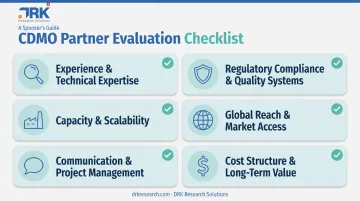
Global Reach and Market Access
A CDMO's geographic footprint and regulatory familiarity affect how fast you reach target countries, particularly in emerging and underserved markets.
Look at:
- Number of operational regions and local regulatory relationships
- Distribution network coverage
- Experience with pathways like WHO prequalification, which offers a 90-day regulatory review once assessment data is ready
For sponsors targeting several regulated and emerging markets at once, this factor often determines whether a launch happens in one region or five.
Communication, Transparency, and Project Management
Proactive, structured communication prevents delays before they start. Cross-functional pharma projects involve regulatory, quality, manufacturing, and clinical teams working across time zones. Misalignment anywhere in that chain shows up as a missed milestone.
Evaluate their project management tools and reporting cadence, escalation protocols for deviations, and responsiveness during the proposal and audit phase. That last one is a preview of what's ahead once you're under contract.
Cost Structure and Long-Term Partnership Value
Unit price tells you almost nothing about total cost of ownership. Batch failures, rework, and delays quietly erode any savings from a lower quoted rate.
Evaluate:
- Cost-per-batch trends over time, not just the initial quote
- Contract flexibility and willingness to invest in the relationship for the long haul
A cheaper quote that leads to a failed batch costs more than a fair quote that works the first time.
How DRK Research Solutions Can Help
DRK Research Solutions operates as a hybrid CRO-CDMO, built over more than a decade of pharmaceutical and clinical research work. That combination matters because it removes the handoff friction sponsors usually face when a clinical-stage CRO and a manufacturing-stage CDMO sit under two separate contracts, each with its own timeline and communication style.
What sets DRK apart:
- Integrated CRO+CDMO capabilities spanning first-in-human studies through commercial-scale launch, under one partnership model
- Specialization in generics and hybrid product development for regulated markets, covering formulation, analytical validation, technology transfer, and eCTD dossiers
- A 100+ person global team with strategic alliances across Europe, the Middle East, Asia, Africa, and the Americas
- On-the-ground regional leadership spans Dr. Nigel Whittle in the UK and Dr. Onesmo Mpanju in the USA and Africa, giving sponsors local regulatory familiarity
- A track record in underserved and LMIC markets, tracing back to DRK's origins as a patient advocacy organization before its 2016 CRO launch and 2022 CDMO expansion
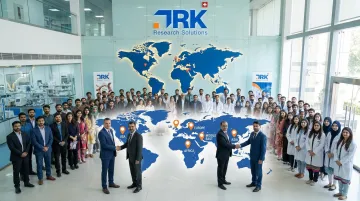
For sponsors weighing a single-service CDMO against a partner who can carry a product from early clinical work through commercial supply, that integration often means one continuous relationship instead of multiple separate vendor handoffs.
Conclusion
Brand recognition alone doesn't make a CDMO the right fit. What matters is whether their technical expertise, capacity, and regulatory footprint align with your specific molecule, timeline, and target markets.
The criteria above, spanning experience, compliance history, scalability, global reach, communication, and cost structure, give you a framework to compare partners on substance rather than reputation.
That framework isn't a one-time checklist, either. Pipeline needs shift, regulations change, and scale-up requirements evolve. What worked for your Phase I supply might not fit your commercial launch. Revisit the partnership periodically, and ask the hard questions again, even with a CDMO you've worked with for years.
Frequently Asked Questions
What is a CDMO partner?
A CDMO partner is an organization that provides integrated drug development and manufacturing services, helping pharma and biotech companies bridge internal resource gaps. It handles formulation and scale-up work through full production, all under one contract.
What's the difference between a CDMO and a CMO?
A CMO handles manufacturing only, typically producing drug substance or product to a sponsor's existing specifications. A CDMO also supports earlier-stage work, such as formulation development and scale-up, before manufacturing begins.
How do I evaluate a CDMO's regulatory track record?
Check audit history and inspection classifications (NAI, VAI, or OAI). Also review outstanding warning letters and the CDMO's experience supporting filings in your target markets, since prior success in similar product categories is a strong indicator.
What questions should I ask a CDMO before signing a contract?
Ask about production capacity, past project experience with your molecule type, communication protocols, and contingency planning for delays or deviations. Their answers during due diligence often predict how they'll perform once you sign.
How long does it typically take to select and onboard a CDMO?
Timelines vary by project complexity, but the process generally includes technical audits and quality assessments, plus pilot or engineering batch runs, before full onboarding. Complex technology transfers can take well over a year.
Can a CDMO support both clinical and commercial manufacturing?
Yes. Many full-service CDMOs, including integrated CRO-CDMO partners, support the full lifecycle from clinical trial supply through commercial-scale production without requiring a vendor change.