This transition, known as large-scale synthesis, has become a genuine bottleneck for drug developers. Cost pressure, faster-to-market timelines, and stricter regulatory quality expectations all collide at this stage. In fact, a 2024 review of FDA refuse-to-file letters found that 19.4% of the 644 cited deficiencies involved chemistry, manufacturing, and controls (CMC) issues, with a median 182-day delay to resubmission (FDA refuse-to-file study).
This article breaks down what large-scale synthesis actually means, why it matters, the main approaches used across pharma manufacturing, and how to choose the right one for your molecule.
Key Takeaways
- Large-scale synthesis scales validated processes to production volume without sacrificing yield, purity, or safety.
- CMC and process issues cause nearly one in five FDA refusal-to-file decisions, a genuine regulatory risk.
- Three core approaches dominate: batch synthesis, continuous flow synthesis, and biocatalytic/hybrid synthesis.
- Molecule complexity, target volume, and budget should guide your approach choice, not trend-chasing.
- CDMOs with global manufacturing partnerships can help sponsors execute scale-up without heavy in-house capital investment.
What Is Large-Scale Synthesis?
Large-scale synthesis is the chemical manufacturing process used to convert a lab-validated reaction route into repeatable, high-volume production of an active pharmaceutical ingredient (API) or intermediate. It's an engineering problem layered on top of existing chemistry, not a new chemistry challenge to solve from scratch.
At small scale, a chemist controls temperature, mixing, and reaction time almost by feel. At industrial scale, those same parameters need to translate into reactor conditions that behave predictably across every batch, every time. That means re-evaluating:
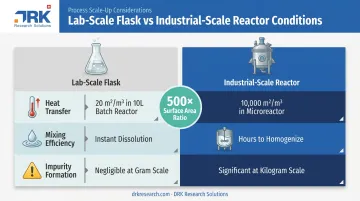
- Heat transfer: a 10 L batch reactor offers roughly 20 m²/m³ of surface area, versus closer to 10,000 m²/m³ in a microreactor, critical for fast, exothermic reactions
- Mixing efficiency: what dissolves instantly in a flask may take hours to homogenize in a large tank
- Impurity formation: side reactions that were negligible at gram scale can become significant at kilogram scale
This manufacturing discipline applies at every stage of drug development, from producing clinical-trial material to running full commercial production.
Why Large-Scale Synthesis Matters in Drug Manufacturing
Scale-up decisions directly affect a drug's cost of goods, supply reliability, and time-to-market. Get it wrong, and the consequences extend beyond a technical setback to delayed clinical trials or a stalled commercial launch.
What Goes Wrong Without a Solid Scale-Up Strategy
Poorly planned large-scale synthesis tends to produce the same recurring problems:
- Inconsistent batch-to-batch yields
- Unexpected impurity profiles that trigger additional testing or rework
- Safety hazards from exothermic or fast reactions that weren't fully characterized at small scale
- Regulatory non-compliance findings during inspection or filing review
These aren't hypothetical risks. Modeled cost-of-goods analyses for products like long-acting cabotegravir show API synthesis alone can represent 25% to 38% of total launch-stage manufacturing cost, depending on production volume. Process decisions made early can lock in that cost structure for years.
Bridging the Capability Gap
Many pharmaceutical companies, particularly smaller biotechs and generics developers, don't have in-house infrastructure built for kilogram- or ton-scale synthesis. Building that capacity from scratch is expensive and slow. This is where specialized CDMOs step in.
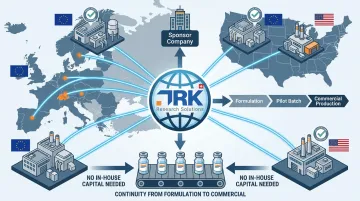
DRK Research Solutions, for example, supports generics and hybrid product development for regulated markets through its CDMO service line. Rather than requiring sponsors to build proprietary plants, the company connects them with EU- and US-approved manufacturing partners. That model lets a sponsor move from formulation development through exhibit and commercial batch manufacturing without the capital burden of owning the physical infrastructure.
Types of Large-Scale Synthesis Approaches
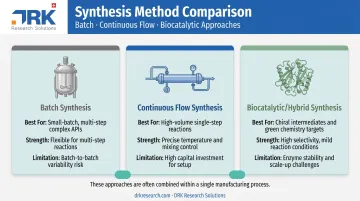
There's no single "correct" way to scale a synthesis. The right approach depends on the molecule's chemistry, the target production volume, and the constraints your team is working under. In practice, these three approaches are often combined within a single manufacturing process rather than used in isolation.
Batch Synthesis
Batch synthesis is the traditional workhorse: a reaction runs to completion in a single vessel before the process moves to the next step. Reactants are charged into large stirred-tank reactors, processed sequentially, and isolated between steps before the next transformation begins.
What sets it apart from continuous or enzyme-based methods is its sequential, vessel-based structure. Each step is discrete. Each batch is its own defined unit.
Best suited for:
- Well-established chemistry with predictable reaction behavior in moderate-volume, multi-step syntheses that need intermediate isolation
- Companies with existing batch reactor infrastructure and regulatory filings already built around batch processes
Key strengths: Batch reactors are flexible enough to run multiple different products in the same equipment, and the regulatory framework around batch manufacturing has been in place since ICH Q7 was established in 2000, giving it the longest track record of any approach.
Limitations: Heat and mass transfer behave differently at scale, which can affect yield and impurity formation in fast or exothermic reactions. Batch-to-batch variability also requires careful monitoring, and hazardous reaction steps often mean longer processing times to manage safely.
Continuous Flow Synthesis
Continuous flow synthesis reverses the batch model. Instead of processing discrete lots, reactants are pumped continuously through tubular or microreactors, allowing the reaction and isolation to happen in a steady, uninterrupted stream. Precise control over temperature, mixing, and residence time is built into the reactor design itself.
The key distinction is steady-state operation versus the stepwise, start-stop nature of batch processing.
Best suited for:
- Fast, exothermic, or hazardous reactions where small reacting volumes reduce risk
- Photochemistry, electrochemistry, or organometallic steps that are difficult to control in large vessels
- Companies aiming to shrink their manufacturing footprint and shorten timelines for kilogram-to-multi-kilogram API output
Key strengths: Flow systems offer tighter reaction control and can dramatically cut solvent use and waste. A modeled comparison of seven industrial API processes found flow reduced average energy use by 78% and E-factor (waste-to-product ratio) by 87% compared to batch equivalents, though operating cost differences weren't statistically significant across the cases studied.
One of the clearest real-world demonstrations is Eli Lilly's cGMP continuous manufacturing process for prexasertib monolactate monohydrate, which produced 24 kg of API at roughly 3 kg per day across eight linked continuous unit operations, generating material suitable for clinical trials (kilogram-scale prexasertib case study).
A similar flow approach was used for verubecestat, applying a kilogram-scale organolithium addition to a chiral ketimine under noncryogenic conditions that would have been far riskier in a traditional batch vessel.
Limitations: Flow systems demand higher upfront equipment and engineering investment. Handling solids or slurries within narrow tubing also adds real complexity that batch processing simply doesn't face.
Biocatalytic and Hybrid Synthesis
Biocatalytic synthesis uses enzymes, or engineered biological catalysts, to carry out key transformations, often paired with chemical batch or flow steps in a hybrid process. Enzymes catalyze specific, highly selective reactions under mild conditions, frequently replacing hazardous reagents or metal catalysts entirely.
What separates this approach from the other two is its reliance on biological selectivity rather than purely mechanical reaction engineering.
Best suited for:
- Complex chiral molecules where stereochemistry is critical
- Green chemistry initiatives aiming to cut toxic byproducts
- Processes where improving atom economy is a priority alongside product quality
Key strengths: Biocatalysis delivers a level of chemo-, regio-, and stereoselectivity that's hard to match with conventional catalysts, usually under gentler reaction conditions.
The clearest example is Merck's engineered transaminase route for sitagliptin, which replaced a rhodium-catalyzed high-pressure hydrogenation step entirely. The switch increased overall yield by 10-13%, boosted productivity by 53%, and cut total waste by 19%, while eliminating heavy-metal catalysts and high-pressure equipment from the process (biocatalysis in pharmaceutical manufacturing).
Limitations: None of that came free. Directed evolution of the enzyme took roughly a year, and the team had to work through low initial activity, solvent instability, and substrate precipitation before the process was production-ready. Enzyme cost and the need for specialized biocatalyst development remain real barriers compared to picking up an off-the-shelf chemical catalyst.
How to Choose the Right Type of Large-Scale Synthesis Approach
The right approach depends on your specific molecule, production goals, and available resources — not on which method sounds the most impressive. Continuous flow gets a lot of attention, but that doesn't make it the right fit for every project.
Key Factors to Evaluate
Work through these factors before committing:
- Purpose and goals: Are you supplying a Phase I clinical trial or planning for years of commercial manufacturing? Small clinical batches often don't justify flow's upfront engineering cost.
- Scale and frequency: Grams per month, kilograms per quarter, or tons per year all point toward different equipment and staffing needs.
- Chemistry complexity: Multi-step routes with hazardous intermediates may favor flow or biocatalysis; straightforward, well-characterized chemistry often does fine in batch.
- Budget and capital investment: Specialized flow reactors or enzyme development programs require capital and lead time that not every project has.
- In-house expertise vs. external partnership: If your team hasn't run flow chemistry at scale before, a CDMO with global manufacturing experience can shorten the learning curve considerably.
- Long-term flexibility: Consider whether you'll need to switch or scale between approaches as the drug moves from Phase II through commercial launch.
What to Check Before Finalizing a Type
A few practical checks can save months of rework later:
- Don't default to the flashiest option. Continuous flow is powerful, but if batch processing already meets your production needs and regulatory filings, switching adds cost without adding value.
- Weigh the trade-offs honestly. Batch has scalability limits with hazardous chemistry; flow has real capital and integration costs. Neither is universally "better."
- Account for transfer costs across phases. A process that's efficient at Phase II clinical supply might need re-validation entirely when scaled to commercial volumes.
- Validate before you commit. Don't choose an approach purely because your team is familiar with it. Pilot-scale trials, or a technical assessment from an experienced CDMO, catch problems before they become expensive.
DRK Research Solutions' technology transfer service, for instance, is built around this kind of transition. It carries formulation and process documentation from lab-scale work through scale-up studies, adding on-site support at partner manufacturing facilities. The goal: a process validated in development that still holds up at commercial volume.
Conclusion
Large-scale synthesis sits at the foundation of safe, cost-effective, and timely drug manufacturing. Get the approach wrong, and you're looking at delayed trials, inflated costs, or regulatory setbacks that ripple through the entire development timeline.
Batch, continuous flow, and biocatalytic or hybrid synthesis each solve different problems. None is inherently superior; each simply serves different molecules, volumes, and risk profiles. Understanding those differences, and partnering with an experienced CDMO when the in-house capability isn't there, lead to better manufacturing decisions and faster patient access to the therapies that depend on them.
Frequently Asked Questions
What is the main difference between batch and continuous synthesis in drug manufacturing?
Batch processes run reactions to completion in a single vessel before moving to the next step, while continuous flow pumps reactants steadily through reactors. Flow generally offers tighter process control and better safety margins for hazardous chemistry.
Why is scaling up from lab to industrial production so challenging in pharma?
Heat and mass transfer behave very differently in a large reactor than in a lab flask, and larger reagent volumes raise safety stakes. Maintaining consistent yield and purity across every batch adds another layer of difficulty.
What is continuous flow chemistry used for in pharmaceutical manufacturing?
Continuous flow chemistry is primarily used for hazardous, fast, or highly exothermic reactions, along with photochemical, electrochemical, or organometallic steps that need precise control at scale. Prexasertib and verubecestat are both documented examples of flow chemistry at kilogram output.
How does biocatalysis improve large-scale drug synthesis?
Enzymes provide exceptional selectivity under mild conditions, often eliminating toxic reagents or metal catalysts. The sitagliptin case showed a 53% productivity gain and 19% waste reduction versus the original chemical route.
What regulatory standards apply to large-scale API synthesis?
API manufacturing must follow GMP requirements under ICH Q7, with process validation expectations outlined in ICH Q11 and, for continuous processes, ICH Q13. All three demand validated, reproducible processes regardless of the technology used.
How do CDMOs support large-scale synthesis for pharmaceutical companies?
CDMOs provide manufacturing infrastructure, technical expertise, and regulatory support without requiring sponsors to build their own facilities. DRK Research Solutions, for example, connects generics and hybrid product developers with EU- and US-approved manufacturing partners across its regulated market network.