This matters for pharmaceutical QA/QC professionals, analytical scientists, and sponsors preparing regulatory submissions. Get validation wrong, and you risk failed batch releases, rejected filings, or worse: a product recall traced back to a method that never should have been trusted in the first place.
Terms like accuracy, precision, and linearity show up constantly in SOPs and regulatory dossiers. Yet many teams treat them as checkboxes rather than distinct, measurable performance characteristics. This article breaks down what each parameter actually means, the step-by-step validation process, the four validation types, and exactly when each one applies.
Key Takeaways
- Method validation confirms ICH Q2(R1), USP <1225>, and FDA compliance before release or stability testing
- Core parameters include accuracy, precision, specificity, linearity, range, LOD/LOQ, and robustness
- A full validation exercise typically follows an eight-step sequence, from objective-setting through QA approval
- Four distinct validation approaches exist, chosen based on the method's origin and development stage
- Confusing validation with verification, or skipping revalidation after a site change, is a costly regulatory misstep
What Is Method Validation in Pharma?
Per ICH Q2(R1), the objective of validating an analytical procedure is to demonstrate that it is suitable for its intended purpose, backed by documented laboratory evidence rather than a paperwork formality (ICH Q2(R1) Guideline).
In practice, this means confidence that your identity, purity, and potency results genuinely reflect sample quality under real lab conditions, day after day, rather than in a single ideal test run.
Validation isn't the only word in this space, though. Three terms get conflated constantly:
- Method validation applies to new, in-house developed procedures or noncompendial alternatives
- Method verification confirms a compendial (USP) procedure performs as expected in your specific lab, and is required the first time you use that procedure
- Method qualification (per USP
<1220>) is a broader lifecycle stage that may include validation, verification, or transfer activities
Why Method Validation Is Critical in Pharma
FDA, ICH, and EMA guidelines all require validation data before a product can be approved. FDA's guidance states plainly that NDAs, ANDAs, and BLAs must include supporting data establishing accuracy, sensitivity, specificity, and reproducibility for every analytical procedure submitted.
The consequences of skipping this step show up in enforcement records. FDA cited Green Wave Analytical for failing to establish accuracy, sensitivity, specificity, and reproducibility, and for failing to validate or verify methods before use. That gap directly produced unreliable identity, strength, and purity results.
Without proper validation, labs typically see:
- Out-of-specification results that trigger lengthy investigations
- Failed regulatory submissions due to unsupported analytical claims
- Batch-to-batch inconsistency that undermines patient safety
- Technology transfer delays when a method's performance can't be reproduced at a new site
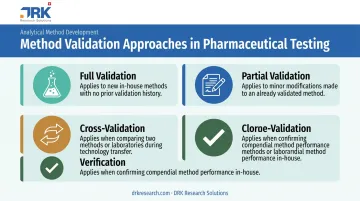
The Four Types of Method Validation
Not every method needs the same depth of validation work. The approach depends on where the method came from and what stage of development you're in.
These four categories are widely used across pharma quality labs. Full, partial, and cross-validation are formally defined in ICH M10 bioanalytical guidance, while verification comes from USP compendial practice. In day-to-day QC work, teams apply the same logic to chemical assay methods.
| Type | When It Applies |
|---|---|
| Full validation | New, in-house developed method with no prior performance history |
| Partial validation | Minor modifications made to an already-validated method |
| Cross-validation | Comparing two methods or two laboratories, common during technology transfer |
| Verification | Confirming a compendial or previously validated method performs correctly under actual lab conditions |
Key Validation Parameters: Accuracy, Precision, Linearity & More
ICH Q2(R1) defines a core set of performance characteristics. Not every parameter applies to every method, though — identification tests, for instance, generally don't require accuracy or precision data the way an assay method does.
Accuracy
Accuracy measures how close a result comes to the true value. Two approaches dominate:
- Spiked placebo: adding a known amount of analyte to a placebo matrix and measuring recovery
- Standard addition: adding known quantities of analyte to an actual sample and calculating recovery mathematically
ICH Q2(R1) recommends at least nine determinations across a minimum of three concentration levels, such as three replicates at each of three concentrations. Acceptable recovery ranges vary by product and are defined in the validation protocol itself, not by a single ICH-mandated number.
Precision
Precision measures the scatter among repeated measurements of the same sample. It breaks into three levels:
- Repeatability: same analyst, same equipment, short time interval
- Intermediate precision: variation within one lab across different days, analysts, or equipment
- Reproducibility: variation between different laboratories, typically assessed in collaborative studies
Relative standard deviation (RSD) is the standard metric used to express this consistency. Tighter RSD values indicate a more reliable method, though the acceptable threshold depends on the assay type and is set in the protocol.
Linearity & Range
Linearity confirms that a method's response is directly proportional to analyte concentration across a defined range. ICH Q2(R1) recommends testing a minimum of five concentrations, then evaluating the results with regression analysis.
Many labs target a correlation coefficient of 0.99 or better as an internal benchmark. However, ICH Q2(R1) doesn't mandate a universal r-value. Acceptance criteria are protocol-specific and depend on what the method is measuring.
Range is simply the concentration interval (upper to lower) where accuracy, precision, and linearity have all been demonstrated together. Typical ranges include 80%-120% for assay methods and 70%-130% for content uniformity testing.
Specificity (Selectivity)
Specificity is the method's ability to measure the target analyte cleanly, without interference from impurities, degradation products, or excipients in the matrix.
This matters most for stability-indicating assays, where degradants form over time and must be distinguished from the intact drug substance. A method that can't separate a degradation peak from the main peak isn't specific enough to support a stability program, full stop.
Limit of Detection, Limit of Quantitation & Robustness
LOD and LOQ define a method's sensitivity limits:
- LOD: the lowest amount detectable but not necessarily quantifiable, often calculated using a signal-to-noise ratio of 2:1 or 3:1
- LOQ: the lowest amount that can be measured with acceptable precision and accuracy, typically using a 10:1 signal-to-noise ratio or the formula 10σ/S (where σ is the standard deviation of the response and S is the calibration curve's slope)
Robustness, meanwhile, tests how well a method holds up under small, deliberate changes: a different analyst, a new column lot, a slightly aged reagent. Note that ICH Q2(R1) doesn't actually use the term "ruggedness" as a separate category. Random day-to-day and analyst-to-analyst variation falls under intermediate precision instead, while robustness covers intentional parameter tweaks.
The Method Validation Process: Step-by-Step
FDA's guidance on Analytical Procedures and Methods Validation outlines a general flow: development, a sponsor-approved protocol with predetermined criteria, execution, results, documentation, and lifecycle review (FDA guidance, 2015). Most labs translate that into a practical eight-step sequence.
- Define the method objective and scope: Identify the critical quality attribute being measured and the intended use, whether release testing, stability testing, or impurity profiling.
- Prepare the validation protocol: Document scope, acceptance criteria, responsibilities, and experimental design before any testing starts.
- Establish precision: Run a minimum number of replicate preparations to confirm repeatability and intermediate precision.
- Confirm accuracy: Execute spiked-sample or standard-addition experiments and calculate percent recovery.
- Verify specificity and system suitability: Test known interfering compounds to confirm the method isolates the analyte cleanly.
- Assess linearity and range: Run multi-concentration testing and regression analysis to confirm proportional response.
- Set LOD, LOQ, and robustness limits: Establish sensitivity limits, then deliberately vary operating conditions to test stability.
- Compile the validation report and obtain approval: Compare all results against pre-defined acceptance criteria and route the report through QA for final sign-off.
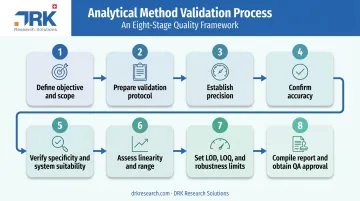
Q2(R1) doesn't require this exact order; some labs run accuracy and precision studies in parallel. But this sequence keeps documentation clean and traceable, which matters just as much as the data itself during an inspection.
Practical Considerations: Applications, Challenges, and Misconceptions
Where Method Validation Is Applied
Validation shows up across nearly every analytical workflow in a pharma lab:
- HPLC assay and impurity methods
- Dissolution testing for solid oral dosage forms
- Identification tests for raw materials and finished product
- Degradation and stability-indicating methods
It also recurs at several points across a product's lifecycle: initial method development, technology transfer between sites, and after post-approval changes to formulation or manufacturing.
Multi-site validation and transfer projects get complicated fast when different labs use different equipment, reagent lots, or even units of measure.
An experienced CRO partner with global laboratory capabilities, such as DRK Research Solutions, adds real value here. DRK coordinates method transfer across sites in the UK, USA, Pakistan, Malaysia, Nepal, and the UAE, keeping results consistent regardless of where testing happens.
Common Misconceptions
A few errors show up repeatedly across sponsor teams:
- Validation vs. verification confusion: assuming a compendial USP method never needs in-house checking. It does, every time, per USP <1226>.
- Robustness mistaken for ruggedness: treating deliberate parameter changes and random day-to-day variation as the same thing, when they're evaluated separately.
- Oversimplified acceptance criteria: copying generic pass/fail limits from another product's protocol instead of setting criteria based on that specific method's risk profile.
When Revalidation Is Required
Revalidation isn't optional guesswork. Common triggers include:
- Transfer of a method to a new manufacturing or testing site
- Major equipment, column, or reagent changes
- Changes to drug substance synthesis or finished product formulation
- Explicit request from a regulatory authority during inspection or submission review
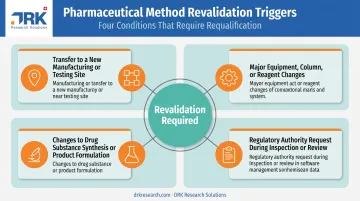
Skipping revalidation after any of these changes is one of the fastest ways to end up explaining an unexplained assay drift to an inspector.
Conclusion
Method validation is a structured, evidence-based process that confirms accuracy, precision, linearity, and every other core parameter against defined acceptance criteria. Nothing more mystical than that.
Applying it correctly matters more than applying it excessively. Over-validating a low-risk method wastes both budget and timeline, while under-validating a high-risk one invites regulatory findings.
For sponsors managing method validation and technology transfer across multiple regulated markets, DRK Research Solutions supports analytical method development designed to meet ICH, USP, and global regulatory standards. Its technology transfer services span process documentation, scale-up studies, and on-site support, helping teams move faster without cutting corners on compliance.
Frequently Asked Questions
What is method validation in pharma?
It's the documented process proving an analytical method reliably produces accurate results for its intended use, following ICH Q2(R1) and USP <1225> requirements. Without it, a method can't support release or stability testing.
What are the 8 steps of method validation?
The eight steps run from defining objectives and preparing the protocol, through precision, accuracy, specificity, linearity, and LOD/LOQ/robustness testing, to a final QA-approved validation report.
What is the FDA guideline for method validation?
FDA's guidance, Analytical Procedures and Methods Validation for Drugs and Biologics, complements ICH Q2(R1) and outlines expectations for validation data supporting drug and biologic submissions.
What are the four types of validation in pharma?
Full validation covers new methods, while partial validation addresses minor modifications. Cross-validation compares two methods or labs, and verification confirms a compendial method works in your specific lab.
What is the difference between method validation and method verification?
Validation applies to new or in-house developed methods with no performance history. Verification confirms an existing compendial or previously validated method performs correctly under your lab's actual conditions.
When should an analytical method be revalidated?
Common triggers include transfer to a new site, major equipment or reagent changes, formulation changes, or a direct request from a regulatory authority during inspection or review.