
Introduction
Freeze drying, or lyophilization, is a low-temperature dehydration process that removes water from a product through sublimation under vacuum, preserving its structure and potency without ever exposing it to damaging heat.
That precision is why this guide targets formulation scientists, R&D leads, and sponsors evaluating drug stability, shelf life, and manufacturing strategy. Getting lyophilization right affects compliance, product quality, and your ability to distribute sensitive therapies globally.
Pharma teams reference lyophilization constantly, but few understand it at the operational level. That gap leads to costly missteps in formulation and scale-up.
Here's what this guide covers: how the process actually works, what variables determine success, where it fits into a product's lifecycle, and when it might not be the right call at all.
Key Takeaways
- Freeze drying removes water via sublimation, protecting heat-sensitive biologics
- Three stages drive the process: freezing, primary drying, and secondary drying
- Injectables, vaccines, and biologics achieve long shelf life without refrigeration
- Freezing rate, chamber pressure, and shelf temperature all determine batch success
- Cost and cycle time mean it is not always the right choice for every product
What Is Freeze Drying (Lyophilization) and Why Is It Used in Pharma?
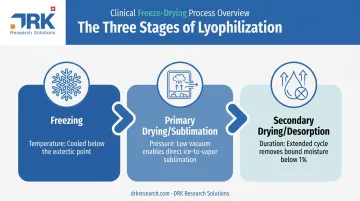
The FDA's own inspection guidance defines lyophilization plainly: water is removed after freezing, under vacuum, so ice converts directly to vapor without ever passing through a liquid phase. This inspection guidance breaks the process into three stages — freezing, primary drying by sublimation, and secondary drying by desorption.
In practical terms, freeze drying converts a liquid or fragile biological product into a stable, porous solid. That solid, often called a "cake," sits at room temperature for months or years and reconstitutes almost instantly when mixed with water before dosing.
How it differs from other drying methods:
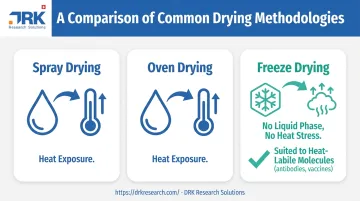
- Spray drying and oven drying rely on heat and often pass through a liquid or semi-liquid phase, both of which stress fragile molecules
- Freeze drying skips the liquid phase entirely, keeping the product frozen until ice sublimates directly to vapor
- This makes it uniquely suited to heat-labile molecules such as monoclonal antibodies and live-attenuated vaccines
That distinction matters because pharma has three non-negotiable demands: consistency, sterility, and long-term stability. Freeze drying addresses all three for biologics, vaccines, and parenteral products that can't tolerate a liquid presentation for years on a shelf.
What typically happens without it:
- Proteins and antibodies in liquid form degrade through aggregation, oxidation, and unfolding, particularly under temperature swings or agitation
- Products become locked into cold-chain logistics, limiting distribution to regions with reliable refrigeration
- Shelf life for sensitive APIs shrinks dramatically, sometimes to weeks instead of years
For temperature-sensitive injectables and biologics, freeze drying has become close to standard practice. Two forces drive that shift equally: regulatory expectations around sterility and potency retention, and the commercial reality that room-temperature storage opens up global distribution.
That's precisely where a CRO partner with formulation development expertise matters. DRK Research Solutions helps sponsors weigh lyophilization against formulation goals early, informing decisions before they commit to a production pathway that's expensive to reverse later.
How the Freeze Drying Process Works (Step-by-Step)
At a high level, the process moves through three stages. Freezing solidifies the product. Primary drying removes ice by sublimation under vacuum. Secondary drying strips out residual moisture bound to internal surfaces, leaving a stable, storable solid.
What goes into the chamber is the formulated product: the active ingredient plus excipients such as bulking agents, cryoprotectants, and stabilizers, filled into vials, syringes, or trays. What comes out is a dry, porous cake that dissolves rapidly on reconstitution.
Every stage is controlled through precise regulation of shelf temperature, chamber pressure, and duration, guided by the product's eutectic point or critical temperature. Push any of those variables too far and you risk collapse, meltback, or a batch that looks dry but isn't.
Step 1: Freezing
The product is cooled below its eutectic or critical point, often through controlled shelf cooling or, for some applications, liquid nitrogen. Formulators typically hold product temperature several degrees below that eutectic point before moving into the next stage.
Freezing rate matters more than it gets credit for. Faster cooling produces smaller ice crystals; slower cooling produces larger ones. That crystal size directly affects:
- How quickly the product reconstitutes later
- How efficiently ice sublimates during primary drying
- The final structure and appearance of the cake
Step 2: Primary Drying (Sublimation)
Chamber pressure drops below the product's triple point, and controlled heat is applied so ice sublimates directly to vapor rather than melting. A condenser captures that vapor and refreezes it, keeping it out of the vacuum system.
This stage typically runs the longest of the three. Research on formulation-specific endpoints shows just how much residual moisture varies at the close of primary drying. A foundational 2010 study on primary drying endpoints found roughly 5 to 10% residual water for crystalline mannitol formulations, compared to 15 to 20% for amorphous systems. In other words, secondary drying still has real work to do.
Step 3: Secondary Drying (Desorption)
Shelf temperature rises while pressure stays low, driving off moisture bound to the product's internal surfaces rather than frozen as ice. This step pushes residual moisture down to a fraction of a percent, typically well under 1%, which is what long-term stability specifications demand.
Once the target moisture level is reached, vials are stoppered under vacuum or inert gas before the chamber is even opened, protecting sterility until the product reaches the patient.
Where Freeze Drying Is Applied and the Key Factors That Affect It
Freeze drying shows up across a range of pharmaceutical dosage forms:
- Injectable vials and prefilled syringes, including dual-chamber syringes that hold lyophilized drug and diluent separately
- Biologics and monoclonal antibodies, reconstituted before IV administration
- Vaccines, including well-established products that still require cold storage before reconstitution
- Blood plasma products, including freeze-dried plasma formulations
- Oral lyophilized wafers and tablets designed to disintegrate rapidly in the mouth
Freeze drying gets built into a product's process design from the start, recurring across the lifecycle rather than functioning as a single, isolated step:
- Early formulation development and feasibility studies — testing whether a molecule tolerates freeze-thaw stress
- Clinical batch manufacturing — refining cycles against a growing dataset
- Scale-up — re-validating lab-scale parameters against production equipment
- Commercial production — prioritizing consistency and throughput
What usually triggers the decision to freeze-dry a product:
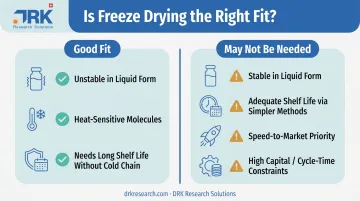
- Instability in liquid form, particularly aggregation or degradation in proteins and peptides
- Sensitivity to heat that rules out conventional drying methods
- A business need for extended shelf life without full cold-chain dependence
Key factors that determine whether a cycle succeeds:
- Formulation inputs — excipients, cryoprotectants, and solute concentration shape ice crystal formation and final cake structure
- Operating conditions — freezing rate, chamber pressure, and the temperature differential between shelf and condenser
- Equipment dependencies — vacuum system capacity, condenser efficiency, and shelf-fluid (commonly silicone oil) performance
- Batch scale and throughput — larger batches introduce variability in drying uniformity across vials
- Regulatory and quality constraints — GMP compliance, sterility assurance, and residual moisture specifications
This is where product development work intersects directly with lyophilization decisions. Lab-scale formulation development, technology transfer to manufacturing partners, and analytical method development all feed into whether a freeze-dried product will hold up at commercial scale.
Common Misconceptions and When Freeze Drying May Not Be the Right Fit
"It's basically just advanced freezing." It isn't. Freeze drying is a precisely engineered, vacuum-based dehydration process that requires deliberate scientific design, not prolonged freezer storage. Skipping that design work is how batches fail.
"A lab-scale cycle can be scaled up directly." This one causes real damage. Chamber geometry, heat transfer, radiation, and condenser resistance all shift between lab and production equipment.
A foundational scale-up study found that after scaling up, total drying time stretched two hours longer in one run; a faster setting shortened drying by five hours but pushed another group of vials past its temperature limit. Every scale-up needs its own re-optimization of freezing rate, pressure, and temperature.
"If it looks dry, it is dry." A cake's appearance says nothing about whether secondary drying actually hit its target. Products can look perfectly formed while still holding excess bound moisture that compromises long-term stability.
When freeze drying isn't the right fit:
- The product is inherently stable in liquid form and doesn't need the added protection
- Simpler preservation methods already deliver adequate shelf life
- Speed-to-market matters more than extreme thermal protection
Real constraints to weigh:
- High capital investment in specialized equipment
- Cycle times running from hours to multiple days
- Operational costs that exceed conventional drying methods
Spray drying or a well-stabilized room-temperature liquid formulation can be the better call when cost sensitivity or timeline pressure outweighs the need for freeze-dry-level protection. The right choice depends on the molecule, not a default assumption.
Conclusion
Freeze drying is a controlled, multi-stage process (freezing, primary drying, secondary drying) engineered to keep sensitive pharmaceutical products stable at room temperature for the long haul.
Understanding the science behind each stage, not just the finished cake, is what separates a successful lyophilized product launch from an expensive formulation failure. Freezing rate, chamber pressure, and drying endpoints need attention from day one, since these choices shape the entire product lifecycle.
These upfront decisions only pay off when freeze drying is the right fit for the product in the first place. Correct application depends on the product's characteristics and the sponsor's business goals, not automatic adoption of the process. Partnering with an experienced CRO/CDMO such as DRK Research Solutions can help sponsors work through formulation development, process optimization, and regulatory compliance for lyophilized products across established and emerging markets alike.
Frequently Asked Questions
What is freeze-drying in pharma?
Freeze-drying, or lyophilization, is a low-temperature dehydration process that removes water from a product through sublimation under vacuum. It's used to stabilize drugs, biologics, and vaccines for long-term storage.
What's the difference between a pharmaceutical freeze dryer and a regular freeze dryer?
Pharmaceutical freeze dryers require sterile, GMP-compliant chambers, automated vial loading and stoppering systems, and validated process controls. Food or lab-scale units don't need to meet those aseptic standards.
How long does the freeze-drying process take?
Cycles range from several hours to multiple days, depending on the product, batch size, and how long primary and secondary drying need to run. Some published formulations take close to four days.
What are the disadvantages of freeze-drying in pharmaceuticals?
It carries high capital and operational costs, long cycle times, and risks of product damage from poorly controlled temperature or pressure. A failed cycle can mean losing an entire batch.
What types of pharmaceutical products are commonly freeze-dried?
Vaccines, monoclonal antibodies, injectable antibiotics, blood plasma products, and other biologics that can't tolerate heat or moisture in liquid form are common candidates.
Can freeze-drying damage a drug product?
Yes. Poor process control can leave the product with a collapsed cake, reduced potency, or reconstitution times so slow they fail stability testing, sometimes forcing rejection of the entire batch.