Parenteral dosage forms have quietly become the backbone of modern medicine, from vaccines to chemotherapy to insulin pens used at kitchen tables every morning. They offer rapid onset, near-complete bioavailability, and a way to deliver biologics and other fragile molecules that oral drugs simply cannot handle. The market reflects this: the global injectable drug-delivery sector was valued at $764.26 billion in 2025 and is projected to reach $1,719.57 billion by 2035, growing at a CAGR of 8.45% through that period, according to Precedence Research.
This article breaks down the main physical forms, the routes of administration, their clinical applications, and what goes into choosing and manufacturing the right parenteral product.
Key Takeaways
- Parenteral forms bypass the GI tract for near-100% bioavailability
- IV, IM, SC, and ID routes differ in onset time, volume, and clinical use
- Intrathecal and intraperitoneal injections serve narrow, high-precision clinical needs
- Drug stability and patient factors, not convention, drive route selection
- Sterility assurance and global regulatory compliance remain non-negotiable throughout development
What Are Parenteral Dosage Forms?
Parenteral dosage forms are sterile pharmaceutical preparations administered by injection or infusion, delivering medication directly into tissue, muscle, or the bloodstream. The word "parenteral" literally means "outside the intestine," distinguishing it from enteral (oral) routes that rely on digestion and absorption through the gut wall.
That distinction matters clinically. Oral drugs pass through the liver before reaching systemic circulation, a process known as first-pass metabolism that can degrade or reduce the active dose. Parenteral routes skip this step. Bioavailability from an IV injection is considered 100% because the drug enters the bloodstream directly, according to NIH StatPearls.
This makes parenteral delivery essential for:
- Emergency situations where seconds matter, such as cardiac arrest or anaphylaxis
- Biologics and peptides, such as monoclonal antibodies, that would be destroyed by stomach acid
- Chronic conditions requiring precise, sustained dosing, like insulin therapy
Common Physical Forms of Parenteral Preparations
Choosing the right route is only half the equation; matching the physical form to the drug's chemistry matters just as much. Not all injectables look the same, and the form selected depends on how the drug needs to behave once inside the body.
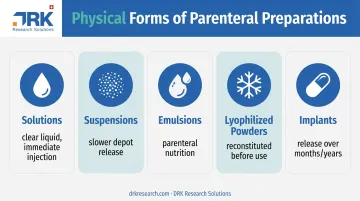
- Solutions: clear liquids like saline or insulin, ready for immediate injection
- Suspensions: solid particles dispersed in liquid, such as corticosteroids, offering slower, depot-style release
- Emulsions: lipid-based formulations used for parenteral nutrition
- Lyophilized powders: freeze-dried preparations reconstituted before use, common for vaccines and peptides that degrade quickly in liquid form
- Implants: solid depots, like contraceptive rods, releasing drug over months or years
Container choice matters just as much as the form itself. Ampoules, vials, prefilled syringes, and infusion bags each affect stability, dosing accuracy, and which route the product can realistically support.
Routes of Parenteral Administration: Types, Differences & Clinical Uses
Route selection depends on desired onset, dose volume, target tissue, and the drug's own properties. Each route produces a distinct pharmacokinetic profile, so the "best" route is really the one matched to the clinical goal.
Intravenous (IV) Route
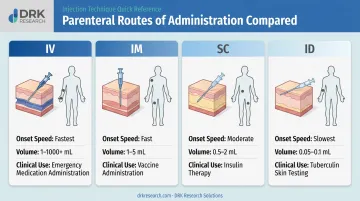
IV administration injects medication directly into a vein, either as a rapid bolus or a continuous infusion. It's the fastest way to get a drug into systemic circulation.
An international audit across 14 hospitals in 13 countries found that 59% of screened patients had at least one peripheral IV catheter in place, with another 16% carrying a different vascular access device, per research published in the Journal of Hospital Medicine. That prevalence reflects just how central IV access has become to routine hospital care.
Best suited for: emergencies, anesthesia, chemotherapy, IV antibiotics, and large-volume fluid or nutritional infusions.
Strengths:
- Fastest onset of any route
- Near-100% bioavailability
- Large-volume support with precise dose titration
Trade-offs: IV access requires trained personnel, carries a higher risk of infection or thrombosis, and effects are hard to reverse quickly once administered.
Intramuscular (IM) Route
IM injections deposit drug into muscle tissue, typically the deltoid, gluteus, or vastus lateralis, using a longer needle for deeper placement. Muscle is more vascular than fat, so aqueous solutions absorb fairly quickly and evenly.
Best suited for: vaccines, depot hormonal therapies, and antibiotics that need gradual, sustained release.
Strengths: IM supports moderate injection volumes and depot formulations, and it's simpler to administer than IV access.
Trade-offs: onset is slower than IV, injection-site pain is common, and poor technique risks nerve or tissue damage.
Subcutaneous (SC) Route
SC injections go into the fatty layer beneath the skin, using a short, thin needle. Absorption happens slowly through capillaries, which is exactly why it works so well for drugs needing steady, predictable release.
Best suited for: insulin, heparin, GLP-1 agonists, and monoclonal antibodies meant for routine self-administration.
Strengths:
- Patient-friendly and compatible with autoinjectors, pens, and wearable injectors
- Lower infection risk compared to IV access
- Ideal for chronic, at-home therapy
Trade-offs: volume is limited, generally around 1.5 mL with some formulations pushing to 4 mL, and it's unsuitable when an immediate effect is required.
Intradermal (ID) Route
ID injections are placed between the epidermis and dermis at a shallow angle, restricted to tiny volumes. The CDC's Mantoux tuberculosis test uses exactly 0.1 mL of PPD solution injected intradermally, a precise standard that illustrates how small these doses are, per CDC guidance.
Best suited for: allergy testing, TB screening, and certain DNA-based vaccines.
Strengths: highly localized, antigen-rich response, ideal for diagnostic reactions rather than systemic treatment.
Trade-offs: requires precise technique, restricted to tiny doses, and isn't used for routine systemic therapy.
Other Specialized Parenteral Routes
A handful of routes exist for narrow, high-stakes clinical scenarios:
- Intrathecal: injected into cerebrospinal fluid for chemotherapy, anesthesia, or chronic pain management
- Intra-articular: corticosteroids injected directly into a joint, offering short-term relief for osteoarthritis
- Intraperitoneal: delivered into the abdominal cavity, used in procedures like heated chemotherapy (HIPEC)
- Intraosseous: needle inserted into bone marrow for emergency access when IV lines fail
These routes demand specialized formulations and highly skilled administration given their elevated risk and precision requirements. Intracardiac injection, once used in emergencies, has fallen out of favor in modern resuscitation guidance, replaced by IV or intraosseous access.
How to Choose the Right Parenteral Route and Dosage Form
The right choice depends on the drug, the patient, and the clinical setting, not on which route a team happens to be most familiar with.
Key factors to weigh:
- Drug properties: stability, molecular size, and viscosity often dictate the route; large biologics frequently need SC or IV delivery since oral absorption isn't feasible
- Desired onset and duration: an emergency calls for IV, while chronic maintenance therapy may favor a sustained-release IM or SC depot
- Patient factors: age, vascular access, ability to self-administer, and comfort all affect compliance
- Dose volume and frequency: small-volume parenterals for a single vaccine dose look very different from large-volume IV fluids given daily
- Manufacturing complexity: cold-chain needs and production cost can shift a formulation decision as much as the pharmacology does
Common Mistakes to Avoid When Selecting a Route
A few recurring missteps show up across development programs:
- Defaulting to IV out of convenience when a less invasive SC or IM route would achieve the same clinical outcome with lower infection risk
- Overlooking stability data early on, risking degradation or incompatibility once a sterilization method is chosen
- Underestimating regulatory and cold-chain costs until late in development, when changes become expensive to implement
That third mistake is the one that catches sponsors off guard most often. Assessing feasibility, stability, sterilization compatibility, cold-chain logistics, and regulatory cost before locking in a formulation strategy is far cheaper than reworking it post-submission. This is precisely where partnering with a CRO experienced in formulation development, analytical method work, and regulatory strategy pays off early in the process.
Manufacturing & Regulatory Considerations for Parenteral Products
Parenterals carry higher manufacturing risk than almost any other dosage form, simply because they bypass the body's natural defenses. A contaminated tablet causes problems; a contaminated injection goes straight into the bloodstream.
That's why parenteral production relies on either aseptic processing or terminal sterilization, carried out in Grade A or B cleanrooms with rigorous container-closure integrity testing. Regulatory frameworks governing this work include:
| Framework | Focus |
|---|---|
| FDA 21 CFR 210/211 | Core US drug CGMP requirements, including sterility validation |
| EU GMP Annex 1 | Cleanroom classification and contamination control |
| ICH Q8–Q10 | Pharmaceutical development, quality risk management, and quality systems |
| USP <71>, <85>, <788> | Sterility, bacterial endotoxin, and particulate matter testing |
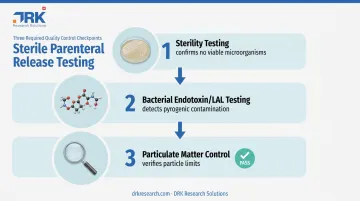
Every batch claiming sterility must pass three release checks:
- Sterility testing confirms no viable microorganisms are present in the final product
- Bacterial endotoxin (LAL) testing detects pyrogenic contamination that could trigger a patient reaction
- Particulate matter control verifies the product meets visible and sub-visible particle limits
Developing a compliant, market-ready parenteral product demands specialized expertise across formulation, analytics, and regulatory strategy simultaneously. DRK Research Solutions supports sponsors through this exact challenge, offering end-to-end formulation development, analytical method development including endotoxin testing, and technology transfer to GMP-compliant manufacturing partners.
Its team also prepares eCTD dossiers and navigates approvals across EU GMP, MHRA, PIC/S, WHO PQ, and US FDA frameworks, including for generics and hybrid parenteral products destined for underserved regulated markets.
Conclusion
Parenteral dosage forms remain indispensable wherever speed and precision matter most, from ICU emergencies and chronic disease management to routine vaccination programs. Different physical forms and routes exist because no single approach fits every drug or every patient.
Understanding these distinctions, from IV infusions to intradermal diagnostics, supports smarter clinical choices and better development decisions. DRK Research Solutions supports sponsors with formulation development and analytical method expertise that turns dosage form science into regulatory-ready products.
Frequently Asked Questions
What are parenteral dosage forms and how do they differ from oral medications?
Parenteral forms are sterile preparations injected or infused to bypass the GI tract, offering rapid, near-complete bioavailability. Oral drugs, by contrast, face variable absorption and first-pass liver metabolism before reaching circulation.
What are the four main routes of parenteral administration?
The four main routes are:
- IV – Directly into a vein for immediate effect
- IM – Into muscle for moderate-speed absorption
- SC – Into fatty tissue for slow, steady release
- ID – Into the dermis for small-volume diagnostic use
Which parenteral route is best for a specific drug or patient?
It depends on the drug's stability and required volume, how quickly onset is needed, and patient factors like whether they can self-administer. The right choice varies by case, guided by these factors rather than a fixed rule.
What are the advantages and disadvantages of parenteral drug delivery?
Advantages include rapid onset and near-complete bioavailability. Disadvantages include higher infection risk, greater cost, and the need for trained personnel or careful patient technique.
What is the difference between small-volume and large-volume parenterals (SVP vs. LVP)?
USP defines LVPs as single-dose injections labeled over 100 mL, typically IV fluids or nutrition. SVPs are 100 mL or less, covering most vaccines, anesthetics, and standard injectables.
How are parenteral dosage forms manufactured to ensure sterility?
Manufacturers use either terminal sterilization or aseptic processing, both within Grade A/B cleanroom environments. Every batch undergoes sterility, endotoxin, and particulate matter testing before release.