The numbers back this up. The global CDMO market hit $136.6 billion in 2024 and is projected to reach $191.6 billion by 2029, growing at a 7.0% CAGR, according to BCC Research's January 2025 market analysis.
But outsourcing carries a real risk: partnering with a manufacturer whose GMP compliance hasn't been properly verified. That gap can trigger regulatory rejection, product recalls, or worse, patient safety failures.
This article breaks down GMP fundamentals, the cGMP regulations under 21 CFR 210/211, how CMOs differ from CDMOs, and what to look for when vetting a compliant manufacturing partner.
Key Takeaways
- The FDA, EMA, and WHO enforce GMP globally to guarantee consistent, safe drug production.
- 21 CFR Parts 210 and 211 anchor US cGMP rules covering personnel, facilities, and documentation.
- CMOs manufacture to a client's existing specs, while CDMOs add development work for smoother commercialization.
- Confirming certifications, inspection history, and a signed quality agreement lowers regulatory risk upfront.
What Is GMP in Pharmaceutical Manufacturing?
Good Manufacturing Practice (GMP) is the system that ensures medicines are consistently produced and controlled to a quality standard appropriate for their intended use. Rather than a single checklist, it's a framework covering everything from raw material sourcing to finished product release.
Regulators around the world enforce this framework, though each brings its own flavor:
- FDA (US) sets minimum requirements for manufacturing methods, facilities, and controls to ensure drug identity, strength, and purity, per the FDA's CGMP regulations overview.
- EMA (EU) coordinates GMP inspections and harmonization across member states.
- WHO applies GMP standards internationally, particularly for products seeking prequalification.
- ICH brings regulators and industry together to harmonize technical requirements globally, including ICH Q7, the harmonized GMP guide for active pharmaceutical ingredients.
GMP vs. cGMP: Why "Current" Matters
The "c" in cGMP isn't decorative. It obligates manufacturers to adopt modern systems and technologies rather than freeze compliance at whatever standard was acceptable a decade ago. A facility that passed inspection in 2015 using outdated data systems won't automatically pass today, regardless of past performance.
Regulators now expect electronic batch records, audit trails, and validated software that leave a permanent, tamper-evident record of every manufacturing step. This is why FDA warning letters increasingly cite data integrity gaps rather than outright production defects. Manufacturers that treat these updates as optional risk falling out of compliance even without changing their core processes.
GMP, GLP, and GCP Are Not Interchangeable
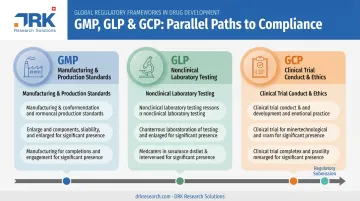
These three frameworks get confused often, but each covers a different stage:
- GMP governs manufacturing and production
- GLP (Good Laboratory Practice) governs nonclinical laboratory testing
- GCP (Good Clinical Practice) oversees clinical trial conduct
Non-compliance carries teeth. FDA inspectors regularly issue Form 483 observations and warning letters tied to GMP violations, and the consequences range from delayed approvals to full product recalls. Facilities that treat inspection readiness as an ongoing discipline, not a once-a-year scramble, fare far better.
Key Principles of GMP in the Pharmaceutical Industry
GMP rests on a handful of core pillars. Miss one, and the whole quality structure weakens.
Quality Management System (QMS). Documented procedures and clear accountability across the entire product lifecycle. FDA's quality-systems model requires the quality unit to have authority to create, monitor, and implement the system, not just rubber-stamp it.
Qualified personnel and ongoing training. Staff need role-specific GMP training, not generic onboarding, and training effectiveness should be documented with retraining triggered whenever gaps appear.
Premises, equipment, and facility design. This covers:
- Cleanroom classifications matched to product sensitivity
- Equipment qualification before first use
- Contamination control measures built into layout, airflow, and workflow
Documentation and data integrity. If it isn't written down, it didn't happen. Data must be Attributable, Legible, Contemporaneous, Original, and Accurate (ALCOA), with UK's MHRA adding Complete, Consistent, Enduring, and Available (ALCOA+).
Process validation and quality control testing. Raw materials get tested on arrival, in-process controls monitor the batch as it's made, and finished products undergo release testing before anything ships.
Deviation management and CAPA. Every deviation needs justification and documentation under 21 CFR 211.100(b), with investigations following under 211.192. Corrective and Preventive Actions (CAPA) close the loop by preventing recurrence, not just fixing the immediate problem.
cGMP Explained: 21 CFR Parts 210 and 211 Requirements
For US drug manufacturers, two regulations form the compliance backbone.
21 CFR Part 210 sets the general scope: minimum cGMP methods, facilities, and controls applicable to manufacturing, processing, packing, or holding any drug product intended to meet safety, identity, strength, quality, and purity standards.
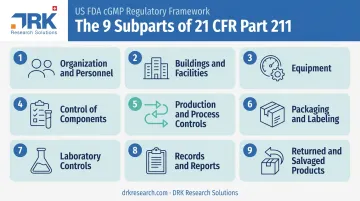
21 CFR Part 211 gets specific. It's broken into subparts covering:
- Organization and personnel
- Buildings and facilities
- Equipment
- Control of components and containers/closures
- Production and process controls
- Packaging and labeling
- Laboratory controls
- Records and reports
- Returned and salvaged drug products
Beyond US Borders: International Equivalents
Companies operating in multiple regions need to track parallel frameworks:
| Region/Body | Framework |
|---|---|
| European Union | EudraLex Volume 4 |
| International (WHO PQ) | WHO GMP |
| Multi-country cooperation | PIC/S Guide (PE 009-17) |
PIC/S publishes updated guidance regularly, with the current Part I and Part II dated August 2023, covering production, quality control, validation, and contract manufacturing arrangements. These parallel frameworks matter most for sponsors running multi-country trials, since gaps in documentation frequently surface during cross-border inspections. Meeting one regulatory standard doesn't guarantee compliance with another.
Audit Readiness Isn't Optional
FDA inspections assess Part 211 compliance through Form 483 observations and, in more serious cases, warning letters. Proactive compliance works best: schedule routine mock audits, maintain documented CAPA trails, and conduct quarterly internal reviews rather than scrambling before an inspector arrives.
CMO vs CDMO: Understanding GMP Contract Manufacturing Models
Not all contract manufacturers offer the same scope of work, and confusing the two can lead to gaps in your development plan.
A CMO (Contract Manufacturing Organization) manufactures drugs according to a client's existing formula and specifications. Its focus sits squarely on production scale-up and packaging. You bring the formula; they bring the facility.
A CDMO (Contract Development and Manufacturing Organization) goes further. It integrates development activities, formulation work, analytical testing, and technology transfer with manufacturing, offering a continuous path from early-stage research to commercial production.
Here's the practical difference:
| Factor | CMO | CDMO |
|---|---|---|
| Formula ownership | Client provides it | Can develop it |
| Analytical support | Limited | Full method development |
| Technology transfer | Client manages | CDMO manages |
| Best fit | Established products | Products still in development |
Whichever model a sponsor chooses, responsibility for cGMP compliance doesn't disappear just because manufacturing is outsourced. The FDA's 2016 Quality Agreements guidance makes this explicit: each party remains accountable for the cGMP activities it performs, and a quality agreement cannot transfer statutory responsibility away from the sponsor.
The owner's quality unit still has to evaluate, qualify, and monitor whatever facility does the work.
Benefits & Criteria for Choosing the Right GMP-Certified CDMO Partner
Key Benefits of Outsourcing to a GMP-Compliant CDMO
Outsourcing to a compliant CDMO isn't just about avoiding headaches. It changes the economics and speed of a program.
- Cost and risk reduction – Skip the capital outlay for facilities and equipment while tapping into specialized regulatory and technical expertise already in place.
- Speed to market – Established GMP infrastructure and pre-validated processes shorten development and approval timelines considerably.
- Multi-regional regulatory access – Valuable for sponsors scaling into markets with different GMP standards, including emerging and underserved regions where local infrastructure may be limited.
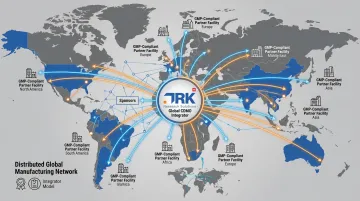
This is where DRK Research Solutions' model illustrates the CDMO approach in action. Rather than owning proprietary manufacturing facilities, DRK operates as an integrator, connecting sponsors to a global network of GMP-compliant partner facilities across Europe, the Middle East, Asia, Africa, and the Americas.
Its CDMO services, introduced in 2022, focus on generics and hybrid product development for regulated markets, spanning:
- Lab-scale formulation development and optimization
- Analytical method development aligned to ICH and USP standards
- Technology transfer with on-site support at manufacturing partners
- Exhibit and commercial batch manufacturing under GMP conditions
- eCTD dossier preparation across Modules 2–5
Because DRK also runs CRO operations for Phase II–IV clinical trials, sponsors can move from clinical development straight into formulation and manufacturing without switching vendors. This continuity cuts down on knowledge-transfer gaps between separate CRO and CDMO teams.
The company positions this integrated structure as a way to shorten development timelines and expand patient access to therapies, particularly across low- and middle-income countries.
What to Look for in a GMP Contract Manufacturing Partner
Before signing anything, run through a short but non-negotiable checklist.
- Verify current certifications. Check FDA registration through DECRS, confirm WHO GMP or EU GMP status through EudraGMDP, and review recent inspection classifications (NAI, VAI, OAI) rather than taking a partner's word for it.
- Assess technical fit. Does the CDMO have real experience with your dosage form? Can it handle your batch volume? Is technology transfer support built into the engagement, or is it an afterthought?
- Insist on a clear quality agreement. Per FDA's recommended framework, it should spell out manufacturing activities, specifications, change control procedures, and who handles inspection communications. Treat a vague or missing agreement as a red flag.
Frequently Asked Questions
What is GMP in pharmaceutical manufacturing?
GMP is a regulatory framework ensuring drugs are consistently produced and controlled to a quality standard suited to their intended use. It's enforced globally by agencies including the FDA, EMA, and WHO.
What are the key principles of GMP in the pharmaceutical industry?
The core pillars include a documented quality management system, trained personnel, validated manufacturing processes, accurate documentation, and properly designed facilities and equipment. Deviation management and CAPA round out the framework.
What are 21 CFR 210 and 211 (cGMP) requirements?
Part 210 defines the general scope of current Good Manufacturing Practice (cGMP) for drug manufacturing, processing, packing, and holding. Part 211 details specific requirements covering personnel, facilities, production controls, and recordkeeping for finished pharmaceuticals.
What is the difference between a CMO and a CDMO?
A CMO manufactures drugs based on a client's existing formula and specs. A CDMO also provides development support, including formulation, analytical testing, and technology transfer, ahead of manufacturing.
Why are quality agreements important in GMP contract manufacturing?
Quality agreements define which cGMP responsibilities belong to the sponsor versus the manufacturer. This reduces compliance gaps and is explicitly recommended in FDA's 2016 guidance on contract manufacturing arrangements.
How can a company verify a GMP contract manufacturer's compliance status?
Check FDA's registration databases and Inspection Classification Database for recent findings. Also request current certification documents, such as WHO GMP or EU GMP certificates, directly from the manufacturer before signing any agreement.