Introduction
Topical drug products, creams, gels, ointments, foams, and patches, sit at an odd intersection in pharma. They look simple on a pharmacy shelf, but formulating one is anything but.
Despite that complexity, the global topical drug-delivery market is on a serious growth trajectory. MarketsandMarkets valued it at USD 268.4 billion in 2025, projecting growth to USD 408.97 billion by 2030 at an 8.8% CAGR. That growth brings more sponsors, more generics, and more competition into a formulation category that's notoriously hard to get right.
The core challenge? Balancing skin permeation, physical and chemical stability, and shifting regulatory expectations, all while sponsors push for shorter timelines. This guide walks through the development stages, PK considerations, stability safeguards, and regulatory strategy needed to bring a topical product to market. We'll also touch on why experienced CRO/CDMO partners can reduce risk across the entire journey.
Key Takeaways
- Topical development requires balancing skin permeation, formulation stability, and region-specific regulatory rules
- Early IVRT/IVPT testing catches problems before they become costly, late-stage failures
- Physical and chemical stability must be built in early, since topical products face greater environmental stress
- Regulatory pathways such as FDA's SUPAC-SS and EMA's equivalence guidelines vary by market, making global partners valuable for generics
What Are Topical Drug Products?
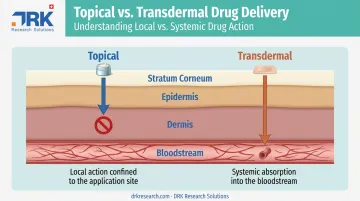
Topical drug products are semi-solid or solid dosage forms applied directly to the skin or mucous membranes. Some act locally at the application site; others are designed to cross into systemic circulation.
The FDA draws a formal line here: topical administration targets a specific spot on the outer body surface, while transdermal administration moves through the dermis into the bloodstream.
Common dosage forms include:
- Creams and lotions
- Gels and foams
- Ointments and pastes
- Transdermal patches
- Topical solutions and sprays
The distinction matters because it shapes almost every formulation decision that follows, from vehicle choice to permeation enhancer strategy.
Real-world examples make this concrete:
| Product | Primary Use | Action Type |
|---|---|---|
| Diclofenac sodium gel (Voltaren Gel) | Osteoarthritis pain in joints like knees and hands | Local |
| Minoxidil 2% solution | Hair regrowth on the scalp | Local |
| Hydrocortisone cream | Corticosteroid-responsive inflammatory skin conditions | Local |
Each of these succeeded commercially because its formulation team solved the permeation-versus-safety puzzle for that specific molecule and indication.
The Main Stages of Topical Drug Product Development
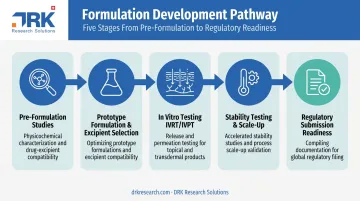
Topical development follows a structured, iterative path, not a straight line. Skip a stage or rush through it, and you risk discovering a formulation flaw during stability testing or, worse, after filing. Each phase generates data that the next phase depends on.
Pre-Formulation Studies
Before selecting a vehicle, teams need to fully characterize the API. That means mapping out:
- Solubility across candidate solvents
- Ionization state relative to skin pH
- Hygroscopicity and moisture sensitivity
- Photosensitivity and degradation risk
This stage decides whether penetration enhancers or specialized excipients will be necessary later. Get it wrong here, and you'll be reformulating months down the line.
Prototype Formulation & Excipient Selection
Teams typically build several prototype formulations (gels, emulsions, ointments) to compare vehicles and excipient combinations side by side. Two factors drive these choices simultaneously:
- Target site of action - surface, epidermis, dermis, or systemic circulation
- Sensory attributes - spreadability, residue, and skin feel, which affect patient adherence
A formulation that performs beautifully in the lab but feels greasy or tacky on skin often fails in the real world regardless of its release profile.
In Vitro Testing (IVRT & IVPT)
IVRT (In Vitro Release Testing) measures how fast a drug releases from its formulation. IVPT (In Vitro Permeation Testing) measures how much of that drug actually penetrates skin layers. Together, they're two of the most valuable early checkpoints in the whole process.
Regulators have increasingly leaned on this data. FDA's 2022 draft guidance recommends IVPT studies comparing generic topical products against their reference standard to support ANDA bioequivalence, covering creams, ointments, lotions, gels, and mucosal products. That's a meaningful shift, since it reduces reliance on large, costly clinical endpoint trials for many generic and 505(b)(2) topical products.
Stability Testing & Scale-Up
Formulations that clear in vitro testing move into ICH-condition stability testing, evaluating temperature, humidity, and light exposure over time. This runs alongside early feasibility work for commercial-scale manufacturing.
Batch reproducibility and equipment selection often surface scale-up challenges invisible at lab scale. A gel that mixes perfectly in a 2-liter beaker can behave completely differently in a 500-liter tank: shear forces, mixing times, and cooling rates all change the picture.
Regulatory Submission Readiness
Everything gathered across the prior stages (release and permeation data, stability results, safety findings) feeds directly into the regulatory filing. Whether that's an NDA, ANDA, or an international equivalent depends on the product's pathway, but the underlying data package looks remarkably similar across markets.
Best Practices for Optimizing Pharmacokinetics & Skin Permeation
The stratum corneum is the outermost layer of skin, and it's the primary barrier standing between your formulation and its target. Vehicle composition and excipient choice are the two biggest levers formulators have for controlling how much drug gets through, and how fast.
Three molecular properties determine permeation potential:
- Molecular size - permeation generally favors molecules under 500 Da
- Lipophilicity/hydrophilicity balance - too lipophilic traps the drug in the stratum corneum; too hydrophilic prevents partitioning into skin lipids
- Ionization state - non-ionized molecules permeate far more readily than charged ones
When natural permeability falls short, chemical penetration enhancers can help by modifying the stratum corneum's structure. But enhancers aren't a universal fix. They need to be matched to the API's chemistry and the product's therapeutic goal.
Application site and skin condition variability deserve early attention too. Broken skin absorbs differently than intact skin, and that difference can swing both efficacy and safety margins substantially. Testing across these conditions early avoids surprises during clinical or regulatory review.
Real-World Example: Topical Diclofenac
Voltaren Gel, dosed at 4 g four times daily to one knee, produced systemic diclofenac exposure averaging just 6% of oral treatment levels. Average total systemic exposure was 17 times lower than oral dosing, with peak plasma concentration 158 times lower.
Separate placebo-controlled studies in knee and hand osteoarthritis showed meaningfully lower pain scores with the gel. This illustrates the core objective: preserve local efficacy while sharply limiting systemic exposure.
Because the topical drug delivery market keeps expanding, PK optimization isn't a one-off task; it needs revisiting whenever the formulation changes. Partnering with experienced formulation scientists early, whether in-house or through a CRO, helps surface these trade-offs before they appear in clinical testing.
Ensuring Physical & Chemical Stability Throughout Shelf Life
Topical products face more environmental exposure than oral tablets or injectables ever will. They sit in bathroom cabinets, get exposed to light every time the cap comes off, and cycle through temperature swings that a sealed vial never sees. Stability has to be engineered in from day one.
Physical stability challenges are common in semi-solid, heterogeneous vehicles:
- Phase separation between oil and water components
- Crystallization of the active ingredient during storage
- Viscosity drift, thickening or thinning over time
Emulsifiers and thickeners are the primary tools for controlling these issues, but their concentrations need testing across the full shelf-life window, not just at time zero.
Chemical stability protects against a different set of threats: oxidation, hydrolysis, and photodegradation. Antioxidants, preservatives, and appropriately opaque or barrier packaging all play a role here.
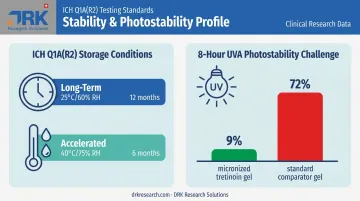
ICH Q1A(R2) provides the framework most sponsors use to set shelf-life claims, requiring at least three primary batches tested in the actual market container-closure system:
- Long-term testing: 25°C/60% RH (or 30°C/65% RH) for 12 months
- Accelerated testing: 40°C/75% RH for six months
Partnering with an analytical development team, like DRK Research Solutions' formulation group, lets sponsors build these protocols into method validation early, avoiding costly rework later.
Photolabile actives illustrate why packaging strategy matters so much. Published photostability data on tretinoin gels found that under an eight-hour UVA challenge, one micronized formulation lost just 9% of active content, versus 72% for a standard comparator gel. That gap reflects formulation and packaging choices working together to slow degradation, not the molecule alone.
Regulatory Pathways and Choosing the Right Development Partner
Regulatory expectations for topical products vary significantly by region, and that variance is exactly where timelines get lost.
Key frameworks sponsors need to navigate:
- FDA SUPAC-SS - governs scale-up and post-approval changes for nonsterile semisolid dosage forms in the US
- EMA's quality/equivalence guideline - a 2024 framework for locally applied, locally acting cutaneous products in the EU
- ICH Q1A/Q1B - the shared stability backbone referenced across most major markets
Bioequivalence requirements for topical generics have traditionally been slow and expensive. A 2024 peer-reviewed review found that comparative clinical BE trials for complex topical generics usually require more than 500 subjects, a burden regulators are actively trying to reduce.
That's part of why IVPT-based pathways have gained traction. They're faster and more cost-effective, though limited to drugs that permeate skin quickly enough to generate a usable profile.
Add multiple markets, such as the US, EU, Middle East, Asia, and Africa, each with its own documentation expectations. It's easy to see why sponsors increasingly lean on partners with proven regional regulatory proficiency.
This is where DRK Research Solutions fits into the picture. As an integrated CRO/CDMO specializing in generics and hybrid product development, DRK operates across Europe, the Middle East, Asia, Africa, and the Americas.
The company pairs formulation development with technology transfer to GMP-compliant manufacturing partners, alongside eCTD dossier preparation aligned to ICH and regional standards. For sponsors juggling multiple regulatory jurisdictions on a single topical program, that kind of coordinated, multi-region support can meaningfully shorten the path from formulation to filing.
Frequently Asked Questions
What is topical drug product development?
It's the multi-stage process of formulating, testing, and gaining regulatory approval for a drug applied to skin or mucous membranes. The goal is achieving a local or systemic therapeutic effect safely and reliably.
What are the main stages of topical drug product development?
The core stages are pre-formulation, prototype formulation and excipient selection, in vitro testing (IVRT/IVPT), stability testing with scale-up, and regulatory submission readiness. Each stage feeds data into the next.
What are topical drug products?
They're semi-solid or solid dosage forms—such as creams, gels, ointments, and patches—applied to skin or mucous membranes for local or systemic therapeutic effect. Common examples include pain-relief gels and anti-inflammatory creams.
What are some examples of topical drugs?
Diclofenac gel treats osteoarthritis pain, minoxidil solution promotes hair regrowth, and hydrocortisone cream reduces inflammation from corticosteroid-responsive skin conditions. All three act locally at the application site.
How long does topical drug product development typically take?
Timelines vary widely based on whether it's a generic, a 505(b)(2), or a novel molecule. In vitro testing pathways like IVPT can shorten timelines considerably compared to relying on full clinical bioequivalence trials.
What regulatory guidelines apply to topical drug products?
FDA's SUPAC-SS governs semisolid generic scale-up and post-approval changes, while EMA's quality/equivalence guidance covers cutaneous products in the EU. ICH Q1A and Q1B set the shared stability testing framework across both regions.