Introduction
Insulin. Monoclonal antibodies. mRNA vaccines. Oncology biologics. None of these life-saving medicines can be swallowed as a pill. Stomach acid and liver enzymes would destroy them before they ever reached a patient's bloodstream, so injection is the only route that works.
That's why injectable dosage forms sit at the center of modern drug development. The global injectable drug-delivery market was valued at $756.22 billion in 2025 and is projected to climb toward $1.72 trillion by 2034. Biologics, cell and gene therapies, and stricter sterility standards are driving much of that growth.
Picking the wrong format can delay approval, drive up costs, or compromise drug stability. This article breaks down the main types of injectable dosage forms, how they differ, and how pharmaceutical companies decide which one fits their product.
Key Takeaways
- Injectable dosage forms are sterile preparations that bypass the digestive system.
- Biologics, vaccines, and unstable APIs often have no viable oral alternative.
- Four main types exist: solutions, suspensions, emulsions, and lyophilized powders.
- The right choice depends on API stability, dosing needs, and manufacturing complexity.
- CRO/CDMO partners help sponsors navigate formulation and regulatory hurdles with proven expertise.
What Are Injectable Dosage Forms and Why They Matter
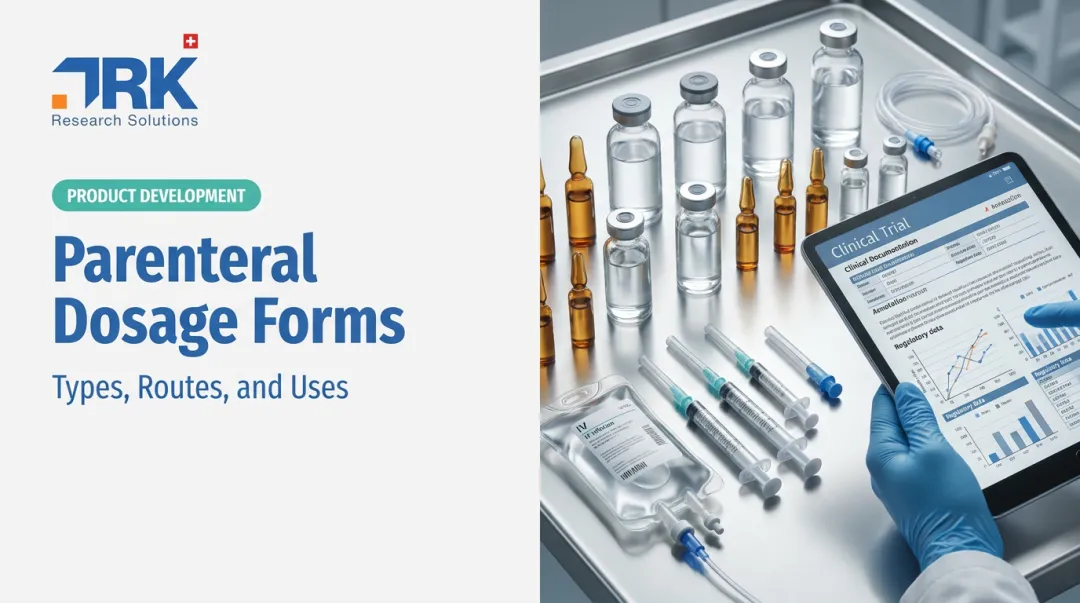
Injectable (parenteral) dosage forms are sterile preparations administered via needle, syringe, or infusion set. Unlike oral tablets or capsules, they're formulated to bypass the digestive system and enter tissue or the bloodstream directly.
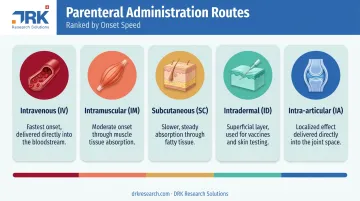
Route selection isn't arbitrary. It shapes how fast a drug acts and how long its effect lasts:
- Intravenous (IV): Direct bloodstream delivery, fastest onset
- Intramuscular (IM): Absorbed through muscle tissue, moderate onset
- Subcutaneous (SC): Injected under the skin, slower and steadier absorption
- Intradermal (ID): Delivered into the skin layer, used for vaccines and skin tests
- Intra-articular: Injected directly into a joint space, for localized effect
Why Injectable Dosage Forms Are Critical in Drug Development
Many of today's most important therapies simply can't survive a trip through the gut. Peptides, oligonucleotides, monoclonal antibodies, and cell and gene therapies would be broken down by digestive enzymes long before reaching their target. Injection is the only route that keeps them intact.
The numbers back this up. A peer-reviewed study found that roughly 81% of FDA-approved biologics are delivered by intravenous or subcutaneous injection combined, with IV accounting for about 45% and SC about 36%.
Without rigorous formulation and sterility standards, injectable products carry serious risks:
- Microbial contamination and infection
- Dosing inconsistency from poor particle control or degradation
- Endotoxin contamination triggering fever or worse
- Regulatory rejection during inspection or review
Building safe, stable injectables takes specialized expertise. DRK Research Solutions supports pharmaceutical and biopharmaceutical companies with formulation development, alongside generics and hybrid product development, for regulated markets, helping sponsors move from early-stage design toward submission-ready dossiers.
Types of Injectable Dosage Forms
Injectable dosage forms aren't one-size-fits-all. Depending on the API's chemical and physical properties, a product might take the form of a solution, a suspension, an emulsion, or a dry powder. Each format addresses a different combination of stability, release rate, and ease of administration.
Injectable Solutions
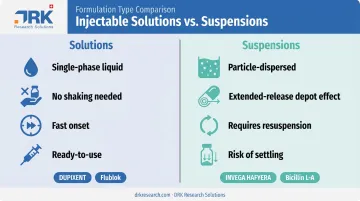
An injectable solution is a drug fully dissolved in an aqueous or non-aqueous vehicle, creating a single-phase, ready-to-use liquid. There are no particles or separate layers, so no shaking or reconstitution is needed before use.
Best suited for:
- Chemically stable small-molecule APIs like insulin
- Biologics and vaccines that need a ready-to-use format
- Products for prefilled syringes, autoinjectors, or emergency-use situations
DUPIXENT, a monoclonal antibody, ships as a clear, preservative-free solution in a prefilled syringe, no mixing required. Flublok, a recombinant flu vaccine, works the same way in a 0.5 mL prefilled syringe.
Solutions offer the simplest manufacturing process and fastest onset. Their main limitation: they don't work for APIs that are chemically unstable in water, and multi-dose vials often need preservatives that add formulation complexity.
Injectable Suspensions
A suspension disperses solid drug particles in a liquid rather than dissolving them, creating a heterogeneous system. Particle size and vehicle viscosity, not solubility, control how the drug releases.
Best suited for:
- Poorly water-soluble drugs requiring particle dispersion
- Depot formulations like corticosteroids or long-acting antibiotics
- Situations needing prolonged effect with fewer doses
INVEGA HAFYERA, an antipsychotic suspension, only needs dosing once every six months after patients are stabilized. Bicillin L-A, a penicillin suspension, can deliver weeks of coverage from a single IM injection.
The trade-off is real: suspensions risk particle settling, caking, or needle clogging, and require tighter quality control around particle size and resuspendability.
Injectable Emulsions
Emulsions combine two immiscible liquids, typically oil-in-water, stabilized by an emulsifying agent. They're the least common injectable form because droplet stabilization is harder to control than solubility or particle dispersion.
Best suited for:
- Lipophilic APIs such as propofol and other oil-soluble anesthetics
- Lipid-based parenteral nutrition products
- Formulations that need oil-in-water stabilization for IV compatibility
DIPRIVAN, the branded propofol emulsion, uses soybean oil and egg phospholipids to carry the anesthetic into an IV-compatible form. Strict droplet control matters here: USP <729> requires a mean globule size of no more than 500 nanometers, with fat globules larger than 5 microns capped at just 0.05% by volume. Oversized droplets can lodge in pulmonary capillaries, creating an embolism risk.
Powders for Reconstitution (Lyophilized Products)
Lyophilized powders are dry, freeze-dried solids that get mixed with a diluent immediately before injection. Unlike solutions, they require an extra reconstitution step at the point of care.
Best suited for:
- Heat- or moisture-sensitive biologics and peptides
- Vaccines that need extended shelf-life stability
- Markets with limited cold-chain infrastructure
HERCEPTIN, the trastuzumab biologic, ships as a lyophilized powder and gets reconstituted to a 21 mg/mL solution before IV infusion. This format buys significant shelf-life protection, which matters more than most people realize. A systematic review of 45 studies found that vaccines were exposed to below-recommended storage temperatures in roughly 33% of observations in wealthier countries and 37.1% in lower-income countries.
The downside is added cost and complexity from validating a lyophilization cycle, plus the risk of reconstitution errors at the bedside.
How to Choose the Right Type of Injectable Dosage Form
Choosing the right dosage form means matching the API's properties, the intended patients, and the commercial goals for the product, not simply picking whichever technology sounds most advanced.
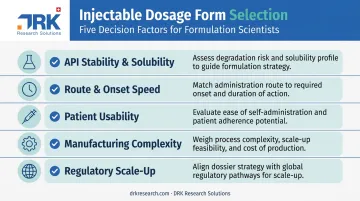
Factors to Consider
- API stability and solubility: Can the drug stay stable in water, or does it need lyophilization or suspension to preserve potency?
- Route and onset speed: Fast-acting IV solutions versus depot IM/SC suspensions for sustained release over days or weeks
- Patient usability: Self-administered autoinjectors versus clinic-administered depot injections for supervised settings
- Manufacturing complexity: Straightforward aseptic fill-finish versus a validated lyophilization cycle, which adds cost and time
- Regulatory scale-up: Sterility assurance and alignment with regulations across every target market, from FDA to WHO PQ
Weighing these factors early prevents costly redesigns later in development.
What to Check Before Finalizing Your Injectable Dosage Form
A few common missteps derail projects before they reach the clinic:
- Defaulting to lyophilization when a simpler, stable solution would meet the product's needs just as well
- Overlooking cold-chain limits in target markets, especially emerging or underserved regions
- Ignoring device compatibility with vials, syringes, cartridges, or autoinjectors until late in development, forcing costly redesigns
Working with an experienced CRO partner early can help validate these decisions before they become expensive to reverse. DRK Research Solutions' global network spans Europe, the Middle East, Asia, Africa, and the Americas, giving sponsors formulation development expertise across both regulated and emerging markets as they finalize their chosen dosage form.
Conclusion
Injectable dosage forms remain indispensable to modern medicine. They deliver drugs that oral administration simply can't handle safely or effectively.
Solutions, suspensions, emulsions, and lyophilized powders each solve a different formulation problem, whether that's fast onset, extended release, lipid solubility, or long-term stability. Understanding these differences, and partnering with a formulation development team like DRK Research Solutions that has navigated them before, leads to safer, more effective drug products with fewer delays getting to market.
Frequently Asked Questions
What is the difference between an injectable solution and an injectable suspension?
A solution is a fully dissolved, single-phase liquid ready for immediate use. A suspension contains undissolved drug particles dispersed in liquid, often used specifically for extended-release effects.
Why do some injectable drugs need to be freeze-dried (lyophilized)?
Lyophilization removes water to protect chemically or thermally unstable drugs, such as biologics and vaccines. This extends shelf life until the product is reconstituted right before use.
What are the main routes of administration for injectable dosage forms?
The main routes are intravenous, intramuscular, subcutaneous, intradermal, and intra-articular. Each route is selected based on how quickly the drug needs to act and how long the effect should last.
Are all injectable dosage forms sterile?
Yes. Every injectable dosage form must be sterile and free of pyrogens, since these products bypass the body's natural microbial defenses like skin and stomach acid.
How is an injectable dosage form different from an infusion?
An injection delivers a discrete dose via syringe, typically in seconds or minutes. An infusion administers a larger volume gradually over time through a catheter, often for extended or continuous treatment.
What determines whether a drug is developed as a small-volume or large-volume parenteral product?
This depends on required dose volume and clinical use. Small-volume parenterals are packaged at 100 mL or less for typical injections, while large-volume parenterals exceed 100 mL for IV fluids and infusions.