The formulator's challenge hasn't gotten any easier. Sponsors need rapid, consistent, and bioequivalent drug release that satisfies strict dissolution standards, batch after batch. Get the disintegrant blend wrong, or overlook a particle-size specification, and an otherwise sound molecule can fail dissolution testing.
This article breaks down the science behind IR formulations, the regulatory framework that governs them, and where they fit in clinical practice. We'll also look at where CDMO partnerships help sponsors move faster without cutting corners on compliance.
Key Takeaways
- Rapid-dissolution benchmarks (≥85% within 30 minutes) stem from ICH M9 and USP
<711>, not one universal FDA rule - Superdisintegrants and granulation choices directly determine disintegration speed and manufacturability
- BCS classification tells formulators whether dissolution or permeability is the real bottleneck
- IR products dominate pain relief, allergic emergencies, and cardiovascular rescue therapy
- Biowaivers and SUPAC-IR filings demand specialized regulatory know-how, which is where CRO expertise pays off
What Are Immediate Release Dosage Forms?
Definition and Regulatory Threshold
IR products are designed to release their active ingredient quickly, with no deliberate delay or prolongation. The regulatory picture, though, is more layered than a single number suggests.
FDA's 2018 guidance on high-solubility drug substances sets Q = 80% dissolved within 30 minutes as the routine quality-control benchmark for swallowed IR tablets and capsules (FDA, 2018). Under USP General Chapter <711>, individual units in the first testing stage must reach at least Q+5%, which works out to 85% when Q equals 80%.
Separately, ICH M9 uses an ≥85% within 30 minutes criterion specifically for comparing BCS Class I products during biowaiver assessments. These are related but distinct frameworks, each tied to a different regulatory decision.
Why this matters: the threshold you're designing against depends on whether you're running routine batch release testing, pursuing a biowaiver, or documenting a post-approval change.
BCS classification adds another layer:
| Class | Solubility | Permeability | Rate-limiting step |
|---|---|---|---|
| I | High | High | Neither dissolution nor permeability |
| II | Low | High | Dissolution/solubility |
| III | High | Low | Permeability |
| IV | Low | Low | Both |
A high-solubility drug is one where the highest single dose dissolves in 250 mL or less across pH 1.2–6.8. Knowing your class early tells you whether formulation effort should go toward faster dissolution or better permeability enhancement.
Key Characteristics of IR Formulations
IR products share a few defining traits:
- Rapid GI dissolution with minimal engineered delay
- Predictable pharmacokinetics, meaning consistent peak concentration and time-to-peak
- Batch-to-batch bioavailability consistency, verified through dissolution testing
Common IR forms include:
- Conventional tablets and capsules — the workhorses of oral IR delivery, swallowed whole
- Orally disintegrating tablets (ODTs): disintegrate on the tongue within about 30 seconds, easing dosing for pediatric patients and those with swallowing difficulty
- Oral solutions skip the disintegration step entirely, since they're already dissolved, and follow different testing rules than solid IR forms
Compare this to modified or extended-release (MR/ER) products, which deliberately slow release to maintain steady blood levels over hours. IR chases fast symptom relief; MR/ER chases sustained control. We'll return to that comparison later.
The Science Behind Rapid Drug Release
Disintegration and Dissolution Mechanisms
Getting a tablet from solid to dissolved drug happens in a sequence: wetting, disintegration, particle dissolution, then permeation across the gut wall. A 2017 pharmaceutical review identified the primary mechanisms driving tablet breakdown (Markl and Zeitler, 2017):
- Wicking — liquid penetrates the tablet's pores through capillary action, often the first and rate-determining step
- Swelling — particles absorb water, expand, and generate internal pressure that pulls the compact apart
- Deformation recovery — particles compressed during tableting spring back once wetted, breaking particle-to-particle bonds
- Fluid-particle force amplification — disintegrants can strengthen the mechanical push needed to separate bonded particles
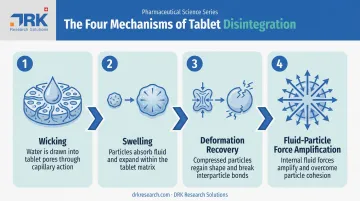
One older idea, the "burst effect" caused by trapped air expanding on contact with warm fluid, no longer holds up as a general explanation. Formulators should design around the four mechanisms above rather than that outdated theory.
Role of Superdisintegrants
Superdisintegrants are the excipients doing most of the heavy lifting:
| Excipient | Mechanism | Watch-out |
|---|---|---|
| Croscarmellose sodium | Rapid swelling combined with wicking | Can partially gel and slow disintegration at high concentrations |
| Sodium starch glycolate | Fast water uptake and pronounced swelling | May form a viscous barrier if overused |
| Crospovidone | Strong capillary wicking with minimal swelling | Sensitive to compression pressure and lubricant type |
Granulation method matters just as much as excipient choice:
- Direct compression blends API and excipients before compressing directly. It's the simplest route for good-flow, moisture-sensitive materials, though broad particle-size distributions raise segregation risk.
- Wet granulation improves flow and content uniformity but adds drying and sieving steps, along with extra time and cost.
- Continuous granulation, including twin-screw processing, is gaining traction for tighter process control, as shown in a 2025 study using a three-zone twin-screw setup for quetiapine IR tablets.
Formulation and Manufacturing Considerations
Three variables typically decide whether an IR product will pass dissolution testing:
- API solubility — poorly soluble drugs may need particle-size reduction or solubility enhancers
- Particle size distribution — affects both dissolution rate and blend uniformity
- Excipient compatibility — incompatibilities can alter disintegration time or cause stability failures
Consistent CMC execution during scale-up is where many programs stumble. A formulation that dissolves perfectly at bench scale can behave differently once compression speed, batch size, or equipment changes.
This is where scientific oversight from an experienced development partner adds real value, catching scale-up risks before they surface in a failed dissolution batch.
Advantages and Clinical Applications of IR Dosage Forms
IR formulations offer a specific set of advantages that keep them in high demand:
- Rapid onset of action — no engineered delay between administration and drug availability
- Dosing flexibility — easier to titrate doses up or down compared to controlled-release matrices
- Manufacturing cost-effectiveness — simpler processes, often direct compression, reduce production complexity
- Broad API compatibility — works across a wide range of solubility and permeability profiles
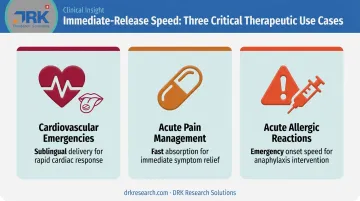
Several therapeutic areas depend on this speed:
- Cardiovascular emergencies: sublingual nitroglycerin tablets carry a Class I recommendation for immediate angina relief
- Acute pain management: recent FDA approvals of oral non-opioid tablets for moderate-to-severe acute pain rely on fast absorption to control symptoms quickly
- Acute allergic reactions and infectious disease: rapid-acting oral formulations remain first-line where treatment can't wait
Speed of onset solves one problem, but dosing frequency raises another: patient compliance. The picture here is more nuanced than marketing copy often suggests.
A meta-analysis across oral therapies found once-daily dosing produced meaningfully better adherence than more-frequent regimens, with an odds ratio of 3.07 favoring once-daily dosing (Srivastava et al., 2013).
Many IR products require multiple daily doses because of their shorter half-lives. This is a genuine trade-off formulators should weigh against the benefit of rapid onset, not a point in IR's favor by default.
Regulatory and Quality Standards for IR Products
Dissolution Testing Requirements
Dissolution testing hinges on apparatus choice and specification design:
| Apparatus | Typical Speed | Volume |
|---|---|---|
| USP Apparatus 1 (basket) | 50–100 rpm | Standard vessel |
| USP Apparatus 2 (paddle) | 50–75 rpm | 500, 900, or 1000 mL |
Specification type follows BCS class. Rapidly dissolving BCS Class I and III products often use a single-point specification, such as not-less-than 85% within 60 minutes.
Slowly dissolving BCS Class II products typically need a two-point specification instead, capturing an early time point (around 15 minutes) plus a later confirmation point to demonstrate the full dissolution profile rather than a single snapshot.
Biowaivers and SUPAC-IR
Dissolution profile comparisons can reduce the burden of in vivo testing. The similarity factor (f2), ranging from 50 to 100, indicates comparable dissolution profiles between test and reference products. Draft ICH M13B guidance builds on this for additional-strength biowaivers, requiring proportional formulations and similarity testing across three pH conditions once in vivo bioequivalence is established for at least one strength.
SUPAC-IR guidance governs post-approval changes, covering:
- Component or composition changes
- Manufacturing site transfers
- Batch scale adjustments
- Equipment or process modifications
Each change level carries different documentation, dissolution, and sometimes in vivo bioequivalence requirements.
Partnering for Regulatory and Development Success
Navigating BCS-based dissolution specifications, biowaiver strategy, and multi-region regulatory submissions demands more than a single discipline. It requires coordinated scientific and regulatory input across formulation, analytical, and dossier teams.
DRK Research Solutions supports sponsors through this exact intersection. Our CDMO capabilities cover generics and hybrid IR product development for regulated markets, backed by regulatory consultants experienced across EU GMP, MHRA, PIC/S, WHO PQ, and US FDA frameworks.
From lab-scale formulation development through eCTD dossier preparation for Modules 2–5, the goal stays consistent: help sponsors move IR products through development without sacrificing GxP compliance along the way.

Immediate Release vs. Modified Release: Choosing the Right Approach
IR and modified/extended-release (MR/ER) formulations solve different clinical problems.
| Factor | Immediate Release | Modified/Extended Release |
|---|---|---|
| Release profile | Fast, no engineered delay | Prolonged, controlled input |
| PK curve | Sharper peaks and troughs | Flatter, more sustained levels |
| Dosing frequency | Often multiple times daily | Once or twice daily possible |
| Best fit | Acute, fast-relief conditions | Chronic maintenance therapy |
| Main trade-off | Adherence burden from frequent dosing | Slower dose titration, dose-dumping risk if formulation fails |
Clinical scenarios generally sort themselves: acute pain, breakthrough symptoms, and emergency situations favor IR. Chronic conditions requiring steady drug exposure, like hypertension or epilepsy management, tend to favor MR/ER.
A growing number of programs don't pick one or the other. Hybrid dosage forms combine an immediate-release component for fast symptom control with a modified-release layer for sustained coverage.
Building these combination products successfully requires:
- Formulation expertise spanning both release mechanisms
- Rigorous testing to prevent dose-dumping in the modified-release layer
- Analytical methods capable of distinguishing each release phase during dissolution testing
That complexity is why many sponsors partner with CDMOs that have hybrid product development experience rather than building the capability in-house.
Frequently Asked Questions
What is the difference between immediate release and extended-release dosage forms?
IR forms release the drug quickly for fast therapeutic effect, typically within 30–60 minutes. Extended-release forms control release over several hours, supporting sustained action and less frequent dosing.
What dissolution rate qualifies a drug as "immediate release"?
The commonly cited benchmark is Q = 80% dissolved within 30 minutes under FDA's high-solubility guidance, equal to an 85% threshold under USP General Chapter 711. ICH M9 applies a similar ≥85% standard for BCS Class I biowaiver comparisons.
What are superdisintegrants and why are they used in IR tablets?
Superdisintegrants like crospovidone, croscarmellose sodium, and sodium starch glycolate accelerate tablet breakdown through wicking, swelling, or both. They're essential for hitting rapid dissolution targets in solid IR products.
How does the Biopharmaceutics Classification System (BCS) affect IR formulation development?
BCS class identifies whether dissolution or permeability limits drug absorption. Class II drugs need dissolution-focused formulation strategies, while Class III drugs need permeability solutions, guiding both formulation design and dissolution testing approach.
Can immediate release drugs be developed as generics?
Yes, generic IR products are common and represent a large share of marketed oral solids. Approval requires dissolution profile comparisons and, in most cases, bioequivalence data matching the reference listed drug.
What is a biowaiver and how does it apply to IR products?
A biowaiver lets sponsors skip additional in vivo bioequivalence testing for certain lower-strength IR products, based on acceptable dissolution similarity (f2) comparisons to an already-approved strength. It reduces study burden without compromising regulatory rigor.