Introduction
Every drug approval decision, batch release, and stability claim rests on one thing: an analytical method that produces accurate, reproducible results a regulator can trust. Get that wrong, and the consequences ripple through an entire program.
Many sponsors don't grasp how much rides on method development until a validation fails or an inspector flags a method as inadequate. In a 2025 warning letter, FDA cited an API manufacturer for impurity methods that couldn't be shown equivalent to compendial standards. The fallout included reserve-sample retesting, an import alert, and the threat of withheld approvals.
This guide breaks down what method development actually involves, the tools and techniques analysts rely on, and the step-by-step process for building a defensible method. It also covers the compliance framework, including ICH Q14, that governs the process worldwide.
Key Takeaways
- Method development designs and refines the procedure; validation confirms it performs consistently
- Four core categories: separation/quantitation, spectroscopic, physical characterization, and biological/bioanalytical
- ICH Q14 adds a risk-based framework for method development, complementing ICH Q2(R2) validation
- Phase-appropriate, structured development cuts rework and speeds regulatory review
- Partnering with a multi-market CRO/CDMO accelerates development while preserving compliance
What Is Method Development in Pharma?
Analytical method development is the systematic process of designing, optimizing, and finalizing a procedure that measures a drug substance or product's identity, purity, potency, and stability. Every element ties back to the molecule's Critical Quality Attributes (CQAs) and the Target Product Profile (TPP) defined earlier in development.
This work sits at the foundation of CMC (Chemistry, Manufacturing, and Controls). Regulators including FDA and EMA won't accept a method just because it produces a number. They require scientific justification showing the method is fit for its intended use.
Before any bench work starts, teams should define an Analytical Target Profile (ATP). The ATP acts as a blueprint: it specifies the analyte's characteristics, what the measurement needs to accomplish, and the performance criteria the finished method must hit. Skipping this step is one of the most common reasons developers end up reworking methods mid-project.
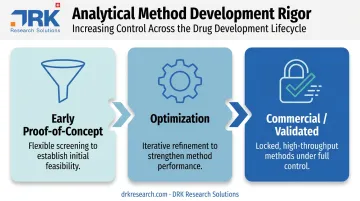
Method development intensity isn't static, either. Early proof-of-concept screening might use simple, flexible techniques to answer basic feasibility questions. By the time a product nears commercial release, that same analyte typically needs a tightly controlled, fully validated method built for routine, high-throughput testing.
Method Development vs. Method Validation: What's the Difference?
Confusing these two stages is a common mistake in CMC planning. Development is exploratory: selecting techniques, adjusting parameters, and building an understanding of how the method behaves. Validation is confirmatory: proving, against predefined acceptance criteria, that the finished procedure performs reliably every time.
| Stage | Purpose | Timing | Deliverable |
|---|---|---|---|
| Development | Select and optimize technique | Early through pre-validation | Optimized procedure, robustness data |
| Validation | Confirm performance | Before intended regulated use | Validation report per ICH Q2(R2) |
Skipping rigorous development doesn't save time; it just moves the pain downstream. Consider a potency assay that fails intermediate precision testing late in the process: the team is then forced to rebuild reliability into the method just to avoid out-of-specification results at batch release. Robustness work done properly during development doesn't need repeating during validation under ICH Q14, but when it's skipped, teams usually discover the gaps only after validation has already failed.
Types of Analytical Methods & Essential Tools Used
Pharma teams group analytical methods into four core categories, each answering a different question about the drug substance or product.
Separation and quantitation techniques isolate and measure individual components in a sample, primarily to establish identity, purity, and potency. Common techniques include:
- HPLC and UHPLC as workhorses for assay and impurity testing
- GC for volatile compounds and residual solvents
- LC-MS for structural confirmation of trace-level impurities
- Capillary electrophoresis as an orthogonal technique for charged species
Spectroscopic and structural tools confirm identity and elucidate structure. UV-Vis and FTIR provide rapid identity checks, NMR offers definitive structural confirmation (including quantitative assay applications), and Raman spectroscopy supports non-destructive identification.
Physical characterization and performance methods matter most for solid dosage forms and complex generics. Dissolution testing predicts in vitro drug release, while particle size analysis, XRPD, and DSC characterize solid-state properties that affect bioavailability and manufacturability.
Biological and bioanalytical methods become essential once a program moves into biologics, peptides, or biosimilars. ELISA, ligand-binding assays, and potency bioassays measure biological activity relative to a reference standard, since these molecules can't be fully characterized by chemical methods alone.
| Category | Example Techniques | Primary Use |
|---|---|---|
| Separation/quantitation | HPLC, UHPLC, GC, LC-MS, CE | Assay, impurities, potency |
| Spectroscopic | UV-Vis, FTIR, NMR, Raman | Identity, structure |
| Physical characterization | Dissolution, particle size, XRPD, DSC | Solid dosage performance |
| Biological/bioanalytical | ELISA, LBA, bioassays | Biologics potency |
Which combination a project needs depends on the molecule type, matrix complexity, and regulatory pathway. An NDA for a novel small molecule leans on separation and spectroscopic techniques. An ANDA for a complex generic often needs deep physical characterization to demonstrate equivalence. A BLA for a biologic can't move forward without validated bioanalytical assays.
The Step-by-Step Method Development Process
Building a defensible analytical method follows a logical sequence, though ICH Q14 doesn't mandate one fixed order.
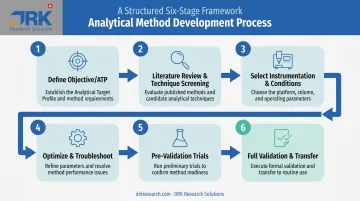
- Define the objective through the ATP. Identify the CQA being measured, set acceptance criteria, and clarify the method's intended use before choosing a technique.
- Review the literature and screen techniques. Benchmark candidate approaches against pharmacopeial methods, published data, and internal method libraries where they exist.
- Select instrumentation and initial conditions. Choose columns, reagents, and starting parameters based on the analyte's chemistry, stability, and expected impurities.
- Optimize and troubleshoot. Adjust mobile phase composition, gradient, pH, and temperature to resolve common problems like peak overlap or weak signal response.
- Run pre-validation trials. Small-scale testing confirms the method is tracking toward ATP requirements before committing full resources to formal validation.
- Execute full validation and transfer. Test accuracy, precision, specificity, linearity, and LOD/LOQ per ICH Q2(R2), then document and train analysts at every site running the method.
That last step deserves a closer look. Method transfer, moving a validated procedure from the developing lab to a receiving site, isn't just paperwork. USP General Chapter 1224 defines it as the documented process of qualifying a receiving laboratory, meaning that lab must demonstrate the same procedural knowledge and ability the original lab had.
Skip this step, and problems surface fast. Receiving-site equipment or even sample-handling details, like glass versus plastic tubes, can behave differently than expected once commercial testing begins. DRK's technology transfer teams qualify receiving labs against the original ATP before that risk ever reaches a sponsor's timeline.
Regulatory Compliance in Method Development: ICH Q14 & Global Standards
ICH Q2(R2) has long governed how analytical procedures are validated, spelling out the parameters, accuracy, precision, specificity, linearity, range, and robustness, that must be tested before a method supports regulatory use.
ICH Q14 fills a gap that existed for years: a formal, science- and risk-based framework for the development process itself. Rather than treating development as an unregulated black box before validation begins, Q14 promotes structured use of the ATP (Analytical Target Profile) and supports both a minimal (traditional) approach and an enhanced approach layering in prior knowledge, risk assessment, and modeling.
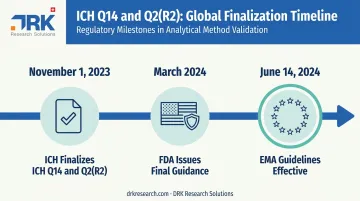
ICH finalized both Q14 and Q2(R2) on November 1, 2023. FDA issued them as final guidance in March 2024, and EMA made both guidelines effective June 14, 2024, giving sponsors a consistent global reference point.
Q14 also aligns closely with Quality by Design (QbD) principles from ICH Q8 and the risk-management approach in ICH Q9. Method development now formally incorporates risk assessment, defined operating ranges, and lifecycle management, so a method isn't validated once and forgotten; it's monitored and adjusted as manufacturing knowledge grows.
Global sponsors still need to reconcile regional expectations layered on top of ICH. FDA guidance, EMA requirements, and GMP/GLP frameworks each carry their own inspection nuances, particularly relevant for multi-regional submissions where the same method package needs to satisfy reviewers in different jurisdictions at once. CROs with regulatory teams positioned across multiple markets, such as DRK Research Solutions' offices spanning Europe, the UK, the Americas, and Asia, help sponsors build one method development package that holds up across these varying regional reviews instead of duplicating work per market.
Common Pitfalls & Best Practices
Even experienced teams fall into predictable traps during method development:
- Insufficient specificity: failing to test against degradation products, related substances, and stressed samples
- Unaddressed matrix effects: overlooking how sample preparation affects recovery
- Incomplete documentation: records too thin for another analyst to reproduce the method exactly
- Inadequate robustness testing: skipping deliberate parameter variation, then discovering fragility during validation or transfer
The fix isn't complicated, but it requires discipline:
- Build risk assessment into the earliest development stages, not as an afterthought
- Maintain audit-ready documentation from day one: equipment, reagents, sample prep, and system suitability all spelled out
- Align analytical, process, and quality teams early: a bench-ready method can still fail when a process shift alters the impurity profile
Methods built this way tend to survive scrutiny, whether it comes from a validation protocol, a technology transfer, or a regulatory inspector.
Choosing the Right CRO/CDMO Partner for Method Development
Sponsors increasingly outsource method development and validation for practical reasons. Specialized instrumentation is expensive to maintain for a single program, and cross-market regulatory expertise is hard to build internally if a sponsor only files occasionally.
A dedicated partner can also move faster, simply because method development is its core business, not a side task squeezed between other priorities.
A few selection criteria matter more than others:
- Proven GxP and regulatory track record across the specific markets a sponsor is targeting, not just a general compliance claim
- Breadth of analytical capabilities spanning separation, spectroscopic, physical, and bioanalytical techniques
- Method transfer experience across multiple sites, since a method that only works in the developing lab isn't finished
- Modality-specific expertise, whether the program involves a small molecule, a complex generic, or a biologic
DRK Research Solutions works across this space as part of its broader product development offering, developing and validating analytical methods designed to meet ICH, USP, and other global regulatory standards. The company backs this technical capability with:
- Generics and hybrid product development experience gained through its CDMO services
- An office network spanning Switzerland, the UK, the USA, Pakistan, Malaysia, Nepal, and the UAE
- A GxP-compliant approach built for sponsors targeting both tightly regulated markets and underserved regions
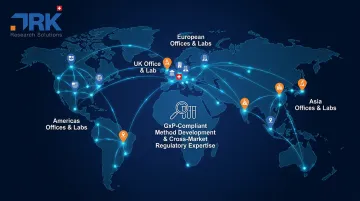
For sponsors juggling multiple filing jurisdictions at once, that combination of technical depth and geographic reach can simplify a process that otherwise means coordinating several separate vendors.
Frequently Asked Questions
What is method development in pharma?
Method development is the process of designing and optimizing an analytical procedure so it reliably measures a drug's identity, purity, potency, or stability. It happens before validation and shapes every quality decision that follows.
What is the difference between method development and validation?
Development creates and optimizes the procedure; validation statistically confirms the finished method meets predefined acceptance criteria. Skipping thorough development is one of the most common causes of validation failure.
What is the ICH Q14 guideline for method development?
ICH Q14 formalizes a science- and risk-based approach to developing analytical procedures, complementing the validation-focused ICH Q2(R2). It introduces the Analytical Target Profile and supports minimal or enhanced development paths.
What are the 4 types of analytical methods?
The four categories are separation/quantitation (HPLC, GC), spectroscopic (UV-Vis, NMR), physical characterization (dissolution, XRPD), and biological/bioanalytical (ELISA, bioassays). The right combination depends on the molecule and regulatory pathway.
How long does analytical method development typically take?
Timelines vary based on molecule complexity, technique selection, and regulatory pathway, since no single benchmark applies across all programs. Plan development early relative to clinical or filing milestones rather than assuming a fixed duration.
What is method transfer and when is it needed?
Method transfer qualifies a new laboratory to run a validated method, usually during clinical scale-up, commercial manufacturing, or multi-site testing. Equipment or sample-handling differences between sites can affect results without careful management.