Many sponsors can't absorb that kind of risk. That's where incrementally modified drugs, or IMDs, come in.
An IMD takes an active ingredient already approved as safe and effective and improves it: a new delivery route, a better dosing schedule, a smarter formulation. It files under a pathway like the FDA's 505(b)(2) NDA instead of starting from zero. The science moves faster and the risk drops, but the program isn't free, and it isn't automatic.
Before committing R&D budget to an IMD, sponsors need a hard-nosed financial feasibility assessment. This article covers what IMDs are, why that assessment matters, the cost drivers that shape it, and how to structure one that holds up under scrutiny.
Key Takeaways
- IMDs build on an already-proven API, lowering risk, though bridging studies still add real cost.
- FDA's 505(b)(2) pathway lets sponsors reference existing data instead of duplicating full trials.
- Modification type (route change, dosing regimen, or formulation) directly drives the feasibility budget.
- NTI drugs and complex formulations raise both cost and regulatory scrutiny.
- Patent status and exclusivity incentives shape an IMD program's projected ROI.
What Are Incrementally Modified Drugs?
Regulators don't use identical language, but the concept translates across markets. South Korea's Ministry of Food and Drug Safety has published casebooks on incrementally modified drug approvals. Korean pharmacology literature describes an IMD as a product that changes an existing drug's chemical structure, formulation, or indication rather than introducing an entirely new molecule.
In the US, that same idea lives inside FDA's 505(b)(2) NDA pathway. A 505(b)(2) application contains full safety and effectiveness reports, but at least some of that data doesn't come from studies the applicant ran itself. It can lean on FDA's own prior findings about a Listed Drug or on published literature.
That's the defining feature of an IMD: it shares an active pharmaceutical ingredient with an already-approved product but adds something new that changes its clinical or commercial value.
Where IMDs Sit Between NCEs and Generics
| Pathway | What it requires | Risk profile |
|---|---|---|
| 505(b)(1) NDA (new chemical entity) | Full, self-generated safety and efficacy package | Highest cost, highest risk, longest timeline |
| 505(b)(2) NDA (IMD) | Bridging data plus reference to FDA findings on a Listed Drug | Moderate cost, moderate risk |
| 505(j) ANDA (generic) | Bioequivalence only; same API, dosage form, route, strength | Lowest cost, lowest risk, no differentiation |
IMDs cost more than a generic because they require sponsor-funded bridging work. They cost far less than an NCE because the API's core safety profile is already established.
Common Types of Incremental Modifications
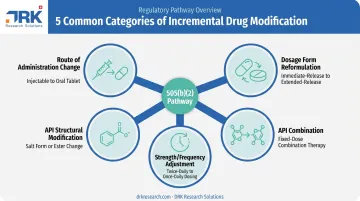
FDA guidance identifies several categories of change that can qualify a product for a 505(b)(2) filing:
- Changing the route of administration (oral to subcutaneous, for example)
- Reformulating the dosage form (immediate-release to sustained-release)
- Combining two APIs into a single dose
- Adjusting strength or dosing frequency (three-times-daily to once-daily)
- Modifying the API itself through prodrug, salt, or ester variations
Two Korean approvals show how this plays out commercially. Liporaxel (DHP107) reformulated oral paclitaxel using a lipid-based delivery system that avoids the solvent tied to hypersensitivity reactions in the original IV formulation, removing the need for premedication and lengthy infusions.
Gastiin CR took a different route, turning a mosapride dose taken three times daily into a bilayer tablet dosed once a day. Its phase III trial showed noninferior efficacy with over 95% patient compliance.
Because the underlying API already carries a proven safety profile, IMDs generally carry lower R&D risk and shorter timelines than NCEs. That's the foundation for the financial feasibility case sponsors need before committing capital.
Why Financial Feasibility Analysis Is Critical for IMD Development
A true generic doesn't need much financial modeling. The bioequivalence bar is fixed, the cost is predictable, and the API's safety case is already closed. IMDs are different. A 505(b)(2) filing usually requires sponsor-funded bridging or clinical studies, and sometimes new nonclinical work, so the size of that investment isn't obvious until someone models it.
There's no clean, source-verified benchmark comparing average NCE cost/timeline to average 505(b)(2) IMD cost/timeline; it depends heavily on modification type, bridging design, and indication. What's defensible is the qualitative comparison: an NCE program proves safety and efficacy from scratch, while an IMD program references FDA's existing findings on the Listed Drug and only bridges the gap the modification creates.
Lower Risk, Better Return Profile
Because the API's core pharmacology is well established, IMD programs typically face:
- Lower clinical failure risk, since the fundamental safety question was resolved during the reference product's approval
- Shorter regulatory review cycles when the bridge is well-designed
- Fewer unknowns in nonclinical work, since the reference product's toxicology package exists
Exclusivity Incentives Factor Directly Into ROI
Regulatory incentives can shift the economics further. FDA's draft guidance on new clinical investigation exclusivity states that an NDA for a previously approved active moiety can earn three years of exclusivity. This applies when the filing includes applicant-sponsored clinical investigations, other than bioavailability studies, that are essential to approval. Pediatric studies completed under a Written Request can add another six months on top of existing protection.
Neither is automatic. The clinical work has to be genuinely essential to approval, and pediatric exclusivity requires meeting FDA's specific study terms. But when a program qualifies, these windows change the ROI math sponsors build into their feasibility models.
Key Factors That Influence the Financial Feasibility of IMDs
Four variables tend to move an IMD's feasibility budget more than any others.
Development and Regulatory Costs
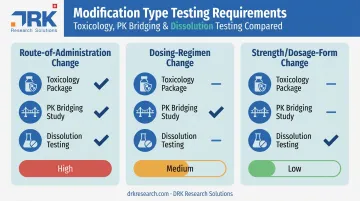
The CMC package, bioavailability/bioequivalence bridging, and nonclinical toxicology work form the core of any IMD budget, and the price tag shifts sharply based on modification type.
- A route-of-administration change often triggers local tolerance and route-specific toxicology questions, which ICH guidance says are usually folded into general toxicology studies rather than run as stand-alone trials, but they still add cost.
- A dosing-regimen change may need little beyond comparative pharmacokinetic bridging to show the new schedule behaves the same way in the body.
- A strength or dosage-form change, such as an alternate salt or tablet size, often needs only comparative dissolution testing rather than a full toxicology package.
That gap, full toxicology package versus a single PK bridge, can be the difference between a program that's financially viable and one that isn't.
Manufacturing and Scale-Up Considerations
Formulation complexity drives CDMO cost more than almost anything else. A simple tablet reformulation scales predictably. A long-acting injectable or microsphere depot system does not.
Peer-reviewed research on PLGA/PLA-based microsphere depots identifies scalable particle-size control, drug stability, burst release, and residual solvent management as major manufacturing challenges, and it flags increased manufacturing cost directly. Small process changes in these systems can alter how the drug releases in the body, meaning more characterization and comparability testing before a sponsor can lock in a commercial process.
Market, Patent, and Reimbursement Factors
A strong clinical case means nothing if the numbers don't work commercially. Before committing capital, sponsors need to assess:
- The reference product's remaining patent life and Orange Book listings, since a 505(b)(2) applicant must certify against relevant patents before approval
- Existing statutory exclusivity, which can block filing or approval outright, or restrict which uses can be approved
- The competitive landscape and how many similar modifications already exist
- Payer reimbursement appetite; CMS typically assigns a 505(b)(2) product its own reimbursement code only when FDA finds it therapeutically equivalent to the reference product
Drug-Specific Risk Factors
Not every API is equally forgiving of modification. Narrow therapeutic index (NTI) drugs, which FDA identifies through examples like warfarin and digoxin, require tighter bioequivalence standards because small differences in blood concentration can cause serious therapeutic failure or dangerous toxicity.
FDA's enhanced bioequivalence (BE) approach for NTI drugs uses a fully replicated crossover design and dual statistical limits, adding both time and cost to a bridging program.
A drug's ADME profile (absorption, distribution, metabolism, and excretion) also determines which modifications are pharmacologically viable. An API with poor oral bioavailability might suit a route change but not an extended-release reformulation. Discovering that mismatch late in development is an expensive lesson.
How to Conduct a Financial Feasibility Assessment for an IMD
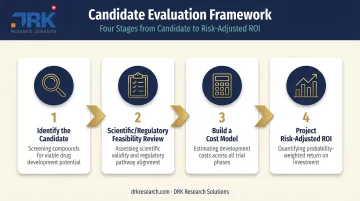
A feasibility assessment isn't a single calculation. It's a sequence of steps that narrows uncertainty before capital gets committed.
- Identify the candidate. Confirm the reference Listed Drug, its patent and exclusivity status, and whether the proposed modification is scientifically sound given the API's ADME profile.
- Run a scientific/regulatory feasibility review. Map out which studies the modification will require: bridging PK/BA work, local tolerance toxicology, or a fuller nonclinical package.
- Build a cost model. Price out CMC development, analytical method validation, bridging studies, and manufacturing scale-up specific to the modification type.
- Project risk-adjusted ROI. Weigh development cost against the value of the exclusivity window, competitive positioning, and reimbursement outlook.
Skipping any of these steps tends to show up later as a budget surprise, usually the expensive kind.
Why Engaging a CRO/CDMO Early Matters
Bringing in an experienced partner before locking in a development plan helps sponsors avoid guessing at study requirements. DRK Research Solutions, for example, supports generics and hybrid product development through formulation development, analytical method development, and bioavailability/bioequivalence study capabilities. This technical input helps sponsors scope required studies and build a realistic budget before committing capital.
That early input matters most when a program sits in a gray zone, where it's genuinely unclear whether a bridging study or a fuller nonclinical package will be required.
Model Three Scenarios, Not One
That same gray-zone uncertainty is exactly why a single-point cost estimate hides risk. Sponsors get a clearer picture by modeling:
- Best case: Bridging-only pathway, no unexpected FDA requests, on-time approval
- Base case: Standard 505(b)(2) bridging plus one round of FDA questions
- Worst case: Additional nonclinical studies requested, or a shift toward a fuller NDA package
Tying each scenario to specific regulatory pathway assumptions keeps the model grounded in what could plausibly happen, not what's convenient to assume.
Real-World Examples of Cost-Effective IMD Development
Two FDA approvals show how modification choice and pathway strategy shape feasibility outcomes.
Otrexup (methotrexate autoinjector). FDA approved this subcutaneous, prefilled autoinjector in October 2013 as a 505(b)(2) product referencing both oral and injectable methotrexate. Instead of running a new efficacy program, the sponsor conducted pharmacokinetic bridging studies showing the autoinjector's exposure matched approved subcutaneous and intramuscular methotrexate.
The sponsor then relied on published literature to support efficacy and safety. Changing the route of administration created a real commercial advantage: patients could self-inject instead of visiting a clinic, without a ground-up clinical program.
Narcan Nasal Spray. FDA's 2015 review describes a 505(b)(2) application that cross-referenced injectable Narcan's existing efficacy and safety data. The pivotal study compared intranasal doses against intramuscular naloxone to establish comparable exposure. FDA required no new nonclinical studies and no new clinical efficacy trials; approval rested on the relative bioavailability bridge plus the prior injectable data.
| Product | Modification | Pathway | Result |
|---|---|---|---|
| Otrexup | Oral/IM methotrexate → prefilled SC autoinjector | 505(b)(2) with PK bridging study | Approved 2013; no new efficacy trials |
| Narcan Nasal Spray | Injectable naloxone → intranasal spray | 505(b)(2) with bioavailability bridge | Approved 2015; no new efficacy trials |
Both cases follow the same pattern: sponsors chose modifications that solved genuine clinical problems, then mapped them to the lightest regulatory bridge FDA had already accepted.
Partnering with the Right CRO/CDMO for IMD Success
Choosing a development partner shapes the feasibility numbers as much as the science does. Sponsors evaluating a CRO/CDMO for an IMD program should look for:
- Multi-regional regulatory experience across the markets where the product will launch
- A documented track record with generics and hybrid product development, not just NCE trial support
- Integrated CRO/CDMO capability, so formulation work, bridging studies, and dossier preparation don't require coordinating three separate vendors
- Manufacturing partnerships with facilities holding current EU GMP, US FDA, or WHO PQ compliance
DRK Research Solutions is one example of a CRO/CDMO built around this combination. Founded in 2012 and headquartered in Geneva, Switzerland, DRK has supported clinical development for over a decade, adding generics and hybrid product development for regulated markets in 2022.
Its regulatory consultants carry a track record across EU GMP, US FDA, MHRA, WHO PQ, and PIC/S standards, which matters for sponsors planning multi-market IMD launches.
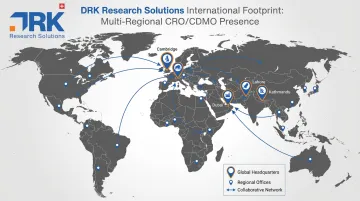
DRK's operational footprint spans Europe, the Middle East, Asia, Africa, and the Americas, with offices from Cambridge and Geneva to Lahore, Kathmandu, and Dubai. For sponsors factoring trial execution cost into their feasibility assessments, that regional spread offers a practical advantage. It provides access to markets with lower clinical trial costs and a path to reach patient populations that branded originators often overlook.
Frequently Asked Questions
What are incrementally modified drugs?
IMDs share an active ingredient with an already-approved Listed Drug but add a therapeutic, safety, or convenience improvement, such as a new route or dosage form. In the US, most file through FDA's 505(b)(2) NDA pathway, referencing existing FDA findings instead of starting from zero.
What are the four stages of ADME?
ADME stands for absorption, distribution, metabolism, and excretion, the four processes that determine how a drug moves through the body. An API's ADME profile tells sponsors which modifications are pharmacologically realistic.
What is an example of an NTI drug?
Warfarin and digoxin are both FDA-recognized narrow therapeutic index drugs, meaning small differences in blood concentration can cause serious therapeutic failure or toxicity. NTI status requires tighter bioequivalence testing, raising feasibility costs for any IMD built on that API.
What is the 505(b)(2) pathway and why does it matter for IMD costs?
It's an FDA filing route that lets sponsors reference the agency's existing safety and efficacy findings on a Listed Drug instead of generating that data themselves. That reduces duplicate trial costs and shortens timelines compared to a full new drug application.
How much can IMD development save compared to developing a new chemical entity?
There's no single verified percentage; savings depend on modification type, bridging design, and CMC complexity. NCE development averages 10-15 years and $1-2 billion, and IMDs cut much of that cost by building on already-proven safety data.
Does patent exclusivity affect the financial feasibility of an IMD?
Yes. Qualifying clinical work can earn three years of data exclusivity, and pediatric studies can add six months more, both of which directly improve a program's projected return by extending its competitive window.