This step matters most to pharmaceutical sponsors, biopharmaceutical innovators, generics developers, and any life science company working with a CDMO. Get it wrong, and you risk regulatory delays, wasted capital on commercial equipment, and products that never reach patients on time.
"Pilot batch" gets used loosely across the industry, but the operational reality behind the term is often misunderstood. This article breaks down how the process actually works, what influences its outcome, and where it fits inside a CDMO partnership.
Key Takeaways
- A pilot batch bridges lab-scale R&D and full-scale commercial manufacturing
- It de-risks scale-up by testing the process, not just the formulation
- Pilot data feeds directly into CMC dossiers and technology transfer packages
- Skipping or rushing this step is a leading cause of failed scale-ups and delays
What Is Pilot Batch Manufacturing?
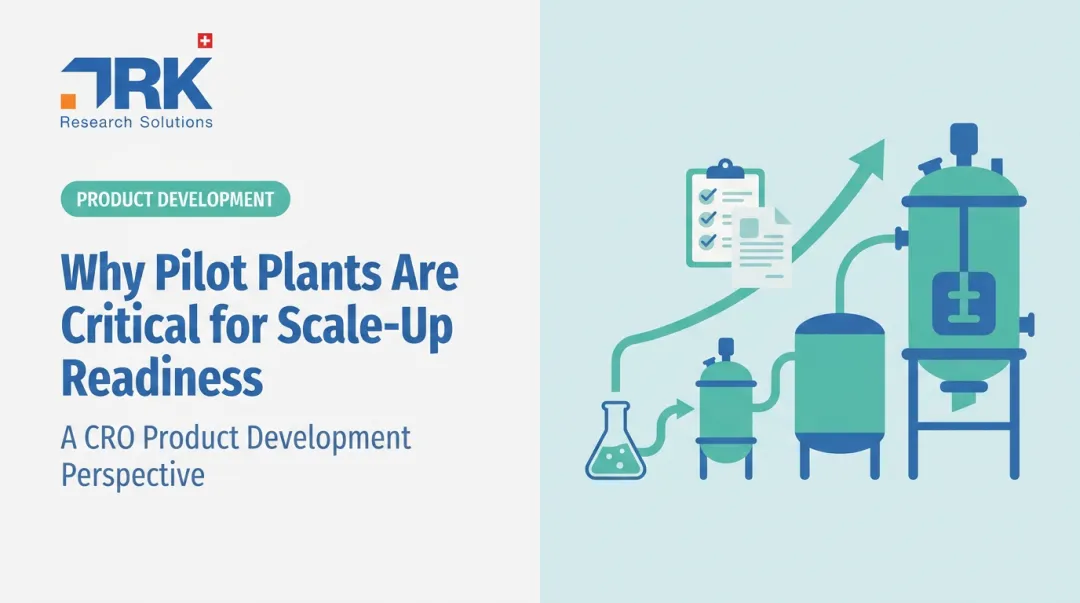
A pilot batch is a limited-quantity production run made using equipment and procedures designed to mimic the future commercial line.
For solid oral dosage forms, ICH guidance points to one-tenth of full production scale or 100,000 dosage units, whichever is larger, though this convention doesn't automatically apply to biologics or other dosage forms, where scale relationships need product-specific justification (ICH Q1A(R2)).
The goal is straightforward: confirm that a formulation proven in the lab can be reproduced reliably at an intermediate scale, before locking the commercial master manufacturing formula.
Two related terms are easy to confuse with a pilot batch:
| Term | Typical Scale | Purpose |
|---|---|---|
| Lab-scale batch | 100 to 1,000 times smaller than production | Proof-of-concept for early formulation development |
| Pilot batch | One-tenth of production scale or 100,000 units | Confirms lab formulation scales reliably |
| Validation batch | Full commercial scale | Formally proves a qualified process performs reproducibly |
A pilot batch tests whether development knowledge scales. A validation batch formally proves the commercial process works. Sponsors who conflate the two often face costly delays or unexpected regulatory pushback.
Why Pilot Batch Manufacturing Is a Critical CDMO Step Before Scale-Up
Small vessels behave differently than large ones. Mixing kinetics, thermal transfer, and granulation dynamics that look fine in a one-liter flask can shift entirely once you're working with hundreds of liters. Pilot batches surface these equipment-dependent variables before they become commercial-scale problems.
Regulators expect this connection to be made explicit, not assumed. ICH Q8 requires applicants to justify how a design space developed at small or pilot scale relates to production scale. Applicants must also disclose meaningful differences in batch size, equipment, and site between development and commercial processes.
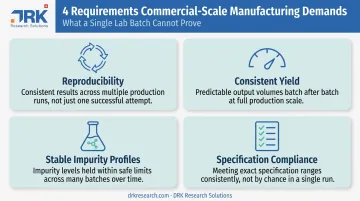
Commercial-scale manufacturing demands things a lab batch simply can't prove:
- Reproducibility across multiple runs, not just one good result
- Consistent yield at a scale where raw material costs and throughput actually matter
- Stable impurity profiles as reaction conditions and hold times shift with volume
- Specification compliance under real production timing, not idealized lab conditions
EMA's process validation guidance describes the pilot batch's core function well: it links process development to industrial production, helping predict production-scale quality and flag manufacturing difficulties before they reach the commercial floor (EMA process validation guideline).
Skipping or rushing this step tends to create problems that surface later:
- Unresolved variability that carries into commercial production
- Deviations flagged during process qualification
- A scale-up that fails to reproduce lab results
Pilot batch data also feeds CMC dossier sections directly. Weak pilot data can stall a regulatory submission before manufacturing even begins.
This is where an experienced CDMO partner earns its value. At DRK Research Solutions, our product development team manages the full sequence, from lab-scale formulation optimization and analytical method development through technology transfer and exhibit batch manufacturing. This coordination is what catches pilot-phase issues before they turn into six-figure equipment mistakes or dossier rejections.
How the Pilot Batch Manufacturing Process Works
At a high level, the process transfers a locked lab formulation into an intermediate facility, runs the batch under controlled conditions, and compares results against pre-set acceptance criteria.
Inputs: the finalized formulation, production-representative raw materials, and equipment scaled to pilot-plant size. Outputs: data that either supports scale-up or sends the team back to refine the process.
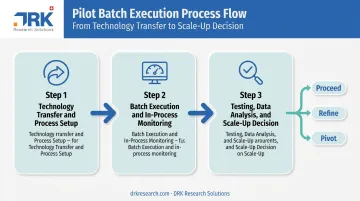
Step 1: Technology Transfer and Process Setup
The lab-scale formulation and its analytical methods move to the pilot facility. Equipment, raw materials, and operating conditions are selected to represent future commercial conditions as closely as possible, since a poor match here undermines everything that follows.
Step 2: Batch Execution and In-Process Monitoring
The batch runs under GMP-aligned conditions. Critical process parameters, such as mixing time, temperature, and pressure, are monitored and recorded at each stage. Catching a deviation here, rather than three steps later, is often the difference between a minor adjustment and a failed run.
Step 3: Testing, Data Analysis, and Scale-Up Decision
The finished batch undergoes full analytical testing against the target product profile. Results are compared to acceptance criteria to determine one of three outcomes:
- The process is validated and ready to move toward commercial scale-up
- The formulation or process needs refinement and another pilot run
- An alternative process approach is flagged as necessary
Every step is documented through protocols, in-process quality checks, and comparisons against the target product profile. WHO's technology transfer guidance calls for exactly this kind of evidence trail, including a formal transfer report summarizing critical parameters, deviations, and conclusions.
Where Pilot Batches Fit in the CDMO Development Lifecycle
Pilot batches occur after formulation lock and lab-scale proof of concept, but before process validation and commercial manufacturing. They're typically triggered by one of a few key factors:
- Completion of stable lab-scale development, signaling readiness for intermediate-scale confirmation
- A sponsor's need for clinical trial material to support first-in-human or early-phase studies
- Regulatory submission requirements, such as generating stability batches for a dossier
Unlike routine production batches, pilot runs are usually a one-time or low-frequency milestone per product. That said, sponsors shouldn't assume one run will always be enough. If results are inconclusive or process changes are needed, multiple pilot runs may be required before the process is ready for the next stage.
Key Factors That Influence Pilot Batch Success
Several variables determine whether a pilot batch actually delivers usable, representative data:
- Raw material variability: inputs that behave consistently in small lab quantities can perform differently at intermediate scale
- Operating conditions: mixing speed, temperature control, and humidity that were negligible at bench-top scale can meaningfully affect outcomes once equipment size changes
- Equipment and facility fit: pilot equipment needs to genuinely reflect the intended commercial line's operating principle, not just its general category
- Batch size, throughput, and frequency: these determine how representative the pilot run actually is of full commercial production
- Regulatory and quality constraints: GMP documentation requirements and expected batch counts vary by product, agency, and jurisdiction (FDA, EMA, and others)
None of these factors act in isolation. A raw material variability issue, for example, often only becomes visible once operating conditions at scale expose it, which is exactly why pilot batches exist in the first place.
Common Misconceptions and When Pilot Batches Aren't Enough
Myth: a successful lab batch guarantees scale-up success. Process behavior often changes non-linearly at larger volumes. Heat transfer, mixing efficiency, and residence times don't scale proportionally with vessel size, which is precisely why a pilot run exists as a separate checkpoint.
Myth: one pilot batch is always sufficient. Regulatory expectations vary by agency, and there's no single universal rule here. FDA guidance states that neither CGMP regulations nor agency policy set a fixed minimum number of batches; the number requires scientific justification based on process knowledge (FDA process validation guidance).
EU GMP and WHO, by contrast, still treat three consecutive batches as a generally acceptable traditional baseline, provided it's backed by risk assessment.
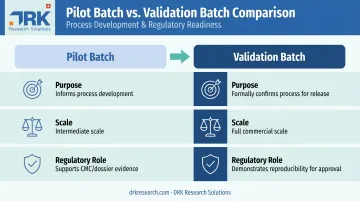
Pilot batches vs. validation batches — these are not interchangeable:
| Aspect | Pilot batch | Validation batch |
|---|---|---|
| Purpose | Informs process development | Formally confirms the process for release |
| Scale | Intermediate | Full commercial scale |
| Regulatory role | Supports CMC/dossier evidence | Demonstrates reproducibility for approval |
Pilot batches may need repeating when formulation changes are significant, equipment gets substituted, or test results show unresolved variability.
On the other hand, a low-complexity, well-established generic process with minimal scale-up risk may not need extensive pilot runs at all. Running one by default, rather than by necessity, simply adds cost without adding insight.
Correct, well-managed pilot execution protects both timeline and quality far more reliably than skipping ahead. DRK Research Solutions supports sponsors through this exact phase, connecting lab-scale formulation work, technology transfer, and exhibit batch manufacturing under one coordinated process, so the scale-up decision is based on solid data rather than guesswork.
Frequently Asked Questions
What is the difference between scale-up and pilot batch production?
Pilot batch production is the intermediate testing step. It generates the data used to inform and de-risk the subsequent scale-up to full commercial manufacturing volumes.
What is pilot batch production?
It's a reduced-scale manufacturing run, made with production-representative equipment and materials, used to test and refine a process before it moves to commercial-scale manufacturing.
Why are three batches required for validation?
EU GMP and WHO treat three consecutive batches as a traditional, generally acceptable baseline for demonstrating reproducibility. FDA, however, doesn't mandate a fixed number — it requires scientific justification instead.
How many pilot batches are typically needed before scale-up?
This varies by product complexity and regulatory pathway. Sponsors should budget for at least one to three pilot runs, depending on how results compare against acceptance criteria.
What size is a typical pilot batch compared to a commercial batch?
For many solid oral dosage forms, pilot batches run around one-tenth of the intended commercial batch size. Exact ratios depend heavily on equipment design and product type.
Who oversees pilot batch manufacturing when working with a CDMO?
A CDMO's process development, quality, and regulatory teams jointly manage execution and the scale-up decision. At DRK Research Solutions, this work spans our product development and technology transfer teams alongside partner manufacturing facilities.