Cold chain gets discussed constantly as a compliance checkbox: keep the box cold, log the temperature, file the paperwork. But its real value shows up elsewhere, in trial outcomes, in drug potency at the point of care, and in patient safety across wildly different markets.
This article breaks down why cold chain matters in practice, from clinical trials running across emerging markets to commercial distribution networks spanning continents, not just what a regulatory guidance document says it should achieve.
Key Takeaways
- Cold chain failures invalidate trial data and permanently destroy drug potency, causing losses far beyond wasted product
- Cold-chain-dependent medicines represented $384 billion, or 32%, of the global medicine market in 2021
- Regulatory bodies (FDA, EMA, WHO) investigate every temperature deviation as a compliance event requiring documented root-cause analysis
- Emerging markets face infrastructure gaps that demand localized execution strategies tailored to each region's logistics reality
What Is Cold Chain in Pharmaceutical Logistics?
Cold chain is the temperature-controlled system of storage, packaging, and transport that keeps pharmaceutical products within their required range from the manufacturing line to the patient's arm.
It applies at every handoff point:
- Manufacturing sites — initial storage and stability testing
- Clinical trial supply chains — from depot to investigator site
- Warehousing — bulk and regional distribution hubs
- Last-mile delivery — hospitals, pharmacies, and increasingly, direct-to-patient home delivery
Cold chain itself isn't the endpoint. Protecting drug efficacy and patient safety is the actual outcome, and every sensor, SOP, and validated shipper exists solely to serve that purpose.
Key Advantages of Cold Chain in Pharmaceutical Logistics
Pharma companies and CROs track these advantages through hard numbers: product loss rates, regulatory pass/fail status, trial timelines, and market access. As pipelines shift toward biologics, cell and gene therapies, and multi-regional trials, each advantage below becomes more critical, not less.
Preserving Drug Efficacy and Patient Safety
Biologics and vaccines are fragile in ways small-molecule drugs simply aren't. Step outside a validated temperature range, even briefly, and you risk molecular degradation, denaturation, or protein aggregation that no amount of good intentions can reverse.
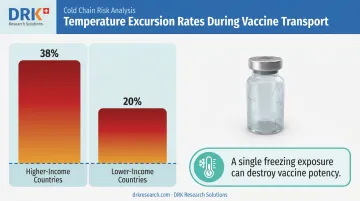
This is where real-time monitoring earns its place. IoT sensors and digital dataloggers create a controlled environment that catches deviations before the product ever reaches a patient. The CDC's vaccine storage guidance is blunt about the stakes: for some refrigerated vaccines, a single exposure to freezing temperatures can completely destroy potency. There's no partial credit here.
Why this matters so much:
- A brief temperature excursion can render a biologic ineffective, threatening both patient outcomes and trial validity in one stroke
- A 2017 systematic review found below-recommended-temperature exposure during transport in 38% of studies from higher-income countries, and nearly 20% from lower-income countries
- Sponsors and CROs need to build monitoring into protocol design from day one, not bolt it on after a problem surfaces
KPIs that get hit hardest:
- Temperature excursion rate
- Product rejection/waste rate
- Adverse event or efficacy failure rate
Cryogenic and ultra-cold products, think mRNA vaccines or cell and gene therapies, feel this risk most acutely. So do multi-site trials with long transit times, where each additional handoff raises the odds of something going wrong.
Ensuring Regulatory Compliance Across Global Markets
Cold chain compliance means satisfying GDP, FDA, EMA, and WHO requirements for documented temperature control at every single handoff. Not most handoffs. Every one.
Validated equipment, written SOPs, and audit-ready temperature logs are what demonstrate compliance when inspectors show up or when a regulatory submission gets reviewed. The EU's GDP guideline requires label-consistent transport, calibrated monitoring, and formal investigation of any excursion. The FDA's approach under 21 CFR 211.142 is similar in spirit: written procedures, quarantine protocols, and conditions that preserve identity, strength, and purity.
Non-compliance isn't a slap on the wrist. It can mean shipment holds, fines, or product recalls that delay both trials and launches. A 2019 FDA warning letter to a pharmaceutical manufacturer cited inadequate investigation of repeated warehouse temperature excursions as a core violation, a reminder that regulators expect documented follow-through, not just a logged number.
| Regulatory Body | Core Requirement |
|---|---|
| EU/EMA (GDP) | Label-consistent transport, risk assessment, calibrated monitoring, excursion reporting |
| US FDA (21 CFR 211) | Written warehousing/distribution procedures, quarantine, lot traceability |
| WHO (TRS 1025 Annex 7) | Controlled conditions, trained personnel, records across the supply chain |
| ICH E6(R3) | Sponsor-defined storage conditions, stability protection, shipment documentation |
KPIs tied to this advantage:
- Audit pass rate
- Documentation completeness
- Regulatory hold or delay incidents
- Time-to-market
This matters most in multi-regional trials spanning jurisdictions with genuinely different GDP standards. What passes inspection in one country won't automatically satisfy an auditor somewhere else.
Expanding Access to Advanced Therapies in Underserved and Emerging Markets
Strong cold chain infrastructure is what allows biologics, vaccines, and investigational products to reach patients in low- and middle-income countries, not just well-resourced regions with reliable power grids and modern freezers.
Localized proficiency, regional warehousing, trained handlers, and contingency planning are what actually bridge the infrastructure gap. Global standards on paper don't move a single vial; local execution does.
The scale of the gap is sobering. Among 65 low- and lower-middle-income countries assessed by WHO and UNICEF for effective vaccine management, none met the minimum standard across all nine criteria. Adequate temperature control was present in only 26% of assessed sites.
Without reliable cold chain networks, sponsors face a hard choice: exclude LMIC sites entirely, or accept a higher risk of product loss. Neither option serves patients well. Organizations that pair global cold chain standards with genuine local execution help sponsors safely extend multi-regional trials and generics or hybrid product distribution into markets that would otherwise stay out of reach. DRK Research Solutions' presence across Europe, the Middle East, Asia, Africa, and the Americas illustrates this model in practice.
KPIs impacted here:
- Site activation time in emerging markets
- Patient recruitment reach
- Product loss rate at remote sites
Sponsors running Phase II–IV multi-regional trials feel this gap directly, as do those launching generics and hybrid products in regulated markets where cold chain infrastructure remains thin.
What Happens When Cold Chain Is Missing or Ignored
Skip cold chain rigor, and the consequences compound quickly:
- Inconsistent drug potency: leading to unreliable clinical trial data that can undermine an entire study's validity
- Higher spoilage and waste: plus the cost and delay of re-shipment
- Reactive firefighting: scrambling to respond to excursions instead of executing a planned contingency response
- Rising costs over time: insurance premiums, recall expenses, and regulatory penalties all climb
- Stalled market expansion: scaling trials or commercial distribution into new regions becomes far harder
None of these problems stay contained. A single mishandled shipment can ripple into delayed database locks, frustrated site investigators, and a regulator asking uncomfortable questions about your quality system.
How to Get the Most Value from Cold Chain Management
Cold chain only delivers full value when it's applied consistently across every handoff, not just the shipments someone flags as high-risk. Treating it as a checkbox for the "important" lanes while ignoring the rest defeats the purpose.
Temperature and shipment data need regular review, not just archiving for the next audit. The goal is spotting recurring lane or facility issues before they become a pattern of failures.
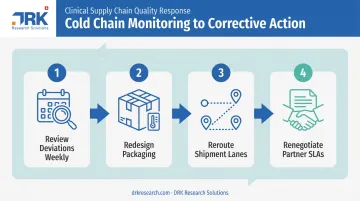
Turn monitoring data into action:
- Review deviations weekly, not quarterly, to catch trends early
- Redesign packaging where recurring excursions point to a systemic issue
- Reroute shipment lanes when a particular corridor keeps underperforming
- Renegotiate partner SLAs when a logistics provider's performance doesn't match the contract
None of this insight matters if it sits unused in a quarterly report. It needs to drive real corrective action.
This is where an experienced partner earns their place. DRK Research Solutions combines a global network with genuine local proficiency, supporting clinical supplies management, storage, warehousing, and labeling across operational hubs in the UK, USA, Switzerland, Malaysia, Pakistan, Nepal, and the UAE.
This reach helps sponsors maintain consistency across regulatory and infrastructure environments that rarely look alike.
Conclusion
Cold chain reliability rests on three connected pillars: temperature control, real-time data visibility, and disciplined compliance. Weaken any one pillar, and the risks ripple across all three:
- Drug efficacy drops when temperature excursions go unmonitored
- Patient safety suffers when product stability is compromised
- Regulatory standing erodes with each unresolved deviation report
These effects compound over time, too. A clean excursion record builds a stronger compliance history, and that history opens the door to faster approvals and broader market access.
Cold chain management demands constant, ongoing attention—not a one-time setup—especially as pharma pipelines diversify into biologics and expand into new global markets.
Frequently Asked Questions
What are some examples of cold chain pharma products?
Common examples include vaccines, insulin, monoclonal antibodies, biologics, and cell and gene therapies. Temperature requirements vary widely, from standard refrigeration to ultra-cold cryogenic storage.
Are GLP-1 drugs considered cold chain pharma products?
Yes. Most GLP-1 medications like Ozempic and Wegovy require refrigeration at 2–8°C before first use. Some formulations allow limited room-temperature storage for a set number of days after opening.
What temperature range is required for most vaccines and biologics?
Most vaccines and biologics require 2–8°C refrigeration. Frozen products typically need -50°C to -15°C, while some specialized cell and gene therapies require cryogenic storage below -150°C.
What happens if the cold chain is broken during pharmaceutical transport?
A break can cause irreversible degradation and permanent loss of potency. Affected shipments must be segregated, investigated, and potentially discarded before reaching patients.
How is cold chain integrity monitored and verified?
Monitoring relies on digital dataloggers, buffered temperature probes, and IoT-enabled remote alarms, often combined with GPS tracking. Documented audit trails and calibration records verify compliance for inspections.
Why is cold chain management especially challenging in emerging or low-resource markets?
Infrastructure gaps, inconsistent power supply, and limited trained personnel all create risk. CROs with established clinical supplies management and regional teams on the ground, such as DRK Research Solutions' offices across Pakistan, Nepal, and Africa, help sponsors navigate these barriers.