That changed with the Orphan Drug Act of 1983, which created FDA Orphan Drug Designation (ODD), a status that offers real financial and regulatory incentives to sponsors willing to develop treatments for rare conditions.
This article breaks down what ODD actually is, the incentives it unlocks, who qualifies, how the application process works, and how the FDA's approach compares to the EMA's system in Europe.
Key Takeaways
- ODD is a status, not an approval, granted to drugs for rare or economically unviable conditions
- Eligibility requires fewer than 200,000 US patients, or an unlikely path to cost recovery
- Sponsors gain 7-year marketing exclusivity, tax credits, PDUFA fee waivers, and grant eligibility
- Applications go through FDA Form 4035, with a standard 90-day review target
- US, EU, and Japanese eligibility thresholds differ, shaping global development strategy
What Is FDA Orphan Drug Designation?
FDA Orphan Drug Designation is a formal status the agency grants to a drug or biologic proposed for a rare disease or condition. It exists to offset the financial risk companies take on when developing treatments for small patient populations.
The Two-Pronged Eligibility Test
A sponsor qualifies under one of two conditions:
- Population size: The disease affects fewer than 200,000 people in the United States
- Cost recovery: The disease affects 200,000 or more people, but there's no reasonable expectation that US sales will recover the cost of developing and making the drug available
FDA assesses these facts at the time the designation request is submitted, not at approval.
Designation Is Not Approval
This distinction trips up a lot of sponsors. ODD doesn't mean the FDA has reviewed safety or efficacy data. A designated product still goes through the exact same review process as any other drug or biologic. Designation simply unlocks incentives that make that development path more financially viable.
Orphan Drug Act: Origins & Impact
Congress passed the Orphan Drug Act (Public Law 97-414) on January 4, 1983, after years of hearings on why pharmaceutical companies were bypassing rare disease research. Small patient populations meant development costs regularly exceeded any realistic sales projection. The law's findings pointed directly at this gap and proposed federal incentives as the fix.
Those incentives changed the trajectory of rare disease drug development. According to the National Organization for Rare Disorders' 40th-anniversary review, only 38 drugs had been approved to treat rare diseases before 1983. Since then, more than 1,100 orphan treatment indications have received FDA approval.
Behind those approval numbers stands a single federal office running the entire program: the Office of Orphan Products Development (OOPD) administers ODD and related programs, including the grant programs covered below. It's the office that sponsors work with directly, from initial request through post-approval questions.
Benefits & Incentives of FDA Orphan Drug Designation
Sponsors pursue ODD because the incentives materially change the economics of rare disease development.
Seven-Year Marketing Exclusivity
This is typically the incentive sponsors value most. Once the drug is approved, FDA blocks approval of the same drug for the same indication for seven years. This protection does not cover the active ingredient broadly; it applies only to that specific approved use. Statutory exceptions still apply, including written consent from the holder or an inability to supply sufficient quantities.
Federal Tax Credit
Under IRC Section 45C, sponsors can claim a 25% federal tax credit on qualified clinical testing expenses tied to the designated indication. Unused credit is not wasted: it carries back one year and forward up to 20 years, subject to general business credit limitations.
PDUFA Fee Waiver
Standard FDA application fees for drugs requiring clinical data are substantial. For FY2026, that fee sits at $4,682,003, according to the Federal Register's FY2026 PDUFA rate notice. A human drug application tied to a designated orphan indication is exempt from this fee, unless the application also covers a non-rare indication.
Grant Programs and Development Support
Beyond exclusivity and tax relief, designated sponsors can compete for:
- Clinical Trials Grants Program: Up to $650,000/year for four years, or $900,000/year for innovative approaches
- Natural History Studies Grants Program: Up to $400,000/year, for four years prospective or two years retrospective
- FDA protocol assistance: Guidance on trial design and development planning, directly from the review division
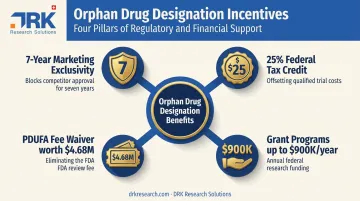
Together, these incentives shift rare disease development from a financial long shot to a viable business case.
Eligibility Criteria for Orphan Drug Designation
Who can apply? Any sponsor developing a drug or biologic for a rare disease or condition, including a new indication for an already-marketed product. There's no restriction based on company size or location.
A few rules shape how eligibility plays out in practice:
- Multiple sponsors, same drug: More than one sponsor can hold ODD for the same drug and disease, each filing a separate request. Exclusivity applies only at approval, not designation.
- Clinical superiority requirement: New sponsors seeking ODD for an already-approved rare disease drug must show a plausible hypothesis of clinical superiority at designation, then prove it by approval.
- Superiority standard (21 CFR 316.3): This means greater effectiveness, greater safety in a meaningful patient subset, or, in limited cases, a major contribution to patient care.
- Timing restriction: ODD requests must be submitted before any marketing application or biologics license application is filed for the same indication.
How to Apply for FDA Orphan Drug Designation
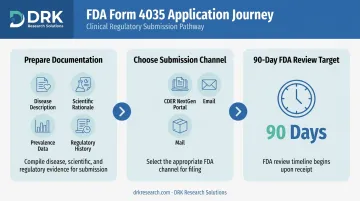
The application runs through FDA Form 4035, which structures the request into the components FDA needs to make a decision.
What the Request Must Include
Under 21 CFR 316.20, a complete request covers:
- Disease description — the rare disease or condition and proposed use
- Scientific rationale — the biological or clinical basis for the drug's use, including all relevant available data
- Regulatory and marketing history — prior FDA or foreign agency interactions
- Prevalence documentation — evidence supporting the population estimate or the lack of reasonable cost recovery
Submission Channels
Sponsors can submit through three routes:
- Submit via the CDER NextGen portal (after account registration)
- Email the request to orphan@fda.hhs.gov
- Mail the request to the Office of Orphan Products Development, WO32-5295, 10903 New Hampshire Avenue, Silver Spring, MD 20993-0002
Timeline and Common Pitfalls
FDA's operational target is to respond to 100% of new ODD requests within 90 days of receipt. That's not a statutory deadline, but it's the benchmark OOPD works against.
The sections that draw the most scrutiny, by a wide margin, are prevalence estimates and scientific rationale. Weak epidemiological sourcing or a thin biological justification are the most common reasons requests come back with deficiencies.
This is exactly where sponsors underestimate the work involved. Building a defensible prevalence estimate often means pulling together registry data, published literature, and sometimes original epidemiological analysis, then presenting it in a way that withstands FDA review.
DRK Research Solutions supports sponsors with this kind of regulatory documentation, including eCTD dossier structuring and product dossier review, drawing on regulatory experience across the US, Europe, the Middle East, Asia, and Africa. For sponsors juggling a rare disease program alongside everything else on a development timeline, having that documentation reviewed before it reaches OOPD can help avoid an extra review cycle.
FDA vs. EMA Orphan Drug Designation: Key Differences
Sponsors developing for both the US and European markets need to understand that FDA and EMA orphan criteria are not interchangeable.
| Criteria | FDA (US) | EMA (EU) | Japan (PMDA) |
|---|---|---|---|
| Population threshold | Fewer than 200,000 patients | Not more than 5 in 10,000 people | Fewer than 50,000 patients |
| Additional test | No reasonable cost recovery expectation | Insufficient return to justify investment | Designated intractable disease |
| Other requirements | Same-drug/clinical superiority rules | Life-threatening or chronically debilitating; no satisfactory treatment or significant benefit | Serious disease, high medical need |
| Exclusivity period | 7 years post-approval | 10 years post-authorization | Not part of this comparison |
The exclusivity gap alone, seven years in the US versus ten in the EU, can shift how a sponsor sequences its regulatory strategy.
In 2007, the European Commission, EMA, and FDA adopted a common application form that lets sponsors submit shared information once. Even so, the two agencies still conduct independent reviews under their own legal standards, so parallel filing doesn't mean parallel outcomes.
Navigating two (or three) rule sets at once is where most single-region regulatory teams get stretched thin. DRK Research Solutions maintains:
- Offices across Switzerland, the UK, the USA, Malaysia, Nepal, the UAE, and Pakistan
- Direct team experience in ICH-GCP, EU GMP, and MHRA standards
- Additional expertise in PIC/S, WHO PQ, and US FDA frameworks
That footprint lets sponsors coordinate a rare disease strategy across regions instead of managing separate, disconnected filings in each one.

Frequently Asked Questions
What is an FDA orphan drug designation?
FDA orphan drug designation is a status granted to a drug proposed for a rare disease affecting fewer than 200,000 US patients, or one unlikely to recoup development costs. It unlocks incentives but doesn't indicate approval.
How do you get FDA orphan drug designation?
Sponsors submit FDA Form 4035 to the Office of Orphan Products Development, including the disease description, scientific rationale, and prevalence data. Submissions go through the CDER NextGen portal, email, or mail.
How long does it take to get FDA orphan drug designation?
FDA's operational target is a response within 90 days of receipt. This isn't a statutory deadline, and incomplete prevalence data or weak scientific rationale can extend the timeline.
What is the difference between FDA and EMA orphan drug designation?
FDA uses a 200,000-patient US threshold and grants 7-year exclusivity. EMA uses a 5-in-10,000 EU prevalence threshold and grants 10-year exclusivity. Sponsors seeking both markets must file separate dossiers, since neither agency automatically recognizes the other's decision.
Does orphan drug designation guarantee FDA approval?
No. Designation and approval are separate processes. A designated drug still undergoes the same rigorous safety and efficacy review as any other drug before it can reach the market.
Can multiple sponsors receive orphan drug designation for the same drug?
Yes. Multiple sponsors can hold ODD for the same drug and disease, but each must file a complete, separate request. Once one version is approved, later sponsors must show clinical superiority.