The FDA finalized its ICH Q13 guidance on continuous manufacturing in March 2023, and the EMA made the same guideline legally effective that July. Regulators are no longer treating CM as an exception to justify. They're building infrastructure for it.
This article isn't another theoretical comparison of CM versus batch processing. It focuses on what actually changes on the plant floor: cycle time, quality outcomes, and cost per unit.
Key Takeaways
- CM merges every production step into one continuous flow, cutting cycle times sharply
- In-line PAT testing catches deviations early, reducing rework and recalls
- Smaller footprints and less manual handling lower cost per unit over time
- FDA and EMA support CM through ICH Q13, turning adoption into a regulatory advantage
- Success hinges on execution: piloting, regulatory engagement, and the right technical partner
What Is Continuous Manufacturing?
Continuous manufacturing produces a drug substance or drug product end-to-end on a single, uninterrupted line, rather than moving material through separate, sequential batch stages with hold times in between.
Under ICH Q13, this means an integrated system with at least two directly connected unit operations, feeding materials in, transforming them, and removing outputs continuously rather than in discrete lots.
Where it shows up in practice:
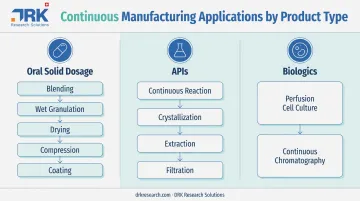
- Oral solid dosage forms: blending, wet granulation, drying, compression, and coating run as one connected sequence
- APIs: continuous reaction, crystallization, extraction, and filtration steps replace discrete batch stages
- Biologics: perfusion cell culture and continuous chromatography are increasingly common applications
CM delivers four measurable benefits when it's implemented and monitored correctly:
- Tighter batch-to-batch consistency
- Shorter development and production timelines
- Lower long-term manufacturing costs
- Faster response to demand changes
A poorly validated continuous line delivers none of these benefits automatically.
Key Advantages of Continuous Manufacturing
The advantages below aren't abstract manufacturing theory. They're the metrics operations teams track every week: cycle time, batch consistency, compliance risk, and cost per unit. Each one ties directly to a KPI that shows up on a production dashboard.
Faster Production Cycles and Time-to-Market
Batch manufacturing involves hold times, transport between rooms or facilities, and restart delays at every stage transition. CM eliminates most of that dead time by keeping material moving through a single connected line.
The clearest documented example comes from Janssen's Prezista process. The batch version required seven separate rooms and roughly two weeks to complete; the continuous version needed just two rooms and one day, according to a peer-reviewed review of small molecule continuous manufacturing.
That's not a universal ratio for every product, but it illustrates the scale of what's possible when hold times disappear.
KPIs this affects:
- Cycle time and throughput
- Lead time to market
- Capacity utilization during demand spikes
This advantage matters most during drug shortages, urgent public health needs, or when a manufacturer is racing to capture market share on a newly approved generic. Speed compounds fastest for manufacturers running two-room continuous lines while competitors remain stuck in seven-room batch operations.
Real-Time Quality Control and Consistency
Batch manufacturing typically tests quality at the end of production. If something went wrong three steps earlier, you find out after the fact, sometimes after the batch is already packaged.
CM incorporates Process Analytical Technology (PAT), which measures critical process parameters in real time, in-line, as material moves through the system. Operators can catch and correct a deviation before it ever becomes a defect, rather than discovering it in a final QC test.
The regulatory upside is measurable. A 2022 peer-reviewed audit of US regulatory submissions found that CM applications averaged 6 months to approval versus 15 months for comparable batch applications, with all five CM products approved in their first review cycle and no Complete Response letters issued, according to the ScienceDirect regulatory audit.
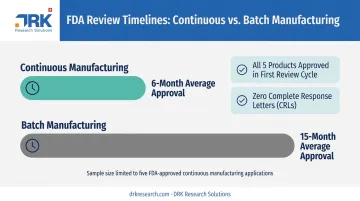
However, several of those CM applicants also held Breakthrough Therapy designation. The gap reflects association rather than proof that CM alone drove the faster timeline.
KPIs this affects:
- Deviation and error rates
- Batch rejection rate
- Regulatory approval timelines
High-value biologics and complex generics carry the most exposure here, since a single deviation can trigger significant compliance and financial fallout.
Lower Operational Costs and Reduced Waste
A smaller, connected production line needs less floor space, less manual material handling, and fewer changeover cycles than a multi-stage batch operation spread across separate rooms or buildings.
Industry reviews report equipment footprints shrinking by up to 70% and facility operating costs dropping 30% to 50% when manufacturers convert to continuous processes, based on a recombinant drug manufacturing analysis. The FDA similarly notes that CM has the potential to lower cost, waste, and inventory carrying requirements.
Where the savings come from:
- Reduced labor hours per production run through fewer manual handoffs
- Lower energy consumption from continuous versus start-stop operations
- Smaller storage footprint since material moves through rather than sitting in inventory
High-volume generics and thin-margin products benefit most here: even a small per-unit efficiency gain adds up across millions of units produced annually.
What Happens When Continuous Manufacturing Is Missing
Sticking exclusively to legacy batch processes in a market shifting toward CM carries real consequences, and they tend to show up gradually rather than all at once.
- Inconsistent product quality: end-of-batch testing catches defects after production, not during it
- Higher error rates and rework — manual handoffs between separate stages introduce more opportunities for mistakes
- Reactive firefighting results when supply chain disruptions delay hold-time-dependent batches, leaving little flexibility to compensate
- Rising relative costs: competitors running CM lines achieve lower cost-per-unit economics, widening the gap over time
- Slower scaling — ramping production to meet demand spikes or address shortages takes longer with multi-stage batch processes
None of this means batch manufacturing is broken. According to FDA's analysis of drug shortage root causes, manufacturing-quality issues are the most common cause of shortages, not evidence that batch technology itself is the problem. But manufacturers standing still while competitors adopt CM are conceding ground on cost, speed, and resilience.
How to Get the Most Value from Continuous Manufacturing
CM only delivers on its promise when it's applied consistently, validated properly with regulators, and supported by real technical expertise. Buying equipment marks the beginning of the work, not the end of it.
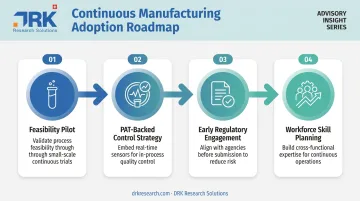
A practical path looks like this:
- Start with a feasibility pilot on a single, well-understood process step before committing to a full-line conversion
- Build a PAT-backed control strategy that demonstrates process stability with real data, not projections
- Engage regulators early — Q13 rewards manufacturers who bring evidence of input-material controls, monitoring, and traceability to the table upfront
- Plan the workforce shift: CM requires different skills than batch operation, and training gaps slow adoption more than equipment does
Many small and mid-sized pharma companies shorten this learning curve by working with an established CDMO rather than building every capability in-house. This is where a partner like DRK Research Solutions fits in.
DRK's product development team supports technology transfer, analytical method development, and regulatory alignment across FDA, EMA, MHRA, WHO PQ, and PIC/S markets for generics and hybrid product development. Before evaluating any shift toward continuous processing, a manufacturer needs the same fundamentals in place:
- Documented process transfer with clear validation records
- Analytical methods proven against real production data
- Regulatory experience spanning multiple jurisdictions
Conclusion
Continuous manufacturing's value goes beyond the equipment itself. The real advantage is the tighter control and consistency it brings to a production line, a level of oversight batch processing simply can't match.
The gains in speed, quality, and lower costs don't appear overnight. They compound over months and years, but only when the process is actively monitored and refined, not installed and left alone. Treat CM as an evolving operational practice, backed by experienced manufacturing and regulatory partners, and the returns follow.
Frequently Asked Questions
What is continuous manufacturing in pharma?
Continuous manufacturing is an uninterrupted, single-line production process that replaces the separate stages of batch manufacturing with real-time, integrated processing. Materials feed in, transform, and exit as finished product without hold times between steps.
How does continuous manufacturing differ from batch manufacturing?
Batch manufacturing moves material through distinct, sequential stages, often in separate rooms, with hold times and end-of-batch testing. Continuous manufacturing (CM) keeps material flowing through a connected system with in-line quality monitoring throughout.
What are the biggest challenges to adopting continuous manufacturing?
Higher upfront capital investment, complex facility changeovers, and workforce training for more technical, automated operations are the main barriers. Global regulatory harmonization gaps can also slow multi-market rollouts.
Is continuous manufacturing more expensive than batch manufacturing?
Upfront capital costs are typically higher due to equipment and PAT investment. Long-term operating costs tend to be lower, thanks to reduced waste, smaller footprints, and less manual labor per unit produced.
How does continuous manufacturing affect regulatory approval timelines?
FDA audit data shows CM applications have seen shorter average review times than comparable batch applications. However, sample sizes remain small, and other factors like Breakthrough Therapy designation may also contribute to that gap.
Can continuous manufacturing be used for generic drugs?
Yes. ICH Q13 explicitly covers new drugs, generics, biosimilars, and conversions of existing batch products, making CM increasingly relevant where cost efficiency and consistent quality are competitive differentiators.