Many formulators still treat excipients as inert fillers, substances that just carry the drug. In practice, their purity, compatibility, and functional performance determine whether an injectable succeeds or fails during development, stability testing, or post-market surveillance. A contaminated buffer or an incompatible stabilizer can undo months of API optimization work.
This article breaks down the practical role excipients play in parenteral formulations: the risks they mitigate, the failures that happen without proper selection, and how sponsors can de-risk formulation development before it becomes a regulatory problem.
Key Takeaways
- Excipients actively enable solubility, stability, sterility, and safe delivery in parenteral products
- Poor excipient selection drives particulate contamination, API degradation, and recalls
- Buffers, preservatives, and stabilizers each target a specific critical quality attribute
- Regulators lack fixed excipient GMP standards, leaving quality assurance to manufacturers
- Early compatibility screening cuts development risk and shortens timelines
What Is the Role of Excipients in Parenteral Dosage Forms
An excipient is any non-API substance intentionally added to a formulation to protect, stabilize, solubilize, or enable safe delivery of the active drug via injection, infusion, or implantation. That definition sounds simple, but the details behind it carry enormous weight in injectable products.
Excipients apply across every parenteral category:
- Small-volume parenterals (SVPs): single-dose or multi-dose vials, prefilled syringes
- Large-volume parenterals (LVPs): IV infusions, fluid replacement therapies
- Lyophilized products: freeze-dried formulations requiring reconstitution
- Biologics and biosimilars: proteins, monoclonal antibodies, peptides
In each case, the excipient supports the API without delivering therapeutic effect on its own. Its job is to keep the API stable, soluble, sterile, and physiologically tolerable from manufacturing through the moment it enters the bloodstream.
Key Advantages of Excipients in Parenteral Formulations
The advantages below focus on measurable, operational outcomes, not theoretical classifications. Each ties directly to a critical quality attribute (CQA) that regulators and formulators track from preformulation through post-approval surveillance.
Solubility and Bioavailability Enhancement
Many injectable APIs, including BCS Class II/IV compounds and biologics, suffer from poor aqueous solubility. Without intervention, these molecules simply won't stay dissolved long enough to be administered safely.
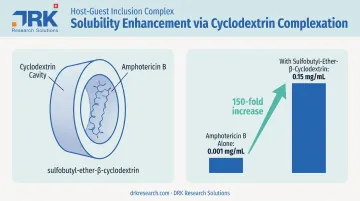
Solubilizing excipients solve this. Cyclodextrins, meglumine, and surfactants each work differently, but cyclodextrins are among the most studied. Hydroxypropyl-β-cyclodextrin and sulfobutyl-ether-β-cyclodextrin form host-guest inclusion complexes, wrapping hydrophobic API molecules inside a ring-shaped cavity that keeps them in solution until the body releases them naturally.
The numbers back this up. Amphotericin B, a notoriously poorly soluble antifungal, has a water solubility of just 0.001 mg/mL on its own. Complexed with sulfobutyl-ether-β-cyclodextrin, that jumps to 0.15 mg/mL, a 150-fold increase in solubility, according to a 2025 review of cyclodextrin applications in drug delivery.
Without solubilizers, APIs can precipitate right in the vial or at the injection site. That causes dosing inconsistency and, in worse cases, localized tissue damage.
Why this matters most:
- High-concentration biologics requiring compact dosing volumes
- Poorly soluble small molecules with narrow therapeutic windows
- Lyophilized products that must fully reconstitute before administration
KPIs affected: solubility limits, dose accuracy, shelf-life, injection-site tolerability.
Stability and API-Excipient Compatibility
Stability failures rarely come from the API alone. They come from what the API reacts with. Antioxidants, chelating agents, sugars like trehalose, and buffer systems all exist to block degradation pathways: oxidation, hydrolysis, and reactions between reducing sugars and amine-containing APIs.
This is where Critical Material Attributes (CMAs) matter. Trace impurities in excipients, not the excipient itself, often cause the damage. Benzyl alcohol, a common preservative, slowly oxidizes in air into benzaldehyde and eventually benzoic acid. That impurity profile matters more for protein-based APIs than most formulators expect.
Consider the data: one study found interferon-alpha2 monomer content dropped from roughly 90% (no preservative) to about 80% with benzyl alcohol present, after 24 hours at 50°C.
A separate study measured 4% IgG1 aggregation after 28 days at 50°C with benzyl alcohol, alongside a 2.8°C drop in melting temperature, both signs of protein destabilization tied to preservative choice, according to a 2023 review on antimicrobial preservatives in protein and peptide formulations.
Incompatible excipient-API pairings don't just reduce potency. They can cause visible discoloration and generate reaction byproducts that compromise patient safety outright.
Why this matters most:
- Liposomal formulations with fragile lipid-drug interfaces
- Lyophilized biologics stored across variable climate zones
- Long-shelf-life injectables intended for global distribution
KPIs affected: shelf-life duration, batch rejection rate, degradation product levels, regulatory approval timelines.
Sterility, Safety, and Patient Tolerability
Parenteral routes bypass the body's natural defenses. Skin, mucosa, and gut barriers that normally filter out contaminants simply aren't part of the equation. That makes excipient purity, meaning low bioburden and low endotoxin, directly tied to patient outcomes.
Tonicity adjusters and buffers are chosen to match physiological pH (around 7.4) and osmolality. Get this wrong, and patients experience pain, hemolysis, or tissue irritation at the injection site. Preservatives, meanwhile, control microbial growth specifically in multi-dose vials where repeated needle entry creates contamination risk.
The cost of getting this wrong is well documented. Particle-related issues accounted for 22% of injectable-product recalls between 2008 and 2012, according to a PDA Journal analysis of FDA recall data. That figure covers both visible and subvisible particulates tied back to manufacturing and raw material quality, excipients included.
An excipient with poorly controlled endotoxin levels introduces systemic risk even when the API itself is completely safe. That's a hard lesson for any sponsor who assumes "pharma grade" is enough.
Why this matters most:
- Multi-dose vial formulations with repeated access points
- High-risk patient populations, including pediatric and ICU patients
- Large-volume infusions where even small contamination scales up fast
- Home infusion therapies administered outside controlled clinical settings
KPIs affected: adverse event rates, sterility test pass rates, recall frequency, patient comfort and compliance.
What Happens When Excipient Selection Is Ignored or Poorly Managed
Skipping rigorous excipient qualification doesn't save time. It just moves the cost downstream, usually to a more expensive and more visible failure point.
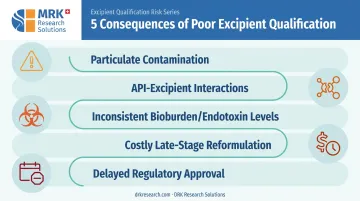
Common consequences include:
- Visible or subvisible particulate contamination discovered during stability testing or, worse, post-market
- API-excipient interactions causing potency loss, discoloration, or unexpected degradation byproducts
- Inconsistent bioburden or endotoxin levels that put patient safety at risk despite a clean API
- Costly late-stage reformulation after a sponsor has already invested in scale-up
- Delayed regulatory approval when stability data reveals problems reviewers can't ignore
Here's the structural issue: regulators don't strictly prescribe GMP requirements for excipients the way they do for APIs. That burden falls squarely on the drug manufacturer. Gaps in vendor qualification or incoming testing can go completely undetected until a stability failure or recall forces the issue.
This regulatory gap creates a specific blind spot: many excipients were originally developed for food, cosmetic, or oral-dose applications. Assuming a "pharma grade" label automatically meets parenteral-specific purity needs, including bioburden and endotoxin limits, is a common and expensive assumption to get wrong.
How to Get the Most Value from Excipient Selection in Parenteral Development
Excipients deliver the most value when teams ground selection in real data, not compendial compliance alone. That means Critical Material Attribute (CMA) profiles, supplier Certificates of Analysis, and documented compatibility studies specific to the API in question.
A few practices consistently separate smooth formulation programs from ones that stall:
- Run compatibility screening early. API-excipient compatibility studies and forced-degradation testing during preformulation catch interaction risks before scale-up, when fixing them is still cheap.
- Don't rely on generic pharma-grade assumptions. Verify excipient-specific impurity profiles (like benzaldehyde content in benzyl alcohol) against your actual API's sensitivity, not a generic compendial spec.
- Document everything. Regulators expect a documented rationale for excipient selection, concentration, and specification, not just a reference to a monograph.
- Build in stability testing from day one. Accelerated and long-term stability data should inform excipient choices, not just confirm them after the fact.
This is exactly where an experienced formulation partner earns its keep. DRK Research Solutions' Product Development team offers lab-scale formulation work built around systematic ingredient selection, risk assessment, and stability-focused design, with injectables listed explicitly among supported dosage forms alongside oral solids and ophthalmics.
The team also handles analytical method development aligned to ICH and USP standards, along with endotoxin testing (LAL/ALT methodologies) for injectable safety assurance. This hands-on formulation expertise helps sponsors navigate excipient qualification, regulatory documentation, and manufacturability testing across global markets, shortening the development runway.
Conclusion
The real value of excipients in parenteral dosage forms lies beyond any single formulation trick. They deliver the control, consistency, and patient safety needed across the entire product lifecycle.
These advantages compound over time. Getting excipient choice right upfront reduces stability failures and regulatory delays. These problems cost far more to fix later, in both money and momentum.
Excipient strategy requires ongoing attention beyond the initial formulation decision, not something finalized early and forgotten. This ongoing discipline benefits from experienced CDMO and CRO partnership rather than internal guesswork alone.
Frequently Asked Questions
What are the most commonly used excipients in parenteral formulations?
Common categories include buffers (citrate), tonicity adjusters (sodium chloride), preservatives (benzyl alcohol), stabilizers (trehalose), and solubilizers (cyclodextrins). Each targets a specific stability or safety function.
Why is excipient purity so critical in injectable drugs?
Parenteral routes bypass the body's natural barriers, so trace impurities, bioburden, or endotoxins in excipients pose a direct systemic risk. Unlike oral drugs, there's no gut or liver filtering the exposure first.
Can excipients cause adverse reactions in parenteral products?
Yes. Incompatible excipients can trigger degradation byproducts, particulate formation, or injection-site irritation. Reactions between reducing sugars and amine-containing APIs, for example, can generate unwanted byproducts over time.
What is the difference between excipients for oral vs. parenteral dosage forms?
Parenteral excipients require sterility, low endotoxin/bioburden, and physiological compatibility (pH, osmolality). Oral excipients instead prioritize taste masking, disintegration, and GI stability, since the gut and liver still filter the exposure first.
How are excipients tested for compatibility with APIs?
Formulators use forced-degradation studies, accelerated stability testing, and analytical screening methods like HPLC and particulate analysis to detect interactions between the API and candidate excipients before scale-up begins.
What regulatory standards govern parenteral excipients?
USP-NF chapters, the European Pharmacopoeia, and IPEC-PQG GMP guidelines all provide frameworks. Regulators don't prescribe exact excipient GMP requirements though, so compliance largely falls on the manufacturer's own quality systems.