This guide is written for pharmaceutical and biopharmaceutical companies, sponsors, and life science teams working anywhere between preclinical studies and commercial launch. Getting formulation right shapes safety data, efficacy results, regulatory approval timelines, and whether patients take their medicine as prescribed.
Many teams confuse formulation with drug discovery or manufacturing. It overlaps with both, which causes real confusion. This article separates the three, explains how the formulation process actually works, covers what factors change outcomes, and clarifies when a specialized partner becomes necessary.
Key Takeaways
- Formulation optimizes bioavailability, stability, and usability from discovery through manufacturing
- Development spans preformulation, optimization, and stability and scale-up testing, each regulated
- Excipient selection, route of administration, particle size, and dosage form drive therapeutic success
- Many sponsors partner with CROs/CDMOs to shorten timelines and reduce in-house development risk
- Poor formulation choices can delay clinical trials or approval, making early strategy essential
What Is Drug Product Formulation and Development?
Formulation and development is the multistep process of combining an API with excipients to create a specific dosage form, a tablet, injectable, or liquid, that is stable, bioavailable, and manufacturable at scale. The intended outcome is straightforward: a finished drug product that delivers a consistent, safe, and effective dose via its intended route of administration.
Formulation and development differs from R&D in one key way: R&D covers broader discovery work, while formulation and development begins only after a molecule is validated. The distinction breaks down like this:
- R&D: Identifies a target, validates a molecule, and proves a mechanism works
- Formulation and development: Turns that validated compound into a deliverable, patient-ready product
As ICH's Q8(R2) guideline frames it, the aim of pharmaceutical development is to design a quality product and manufacturing process that consistently deliver the intended performance. That single sentence captures the entire discipline.
Risperidone illustrates this concretely. The same antipsychotic API is formulated into multiple distinct products:
- Oral tablet
- Oral solution
- Orally disintegrating tablet
- Long-acting injectable, marketed separately
Same molecule, entirely different products, because formulation decisions changed the release profile and delivery route.
Why Drug Product Formulation and Development Is Critical in Pharma
Formulation determines whether an API actually reaches its target concentration in the body. If a compound doesn't dissolve properly or absorb well, dosing accuracy and clinical outcomes suffer regardless of how promising the molecule looked in early screening.
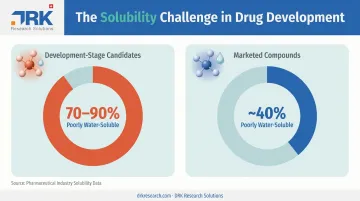
The scale of this problem is larger than most non-formulation teams realize. A 2023 peer-reviewed review found that an estimated 70%-90% of development-stage drug candidates are poorly water-soluble, a figure that lines up with earlier research placing the number at roughly 40% for already-marketed compounds. Poor solubility doesn't automatically doom a candidate, but it does mean formulation science has to work harder to compensate.
What the Industry Actually Demands
Regulators and patients expect formulation to deliver on several fronts simultaneously:
- Batch-to-batch consistency so every dose performs the same way
- Patient compliance through acceptable taste, size, and dosing frequency
- Shelf-life stability across storage and shipping conditions
- Regulatory-compliant manufacturability at commercial scale
What Goes Wrong Without Rigorous Work
Skipping or rushing formulation work tends to surface problems late, when they're expensive to fix:
- Inconsistent dosing between batches or over shelf life
- Poor patient adherence caused by unpleasant dosage forms
- Failed stability studies that delay regulatory filings
- Formulations that work at lab scale but fail during scale-up
Structured formulation development is a regulatory expectation baked into IND and NDA filings, and an industry best practice for de-risking both clinical and commercial success. Formulation decisions made in Phase 1, often simple capsules for speed, have to evolve toward market-representative formulations by Phase 3. Sponsors who plan for that evolution early avoid costly rework later.
How the Drug Product Formulation and Development Process Works
At a high level, formulation development is a continuum: characterize the API, design a candidate formulation, test it, refine it, then scale it. Inputs include the API itself, candidate excipients, analytical data, and the target product profile the sponsor is aiming for.
During the core transformation phase, formulation scientists combine excipients and API, test for compatibility, and refine the mix through iterative rounds. Analytical testing, including dissolution profiles, particle size analysis, pH checks, and stability chambers, controls the process at every step. What comes out the other end is a validated, reproducible formulation ready for clinical supply or commercial scale-up.
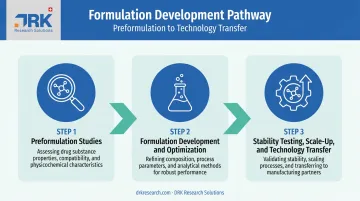
Step 1: Preformulation Studies
Before any excipient gets chosen, the API's physicochemical properties need characterizing: solubility, polymorphism, particle size, and pH sensitivity. This step sets the foundation for every formulation decision that follows. Skip it, and later-stage formulation work becomes guesswork.
Step 2: Formulation Development and Optimization
With preformulation data in hand, formulators select excipients and combine them with the API to build candidate formulations. Each candidate gets screened for compatibility, dosage form feasibility, and whether it hits the target release profile. This stage usually involves several rounds of refinement before a formulation is strong enough to move forward.
Step 3: Stability Testing, Scale-Up, and Technology Transfer
Finalized formulations undergo ICH-aligned stability studies (typically 12 months of long-term data plus 6 months of accelerated data), container-closure testing, and scale-up trials. This confirms the formulation performs consistently from lab batch to commercial manufacturing. Technology transfer, moving detailed process documentation and know-how to a manufacturing site, is where many formulations either hold up or reveal gaps that weren't visible at small scale. DRK Research Solutions supports sponsors through exactly this handoff, pairing formulation development expertise with hands-on technology transfer to manufacturing partners.
Key Factors That Affect Drug Product Formulation and Development
Several variables shape whether a formulation succeeds or stalls:
- API-related inputs – Solubility, particle size, and polymorphism directly influence dissolution and absorption
- Operating conditions – Temperature, humidity, and light exposure affect chemical and physical stability during both development and storage
- Equipment and technology dependencies – Poorly soluble compounds, nanoformulations, and complex injectables often require specialized platforms, such as high-shear granulators or lyophilizers, that not every lab has access to
- Scale considerations – A formulation that works at lab scale may behave differently during pilot or commercial production
- Regulatory and quality constraints – Excipient acceptability limits and required stability data packages vary by target market
- Patient-centric factors – Route of administration, taste, dosing frequency, and ease of use all affect real-world adherence
None of these factors operate in isolation. A change in particle size, for instance, can simultaneously affect dissolution rate, stability under humidity, and the equipment needed to manufacture at scale.
Common Challenges, Misconceptions, and Choosing the Right Formulation Partner
One persistent misconception: formulation is treated as a one-time step rather than an evolving process that continues from Phase 1 through commercial launch. Teams often oversimplify by assuming a formulation that worked for early clinical supply can be scaled directly to market without further optimization or stability work. It rarely can.
Beyond this scaling misconception, smaller biotech and academic teams often face a resource gap. Specialized formulation work commonly demands capabilities most teams don't have in-house:
- Handling poorly soluble APIs, complex generics, and hybrid products
- Specialized equipment for solubility and stability testing
- Regulatory experience spanning multiple jurisdictions
Outsourcing to an experienced CRO/CDMO becomes a practical necessity, not just a convenience.
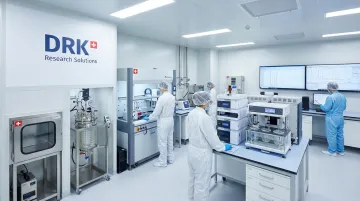
This is where partners like DRK Research Solutions fit in. As a global CRO/CDMO, DRK offers integrated formulation, generics, and hybrid product development support spanning:
- Lab-scale formulation development and optimization
- Analytical method development aligned with ICH and USP standards
- Technology transfer with on-site support at manufacturing partners
- Exhibit and commercial batch manufacturing under GMP conditions
- eCTD dossier preparation covering Modules 2-5
Working across regulated and emerging markets, DRK aligns its formulation and technology transfer work with EU GMP, US FDA, MHRA, WHO PQ, and PIC/S frameworks. That kind of coverage matters because outsourcing demand keeps climbing.
McKinsey research found that CRO/CDMO spending grew 12%-13% annually between 2014 and 2022, nearly double the 7%-8% growth rate of overall pharma R&D spending. Sponsors are choosing specialized partners because building every capability in-house no longer makes sense for most programs.
Teams weighing that decision can reach out to DRK Research Solutions directly to discuss project-specific needs.
Frequently Asked Questions
What is drug product formulation and development?
Drug product formulation and development is the process of combining an API with excipients into a stable, patient-ready dosage form designed to deliver the drug safely and effectively via its intended route of administration.
What is the difference between R&D and formulation & development?
R&D covers early discovery and molecule validation. Formulation and development is the applied science of converting that validated molecule into a deliverable, manufacturable product.
What is an example of a drug formulation?
An oral extended-release tablet and a sterile injectable of the same API are both valid examples, showing how one molecule can be formulated differently depending on the release and delivery goals.
What is the difference between preformulation and formulation development?
Preformulation characterizes the API's physical and chemical properties first. Formulation development then uses that data to design and test the actual dosage form.
How long does drug formulation and development typically take?
Timelines vary widely by API complexity and dosage form. Simple oral solids often move faster, while modified-release products or injectables require more extensive stability and bridging studies, extending development considerably.
Why do companies outsource formulation development to a CDMO?
Outsourcing provides access to specialized expertise, equipment, and global regulatory experience that would take years to build in-house. DRK Research Solutions, for example, integrates formulation development with analytical method development and eCTD dossier preparation, accelerating timelines while reducing cost and risk.