Prototype development often gets filed under "best practice" and left there, discussed in slide decks but rarely tied to real outcomes. Its actual value shows up somewhere less abstract: in faster go/no-go calls, in capital that stays available for the candidates worth pursuing, and in problems caught on a lab bench instead of in a clinical trial.
This article looks at why prototype development matters in practice, not theory, for sponsors trying to move a program from concept to IND without burning through their runway.
Key Takeaways
- Prototyping confirms feasibility before costly IND-enabling studies begin
- Parallel testing replaces slow, sequential experiments to compress timelines
- Catching flaws early costs far less than catching them in clinical trials
- Skipping this step risks costly reformulation, delays, and wasted spend
- Integrated CRO/CDMO partners speed the prototype-to-clinic handoff
What Is Prototype Development?
Prototype development is the process of building early, testable versions of a drug candidate. This might be a computational model, a small-scale formulation batch, or a proof-of-concept sample, built to check feasibility before committing money to full-scale studies.
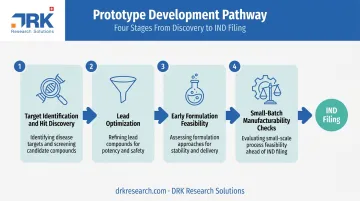
It typically shows up at four points in a program:
- Target identification and hit discovery – testing whether a biological target is druggable using computational models
- Lead optimization – narrowing a pool of candidate compounds to the ones worth carrying forward
- Early formulation feasibility – testing how an API behaves with different excipients and delivery routes
- Small-batch manufacturability checks – verifying processes scale before GLP toxicology work and IND filing
None of this exists for its own sake. A prototype only earns its cost if it produces an informed go/no-go decision. The goal is evidence a sponsor can act on, not a polished product.
Key Advantages of Prototype Development
The advantages below are the ones program leads and sponsors actually track: risk, speed, cost, and scientific confidence. These are the factors that decide whether a program advances to the next phase or gets deprioritized during a portfolio review.
De-Risking Scientific and Technical Uncertainty
Early prototypes, whether a virtual screening model or a bench-scale formulation batch, exist to surface fundamental flaws before they turn into bigger problems. A target that looks promising on paper doesn't always hold up once someone tests it.
That gap between published promise and reproducible reality is well documented. Researchers at Amgen attempted to confirm the findings of 53 landmark preclinical cancer papers and could only reproduce results in 6 of them, roughly 11%. A separate analysis at Bayer validated only about 25% of published preclinical studies to the point where a project could reasonably continue.
That's not a knock on the original research. It's a reminder that assumptions need testing before they carry a full program budget. Automated screening pipelines and rapid formulation cycles let teams test many variables at once, filtering out non-viable candidates before they consume major resources.
In practice, this changes how sponsors commit capital. Instead of funding a program on the strength of a hypothesis, teams commit real budget only once scientific feasibility has been demonstrated with actual data.
KPIs affected by this advantage:
- Candidate attrition rate
- Target validation confidence
- Formulation failure rate
- Time-to-first-decision
This advantage carries the most weight for novel targets, first-in-class compounds, or complex formulations such as modified-release or hybrid products, where uncertainty runs highest and a false positive is most expensive to carry forward.
Compressing Discovery-to-Decision Timelines
Traditional experimentation tests one variable at a time, in sequence. Change the solvent, wait for results, change the ratio, wait again. Prototype development breaks that pattern by allowing parallel, iterative testing instead.
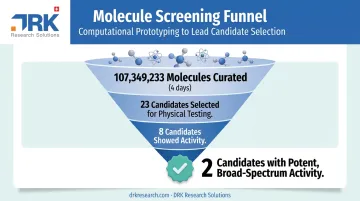
Computational prototyping shows just how much ground this covers. In one widely cited example, researchers curated 107,349,233 molecules in four days, narrowed the list to 23 candidates for physical testing, found activity in 8, and identified 2 with potent, broad-spectrum activity. Work that would have taken months of bench screening happened before a single physical sample was ordered.
Rapid small-batch formulation cycles work the same way on the physical side. Several formulation variants get tested in parallel rather than one after another, so a team converges on a viable candidate in weeks rather than quarters.
The decision-making impact is straightforward: faster prototype cycles let sponsors reallocate budget toward the winning candidate sooner, instead of discovering three months in that they backed the wrong one.
KPIs affected by this advantage:
- Time-to-candidate-selection
- Cycle time per iteration
- Program timeline-to-IND
This matters most under competitive pressure, when a patent clock is running or when multiple candidate variants need comparison before a filing deadline forces a decision regardless of readiness.
Reducing the Cost of Late-Stage Failure
A flaw caught during prototyping costs a technician's time and a small batch of materials. The same flaw caught during GLP toxicology, clinical trials, or manufacturing scale-up costs months of program time and a far larger bill.
The math behind that gap is stark. Industry data covering 12,728 development transitions found a 7.9% cumulative probability of reaching approval from Phase I, with Phase II carrying the lowest transition success rate at 28.9%.
Every candidate that reaches clinical trials without adequate prototype-stage vetting is competing against those odds, whether or not it was ever viable to begin with.
Prototype-stage investment is a small fraction of a full preclinical or clinical program budget. Catching a non-starter early is cheap failure. Catching it after years of clinical spend is a very different kind of setback, one that can sink a smaller sponsor's entire pipeline.
KPIs affected by this advantage:
- Cost-per-viable-candidate
- Sunk-cost exposure
- Portfolio attrition cost
Resource-constrained biotechs and sponsors managing multi-candidate portfolios feel this most: every dollar spent on a candidate that was never going to work is a dollar unavailable for one that might.
What Happens When Prototype Development Is Skipped or Rushed
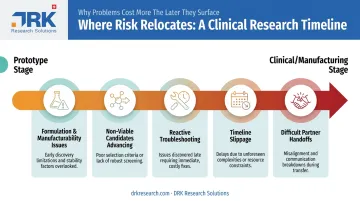
Skipping or compressing this phase doesn't eliminate risk. It just relocates it further downstream, where it costs more to fix. The pattern shows up consistently across sponsor programs:
- Formulation or manufacturability issues surface during scale-up or clinical supply, forcing reformulation that early testing would have caught
- Non-viable targets or compounds advance further than they should, inflating the cost of trials that were never going to succeed
- Teams shift into reactive troubleshooting during GLP or clinical stages instead of catching problems while they're still cheap to fix
- Program timelines slip as late-discovered issues force parts of development to restart
- Handoff to manufacturing or clinical partners gets harder without a validated starting point to build from
Scale-up in particular tends to expose weak assumptions that never got tested at bench scale. A formulation that looked stable in a small batch can behave differently once volumes increase.
By that point, the fix touches process, analytical methods, and sometimes the regulatory dossier all at once. Final dosage form decisions are a frequently underestimated risk for this reason: what works in early testing doesn't automatically translate into what a regulator or a manufacturing line will accept.
How to Get the Most Value from Prototype Development
Prototype development pays off when it's treated as a decision-making tool, not an open-ended science project. A few practices separate programs that extract real value from it and those that merely go through the motions:
- Define go/no-go criteria before starting, not after seeing the data. If success isn't defined in advance, every result can be rationalized as promising.
- Review findings across functions, not just within one team. A formulation issue that looks minor to a bench scientist can be a major regulatory flag, and only a cross-functional review catches that early.
- Feed insights directly into the next phase's protocol design. A prototype that gets archived and forgotten wastes the entire exercise.
The handoff between prototype work and IND-enabling studies is where a lot of that value gets lost, usually because it involves switching vendors. Each transition point creates a chance for data gaps or inconsistent documentation to creep in:
- Formulation to analytical method development
- Analytical method development to technology transfer
- Technology transfer to IND-enabling study protocols
This is where an integrated partner closes that gap. DRK Research Solutions structures its product development services, lab-scale formulation and optimization, analytical method development, technology transfer, and eCTD dossier preparation, as a single continuous engagement rather than separate handoffs between vendors.
Formulation strategies are built with regulatory foresight from the start. The data generated during prototyping carries forward into stability studies, manufacturing scale-up, and the dossier itself, without a separate team re-deriving it later.
For sponsors, that continuity is often the difference between a prototype that directly informs the next phase and one that has to be re-validated because nobody kept the thread intact.
Conclusion
Prototype development earns its place in a drug program through three practical outcomes: risk caught early, decisions made faster, and capital preserved for the candidates that deserve it.
These advantages compound. A target validated at the prototype stage moves into lead optimization with fewer unknowns. A formulation vetted for manufacturability moves into GLP studies without a redesign hanging over it. Each de-risked stage improves the odds and the speed of the one that follows.
Prototype development works best as an ongoing discipline that runs through every early-stage decision, from the first computational screen to the last formulation tweak before an IND filing.
Sponsors who build this discipline into their programs, often alongside a product development partner like DRK Research Solutions, tend to spend their budget on candidates worth pursuing, rather than finding out too late that they weren't.
Frequently Asked Questions
What are the four main stages of drug development?
Drug development generally moves through discovery, preclinical research, clinical trials, and regulatory review. Some frameworks add post-market safety monitoring as a fifth, ongoing phase after approval.
What does prototype mean for medications?
In this context, a prototype is an early, testable version of a drug candidate or formulation, built to check feasibility before a sponsor commits to full-scale development. It's a working sample, not a finished product.
What is an example of a prototype drug?
Morphine is often called a prototype because it represents an entire drug class, the standard other opioids are measured against. An operational prototype is different: it's an early formulation batch built to test dosing or manufacturability, not a reference compound.
How long does prototype development typically take in early-stage programs?
Timelines vary by modality and complexity, but prototyping cycles are typically measured in weeks to months. That's far shorter than the multi-year timelines tied to full preclinical or clinical development.
Why is prototype development important before clinical trials?
It validates scientific and manufacturing feasibility while problems are still cheap to fix. Skipping it shifts that risk into clinical trials, where failures cost far more in time and money.
How can a CRO/CDMO partner support prototype development?
An integrated partner provides discovery, formulation, and small-scale manufacturing expertise under one roof. That reduces the handoff friction sponsors face moving from prototype work into IND-enabling studies.