Introduction
Every new drug candidate lives or dies on its data, and every data point depends on the analytical method that generated it. Get the method wrong, and you get an unreliable answer, no matter how good the drug substance actually is.
Analytical method development (AMD) is the systematic process of designing and validating test procedures that identify, quantify, and characterize a drug substance's physical and chemical properties. Regulatory bodies expect this rigor: ICH Q2(R2) guidelines require demonstrated accuracy, precision, and specificity before a method earns validation status.
In practice, it's how a lab proves a tablet contains exactly what the label says, in the amount it says, with no dangerous byproducts hiding underneath.
This guide is written for pharmaceutical and biopharmaceutical sponsors, CROs, and CDMOs developing new therapies. AMD shows up constantly in CMC sections and regulatory submissions, yet it's often poorly understood outside the technical teams running it.
Here's what we'll cover: what AMD is, why it matters, how it actually works step-by-step, where it applies across development, and when a full-scale approach isn't the right call.
Key Takeaways
- AMD confirms identity, purity, potency, and stability against defined acceptance criteria.
- It's both a regulatory requirement (ICH, FDA, EMA) and a quality assurance necessity.
- The process moves through CQA identification, method design, and validation in that order.
- Its scope spans R&D through commercial production, evolving at each stage.
- Methods must stay phase-appropriate, scaling in rigor as a program matures.
What Is Analytical Method Development?
Analytical method development (AMD) is the process of designing, selecting, and optimizing analytical procedures, such as HPLC, GC, or mass spectrometry, to test specific quality attributes of a drug against predefined acceptance criteria. The intended outcome is straightforward: a reliable, reproducible test method that accurately measures identity, strength, purity, and other quality characteristics.
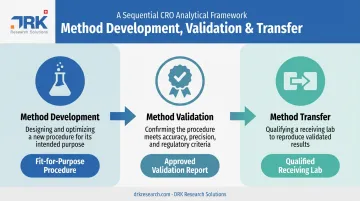
People frequently confuse three related but distinct activities—here's how they actually differ:
| Activity | What it does | End result |
|---|---|---|
| Method development | Selects the technology, studies variables, and builds a working procedure | A fit-for-purpose analytical procedure |
| Method validation | Formally proves the method meets ICH Q2(R1)/Q2(R2) performance criteria | An approved validation report |
| Method transfer | Qualifies a receiving lab to run an already-developed, validated method | A second lab capable of executing the same procedure |
Development asks "what procedure will work?" Validation asks "can we prove it works?" Transfer asks "can another lab run it correctly?" Skipping any one of these steps, or treating them as interchangeable, is one of the most common and costly mistakes sponsors make.
Why Analytical Method Development Is Critical in Pharmaceutical & Biopharmaceutical Development
Drug quality assessment depends entirely on the reliability of the analytical methods behind it. If the method can't detect an impurity, that impurity doesn't exist on paper, even if it's sitting in every batch you manufacture.
FDA's review of investigational new drug holds over a five-year period examined quality-related safety issues across 147 commercial and 211 research INDs. CMC and analytical gaps are a common barrier to clinical progress, the data shows.
The regulatory mandate is unambiguous. Global authorities require validated analytical procedures for IND, IMPD, NDA, and BLA submissions. Without them:
- Clinical trial approvals stall or get delayed
- Reviewers issue information requests that push back timelines
- Sponsors face costly rework late in development, when it's most expensive to fix
When AMD is weak, problems surface quietly and expensively:
- Batch quality becomes inconsistent across production runs
- Degradation products and impurities slip past detection
- Stability failures surface after the fact, sometimes only once product is in patients' hands
AMD is a regulatory obligation and an industry best practice. Treating it as optional invites the kind of deficiency that stalls a submission.
Partnering with an experienced global CRO/CDMO helps sponsors avoid this trap. DRK Research Solutions works across GxP-compliant frameworks spanning ICH, USP, and regional standards across its operating regions in Europe, the Middle East, Asia, Africa, and the Americas. This helps sponsors build methods correctly the first time rather than redeveloping them mid-program.
How Analytical Method Development Works: A Step-by-Step Breakdown
At a high level, AMD begins with identifying critical quality attributes (CQAs), moves through selecting and designing candidate techniques, then optimization and documentation. The process draws on drug substance and product samples, reference standards, molecular chemistry knowledge, and the Target Product Profile.
Analytical chemists systematically test and refine parameters, including mobile phase, column type, and detection settings, until the method reliably distinguishes and quantifies the compound of interest.
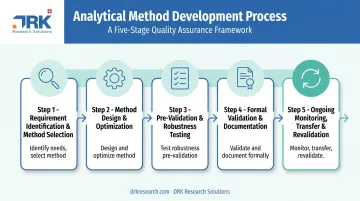
ICH Q14 formalizes this with tools like Design of Experiments (DoE) and the Method Operable Design Region (MODR), which defines the combined parameter ranges within which a method stays fit for purpose. Here's how it plays out in five stages.
Step 1: Requirement Identification & Method Selection
A lab or sponsor recognizes the need for a method and checks whether an existing compendial (USP/EP) procedure fits. A compendial method isn't automatically adequate just because it's published; it must be verified under the actual conditions of use. If it doesn't fit the molecule or matrix, a custom method gets developed instead.
Step 2: Method Design & Optimization
Scientists design the procedure and iteratively optimize it for sensitivity, specificity, and reproducibility. This is where DoE approaches earn their keep, letting chemists test multiple parameters simultaneously rather than adjusting one variable at a time.
Step 3: Pre-Validation & Robustness Testing
Before formal validation begins, the method undergoes robustness checks and preliminary accuracy and precision assessments. This confirms the method is actually ready for the scrutiny of formal validation, rather than discovering gaps mid-protocol.
Step 4: Formal Validation & Documentation
Analysts validate the method against ICH Q2(R2) parameters, covering specificity, accuracy, precision, linearity, range, and detection/quantitation limits. The team then generates a validation report and approves SOPs for routine use.
Step 5: Ongoing Monitoring, Transfer & Revalidation
Labs monitor validated methods through system suitability and QC checks on an ongoing basis. Teams may transfer methods to other labs and revalidate them whenever synthesis, formulation, or the procedure itself changes.
At DRK Research Solutions, our analytical chemists apply this same framework across therapeutic areas, supporting sponsors from initial method design through technology transfer and revalidation.
Where AMD Is Applied Across the Drug Development Lifecycle
AMD isn't a one-and-done exercise. It evolves as a program matures, with regulatory rigor increasing at each stage.
| Development stage | What AMD does here |
|---|---|
| Proof-of-concept / R&D | Initial method design supports the Target Product Profile and helps teams understand API behavior with excipients |
| Early clinical development | Methods get refined for repeatability and robustness to test IMP batches for early-phase trials |
| Scale-up & commercial manufacturing | Methods handle CQA monitoring, stability programs, and GMP release/QC testing |
A method built for a Phase I proof-of-concept study rarely survives unchanged into commercial release testing. Regulatory guidance doesn't expect it to. EMA's IMPD (Investigational Medicinal Product Dossier) requirements, for instance, ask for confirmed method suitability in Phase I, moving to a complete validation summary by Phase II/III.
This full-lifecycle view is part of why analytical method development sits inside DRK Research Solutions' broader Product Development offering alongside formulation development, technology transfer, and eCTD dossier preparation. Methods built early need to hold up as they feed into stability programs, tech transfer packages, and eventually the dossier itself.
Key Factors, Common Misconceptions & When to Reassess Your Approach
Key Factors That Affect Method Development
Several variables shape how a method gets built and how well it performs:
- Inputs and materials: API purity, reference standard quality, and matrix complexity all affect sensitivity and specificity
- Operating conditions: instrument calibration, mobile phase composition, and detector settings change method effectiveness
- Equipment dependencies: availability of specialized instrumentation like HPLC, MS, or dissolution apparatus suited to the molecule type
- Scale and phase: early discovery methods differ substantially from those needed for commercial-scale GMP release
- Regulatory constraints: ICH, FDA, and EMA guidance dictate validation parameters specific to the product class, whether small molecule or biologic
Common Misconceptions
Beyond these technical factors, a few recurring mistakes trip up teams that are new to formal AMD:
- Treating development and validation as interchangeable, rather than sequential and distinct
- Assuming one method can serve unchanged across every development phase without reoptimization
- Confusing method robustness (the test's own consistency) with process robustness (manufacturing consistency)
- Mistaking a passed system suitability check for full validation, which leaves submissions underprepared
When to Reassess Your Approach
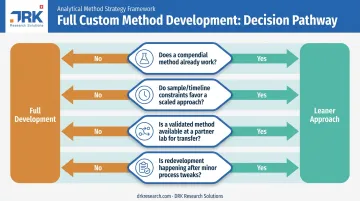
Avoiding these missteps matters, but the bigger question is often whether full-scale custom development is even necessary. Consider a leaner approach when:
- Check whether an existing compendial method already works; verification under actual conditions may be all that's needed
- Weigh sample availability and timeline constraints, since a phase-appropriate, scaled-back approach often fits better than full development
- Look for a validated method at a partner lab, as transferring it in may beat redeveloping from scratch
- Watch for methods getting redeveloped after every minor process tweak, which usually signals a change-control problem rather than a need for more development
Conclusion
Analytical method development is the systematic process of designing, optimizing, and validating test procedures that verify a drug's identity, purity, potency, and stability. Get it wrong, and the consequences ripple through regulatory timelines, product quality, and ultimately patient safety.
Avoiding those consequences takes more than a generic checklist. It means applying the right level of rigor at the right phase, and knowing when a method needs more work versus when it's already fit for purpose. An experienced partner like DRK Research Solutions, working across GxP-compliant frameworks in multiple regions, can help sponsors get this balance right from the start.
Frequently Asked Questions
What is analytical method development in pharma?
Analytical method development is the process of designing and optimizing test procedures used to establish a drug's identity, purity, potency, and stability against predefined acceptance criteria. This process is the foundation every quality claim about a drug rests on.
What are the main types of analytical methods used in analytical method development?
The main categories are separation and quantitation methods (HPLC, GC, MS), in vitro release and dissolution methods, and physical characterization methods like XRPD, DSC, and particle sizing. Which ones apply depends on the molecule and dosage form.
What is the difference between analytical method development and method validation?
Development designs and optimizes the method itself. Validation formally proves that method meets ICH Q2(R1)/Q2(R2) performance criteria through a predefined protocol and report.
How long does analytical method development typically take?
Timelines vary widely by molecule complexity and development phase. Adapting a compendial method might take a few weeks, while developing a novel method for a complex biologic can take several months.
What regulatory guidelines govern analytical method development?
Key references include ICH Q2(R1)/Q2(R2) for validation, ICH Q14 for development, FDA and EMA guidance documents, and USP chapters <1225> and <1226>. Requirements scale with development phase and product class.
What is analytical method transfer and how does it relate to method development?
Method transfer qualifies a receiving lab to run a method that has already been developed and validated elsewhere. It is a distinct activity from original development, focused on confirming another site can execute the existing procedure correctly.