Introduction
Topical ophthalmic dosage form development is the systematic formulation and manufacturing process used to create eye drops, ointments, gels, suspensions, and emulsions that safely deliver an active ingredient to ocular tissue. This guide is written for pharmaceutical and biopharmaceutical formulation scientists, regulatory teams, and sponsors evaluating development partners.
Getting this process right matters. A single sterility failure or comfort complaint can delay approval, trigger a recall, or sink a product's commercial launch.
These consequences often trace back to one avoidable mistake: treating ophthalmic development like standard topical or dermal formulation work. That assumption overlooks critical differences, causing failures that surface late, during stability testing or after launch. The eye has unique sterility, tonicity, and tolerability requirements that skin-applied products simply don't face.
It covers what the process is, why it matters, how it works step-by-step, which factors affect outcomes, and when the topical route isn't the right choice at all.
Key Takeaways
- Rapid tear clearance and low corneal permeability are the biggest barriers to ophthalmic drug absorption
- Quality by Design (QbD) is the standard framework, built on defining QTPPs, CQAs, and CPPs
- Sterility, pH, osmolality, viscosity, and preservative efficacy determine product success or failure
- Posterior segment diseases often need injections or implants instead of topical formulations
What Is Topical Ophthalmic Dosage Form Development?
This is the multidisciplinary formulation science process of designing sterile, ocularly tolerable products intended for direct application to the eye surface or surrounding tissue. It spans solutions, suspensions, emulsions, ointments, and gels.
The goal is straightforward to state but hard to achieve: a product that's safe, compatible with the tear film, and stable through its entire shelf life. It must also deliver enough drug despite the eye's aggressive clearance mechanisms.
This differs from general semi-solid or dermal topical development in a critical way. Ophthalmic products require sterility, isotonicity, and tear-film pH compatibility that skin-applied topicals never need to meet.
Main Types of Topical Ophthalmic Dosage Forms
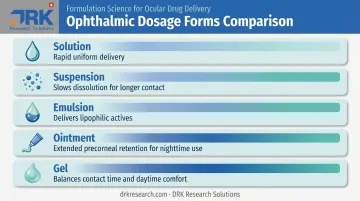
Each dosage form solves a different formulation problem:
| Dosage Form | Primary Purpose |
|---|---|
| Solution | API fully dissolved for rapid, uniform delivery |
| Suspension | Slows dissolution of poorly soluble APIs for longer contact time |
| Emulsion | Delivers lipophilic actives via a dispersed liquid phase |
| Ointment | Extends precorneal retention, ideal for nighttime dosing |
| Gel | Balances extended contact time with better daytime tolerability than ointments |
Selection depends on API solubility, the retention time needed on the eye, and how patients will actually use the product. A once-daily glaucoma drop calls for different engineering than a nighttime lubricating ointment.
Why This Development Process Is Critical in Pharma & Biopharma
The eye is built to reject foreign substances. The lipophilic corneal epithelium blocks many hydrophilic drugs, and rapid nasolacrimal drainage combined with constant tear turnover washes most of the dose away within minutes.
The numbers make this concrete. A peer-reviewed 2021 review found less than 5% corneal bioavailability from conventional eye drops. Most of what patients instill simply never reaches its target.
Rigorous development addresses three demands that general topical work doesn't face:
- Sterility assurance across the entire manufacturing chain
- Patient comfort and tolerability, since irritation drives non-compliance
- Consistent dosing despite blinking, tearing, and dilution
What Goes Wrong Without It
Skipping ophthalmic-specific rigor leads to real consequences. In August 2023, the FDA reported that a lot of Dr. Berne's MSM Drops 5% Solution failed sterility testing, showing both bacterial and fungal contamination. The firm recalled multiple product lines after adverse event reports came in, underscoring that sterility isn't optional paperwork.
This rigor is regulatory-driven, grounded in FDA and EMA sterility expectations and ICH Q8 quality-by-design guidance. Many pharma teams underestimate how different ocular requirements are from general topical work, and that underestimation causes expensive delays.
Partnering with a development team that has already navigated these ocular-specific hurdles helps sponsors avoid these pitfalls before they become costly. DRK Research Solutions, for example, supports generics and hybrid product development for regulated markets.
How Topical Ophthalmic Dosage Forms Are Developed (QbD Framework)
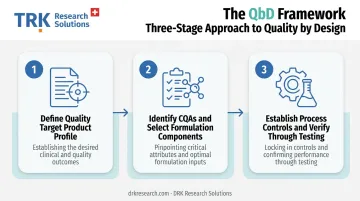
Modern ophthalmic development follows a Quality by Design approach. Instead of testing quality into a finished batch, teams build it in from the start, moving from defined product requirements to a validated, reproducible manufacturing process.
Development inputs include the API's physicochemical properties, the target indication, the patient population, and intended dosing frequency (once daily versus twice daily). From there, formulation scientists translate a Quality Target Product Profile into measurable, controllable attributes.
ICH's foundational Q8(R2) guideline defines this: the QTPP is a prospective summary of quality characteristics that a product should ideally achieve, and Critical Quality Attributes are the properties that must stay within defined limits to protect that quality.
Step 1: Define the Quality Target Product Profile (QTPP)
Before any formulation work begins, the QTPP captures the dosage form, strength, route of administration, in-use stability requirements, and patient-perceived attributes like comfort and clarity. This document becomes the north star for every downstream decision.
Step 2: Identify CQAs and Select Formulation Components
With the QTPP set, teams identify CQAs (sterility, pH, osmolality, viscosity, preservative efficacy) and select components accordingly. This includes:
- Preservatives, such as benzalkonium chloride or polyquaternium-1, chosen for antimicrobial effectiveness balanced against corneal tolerability
- Tonicity agents to match tear osmolality
- Buffers to stabilize pH near ocular tolerance
- Viscosity enhancers to extend contact time where needed
Preservative choice matters more than it might seem. Benzalkonium chloride is effective but has been linked to punctate and toxic ulcerative keratopathy with repeated exposure. Polyquaternium-1 is often gentler on the ocular surface, though it still carries some risk of epithelial irritation. Every preservative option involves trade-offs suited to the specific formulation.
Step 3: Establish Process Controls and Verify Through Testing
CQAs are protected through Critical Process Parameters. Sterilization method selection is the first major decision: terminal autoclaving where the formulation tolerates heat, or aseptic filtration where it doesn't. Fill volume accuracy and aseptic environment controls come next.
Confirmatory testing follows USP chapters built specifically for ophthalmics, covering sterility, particulate matter, and preservative efficacy. These tests run alongside ICH stability protocols before any scale-up decision gets made.
Key Factors, CQAs & Where This Process Is Applied
Several variables and critical quality attributes (CQAs) shape whether an ophthalmic formulation succeeds:
- Inputs and materials: API solubility and stability, preservative-API compatibility, and container interactions such as extractables from LDPE or HDPE packaging
- Operating conditions: pH is typically formulated close to tear pH (around 7.0–7.4), with osmolality targeted near isotonic saline equivalence for comfort
- Equipment dependencies: ISO 5 (Class 100) aseptic filling lines, or validated terminal sterilization equipment where heat-stable formulations allow it
- Scale considerations: small batch sizes dominate early clinical development, while commercial manufacturing demands multi-dose consistency at volume
- Regulatory constraints: USP performance tests, sterility assurance levels, and FDA CMC expectations for ANDA or NDA submissions
Common CQAs for ophthalmic products include:
| CQA | Typical Target |
|---|---|
| pH | 7.0–7.4 |
| Osmolality | ~290 mOsm/kg (isotonic) |
| Sterility | No microbial growth |
Meeting these targets consistently matters across the entire product lifecycle—preclinical formulation screening, IND-enabling development, technology transfer during scale-up, and post-approval changes like preservative-free line extensions for sensitive patient populations.
Common Challenges, Misconceptions & When Alternative Delivery Routes Are Better
A few misconceptions cause the most rework and delay.
Dermal principles don't transfer directly. Teams sometimes assume semi-solid formulation know-how carries over to ophthalmics, overlooking sterility and tear-film compatibility requirements that dermal work never had to address.
Passing preservative efficacy testing isn't the finish line. A formulation can pass PET and still fail ocular irritation or biocompatibility studies. These are separate hurdles, not sequential checkboxes.
Sterility testing isn't full approval. Meeting a sterility specification confirms one attribute. Particulate matter, clarity, and preservative efficacy all need independent validation before a dossier is submission-ready.
When Topical Isn't the Right Route
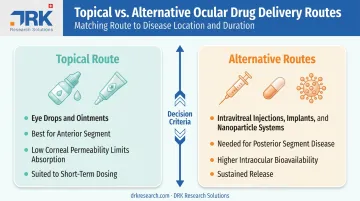
The topical route has real limits. Posterior segment diseases (those affecting the retina or back-of-eye structures) typically need far higher intraocular bioavailability than drops can deliver. These usually call for intravitreal injections, implants, or nanoparticle-based systems instead.
Watch for these signals that a topical approach is being used by default rather than by design:
- Very low corneal permeability for the API in question
- A therapeutic need for sustained release well beyond what drops or ointments can achieve
- A history of formulation attempts falling short of targeted intraocular drug levels
Understanding when the topical route genuinely fits, versus when it's a default assumption, reduces late-stage reformulation risk and regulatory delay. This is exactly where an experienced CRO partner such as DRK Research Solutions adds measurable value, guiding sponsors through formulation science, technology transfer, and eCTD dossier preparation with the ocular-specific expertise many internal teams haven't built yet.
Frequently Asked Questions
What are the main types of topical ophthalmic dosage forms?
The main types are solutions, suspensions, emulsions, ointments, and gels. Each is chosen based on API solubility, stability needs, and how long the product must stay in contact with the eye.
Why must ophthalmic formulations be sterile when many topical semi-solids don't require it?
Ophthalmic products contact sensitive ocular tissue directly, creating infection risk that skin-applied semi-solids don't carry. Dermal products typically only need microbial limits testing, not full sterility.
What is Quality by Design (QbD) and why is it used in ophthalmic development?
QbD is a systematic framework linking the QTPP, CQAs, and CPPs to build quality into a product from the start. It replaces the older approach of testing quality into the finished product after manufacturing.
What pH and osmolality ranges are considered safe for ophthalmic products?
Formulation literature generally targets pH near the tear film's natural 7.4, with a broader tolerability window depending on the specific product. Osmolality is typically formulated close to isotonic saline for comfort.
How is ophthalmic formulation development different from dermal or topical semi-solid development?
Ophthalmics require sterility, isotonicity, and tear-film pH compatibility, plus a much narrower range of approved excipients. Dermal formulations don't carry these constraints.
When should a company consider outsourcing ophthalmic dosage form development to a CDMO?
Outsourcing makes sense when internal teams lack ocular-specific formulation, sterility, or regulatory expertise. Partners like DRK Research Solutions bring that formulation and regulatory experience from day one, helping sponsors avoid costly development delays.