The term gets used constantly in industry conversations, yet the operational reality behind it, the stages, the controls, the decision points where things go right or wrong, is far less understood. Many teams sign a CDMO contract without knowing what happens between "we have a synthesis route" and "batch released to market."
This article walks through how the process actually works end-to-end, what factors shape the outcome, and when outsourcing API production isn't the smartest move.
Key Takeaways
- API contract manufacturing outsources drug substance synthesis, scale-up, and commercial production under GMP control
- Building in-house API capacity demands heavy capital investment and specialized regulatory expertise
- Each stage, from development through commercial rollout, includes dedicated quality checkpoints to catch issues early
- Raw material sourcing, equipment fit, and regulatory jurisdiction all shape final outcomes
- Early-stage proprietary compounds or very low-volume niche APIs often perform better kept in-house
What Is API Contract Manufacturing?
API contract manufacturing means handing off the synthesis, scale-up, and commercial production of a drug's active ingredient to a third-party CMO or CDMO. The goal is consistent output: a GMP-compliant API that meets defined purity, potency, and stability specifications at whatever scale the sponsor needs.
This is distinct from finished dosage form (FDF) manufacturing, which turns the API into the tablet, capsule, or injectable a patient actually receives. It's also distinct from "full CDMO services": A CMO manufactures to an existing specification. A CDMO adds development work, process optimization, and scale-up support before manufacturing even begins.
Why Pharmaceutical Companies Outsource API Manufacturing
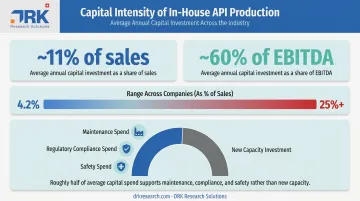
Building API production in-house isn't a light decision. Contract Pharma's analysis of small-molecule API CDMOs found annual capital investment running close to 11% of sales and roughly 60% of EBITDA (Contract Pharma, 2021).
Individual companies range from 4.2% to more than 25% of sales, depending on scale and facility needs. About half of that spend goes toward maintenance, regulatory compliance, and safety requirements, not new capacity.
That capital intensity, paired with the need for specialized synthesis and purification expertise, pushes many sponsors toward outsourcing. The pharmaceutical contract manufacturing market (which spans both API and finished dosage services) is projected to grow from USD 209.9 billion in 2025 to USD 311.95 billion by 2030, an 8.2% CAGR (MarketsandMarkets, 2025).
That's a total-market figure, not an API-only number, but it reflects how much of the industry now runs on outsourced capacity.
Meeting that demand requires partners who deliver on a few non-negotiables:
- Batch-to-batch consistency at every scale
- Tight impurity control, including nitrosamine risk management
- Capacity that scales cleanly from clinical supply to commercial volume
Without a genuinely specialized partner, things go sideways fast: tech transfer stalls, impurity profiles shift unpredictably between batches, or documentation doesn't hold up under a regulatory inspection. Outsourcing, in other words, is both a regulatory necessity under GMP and ICH Q7, and an operational choice for cost and speed.
This is also where organizations that pair CRO and CDMO capabilities add distinct value. DRK Research Solutions' generics and hybrid product development services, for example, connect development-stage data (formulation work, analytical validation, technology transfer) directly to a network of GMP-compliant manufacturing partners. That connection shortens the path from lab data to compliant commercial API supply for regulated markets.
How the API Contract Manufacturing Process Works
At a high level, the process runs from initial synthesis route design through final API release. It starts with three core inputs:
- Starting materials and reagents needed for the reaction
- A documented, reproducible synthesis route
- Regulatory filings (DMF or CEP) that will eventually support approval
The core transformation happens through chemical synthesis, fermentation, or biocatalytic reactions, followed by purification and isolation steps. Throughout, the process stays controlled through:
- In-process testing at critical stages
- Validated analytical methods for accuracy
- Detailed batch record documentation for traceability
What comes out the other end: a validated, GMP-compliant API ready for formulation into a finished dosage form.
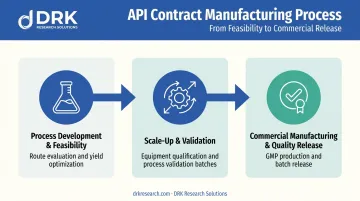
Step 1: Process Development & Feasibility
The CDMO reviews the proposed synthesis route and evaluates whether it holds up at scale. This stage focuses on optimizing yield and purity before anyone commits to larger, more expensive batches. Per ICH Q8, this includes assessing critical process attributes and equipment suitability early, not after problems appear at pilot scale.
Step 2: Scale-Up & Validation
Scale-up moves the process from lab or pilot batches to commercial volume. This means equipment qualification, process validation batches, and aligning documentation with regulatory expectations. Notably, ICH Q11 doesn't mandate a fixed "three batch" rule for process performance qualification; the appropriate number depends on process complexity and how much data already exists.
Step 3: Commercial Manufacturing & Quality Release
Full-scale GMP production follows, backed by comprehensive analytical testing against agreed specifications. Every batch gets reviewed, deviations and out-of-specification results included, before the quality unit signs off on release and shipment to the sponsor.
Where API Contract Manufacturing Is Applied
API contract manufacturing shows up across a wide range of chemistries and product types:
- Small molecule synthesis – route optimization, purification, crystallization, and GMP-scale manufacture
- Generics and hybrid products – same active substance as a reference product, or a hybrid pathway relying partly on reference data and partly on new clinical evidence
- Highly potent APIs (HPAPIs) – compounds active at very low doses, often below 15 micrograms/kg body weight, requiring specialized containment
- Complex modalities like ADCs – where the cytotoxic payload itself qualifies as an HPAPI needing dedicated handling
This engagement isn't limited to one point in a drug's lifecycle. It happens from early clinical-phase supply all the way through ongoing commercial production. Common triggers include:
- Capacity constraints at the sponsor's own site
- Need for chemistry the sponsor doesn't have in-house
- Entry into a newly regulated market
These triggers rarely lead to a single, one-off relationship. Commercial API supply requires recurring engagement, which means the partnership needs long-term planning, not a single project mindset.
Key Factors That Affect the API Contract Manufacturing Process
Several variables shape whether an API contract manufacturing engagement succeeds:
- Raw material sourcing – quality and reliability of suppliers, including dual-sourcing strategies to reduce single-vendor risk
- Operating conditions – reaction temperature, solvent choice, and batch versus continuous processing, all of which affect yield and impurity formation
- Equipment and facility fit – containment systems for HPAPIs, specialized reactors for biocatalysis, and whether existing equipment actually matches the process
- Scale and throughput – clinical-supply batches behave differently than commercial-volume runs, and a process validated at one scale doesn't automatically translate to another
- Regulatory constraints – ICH guidelines, scheduled GMP audits, and impurity or nitrosamine control requirements that vary by jurisdiction
Continuous manufacturing adds another layer here.
ICH Q13 notes that changes in process dynamics or residence-time distribution in continuous systems can shift both conversion rates and impurity formation. This means sampling and diversion strategies need careful, purpose-built design, not a copy-paste from batch processing.
Common Issues, Misconceptions, and When Outsourcing May Not Be Ideal
Common Misconceptions About API Contract Manufacturing
The first misconception: outsourcing is purely a cost-cutting move. In reality, it's often a strategic decision built around access to expertise and specialized equipment a sponsor simply doesn't have.
The second is confusing CMO and CDMO roles:
| CMO | CDMO | |
|---|---|---|
| Core function | Manufactures to existing spec | Develops process, then manufactures |
| Best fit | Mature, transferable processes | Immature or difficult processes |
The third, and riskiest, misconception: once a CDMO is selected, the sponsor has no remaining quality obligations. That's false. FDA guidance is explicit that each party remains responsible for the GMP activities it performs, and the sponsor's quality unit retains legal responsibility for final release, no matter how the contract is written FDA's 2016 guidance on contract manufacturing responsibilities. A written quality agreement can allocate responsibilities, but it cannot transfer statutory accountability.
When API Contract Manufacturing May Not Be the Right Fit
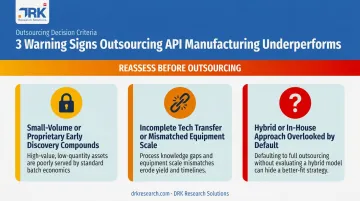
Outsourcing doesn't fit every scenario. It tends to work poorly for:
- Covers very small-volume, highly proprietary early discovery-stage compounds, where control and confidentiality matter more than scale
- Involves incomplete technology transfer documentation or mismatched equipment scale between sponsor and partner
- Applies when a hybrid or in-house approach truly serves the project better, yet outsourcing happens by default rather than for a real strategic reason
If a sponsor can't clearly articulate why outsourcing beats in-house production for their specific compound, that's usually a sign to pause and reassess rather than sign a contract.
Conclusion
API contract manufacturing outsources the synthesis, scale-up, and production of a drug's active ingredient to a specialized partner operating under GMP control. Understanding the operational stages and quality checkpoints, not just the term itself, matters directly for how pharmaceutical and biopharmaceutical companies plan their development timelines.
Getting this right requires choosing a partner with genuine regulatory and scientific depth, not simply deciding to outsource. DRK Research Solutions offers end-to-end CRO and CDMO capabilities, spanning formulation development, analytical method validation, technology transfer, and eCTD dossier preparation.
Working across a network of EU- and US-approved manufacturing partners, DRK turns development-stage data into compliant commercial API supply for regulated markets.
Frequently Asked Questions
What is API contract manufacturing?
API contract manufacturing is the outsourcing of active pharmaceutical ingredient synthesis and production to a specialized third-party CMO or CDMO, operating under GMP standards throughout.
What is the difference between a CMO and a CDMO?
A CMO focuses purely on manufacturing to a specification the sponsor already has. A CDMO also handles development, formulation, and scale-up before production begins.
How long does the API contract manufacturing process typically take?
Timelines vary widely by complexity, from a few months for simple molecules to over a year for HPAPI or highly complex processes requiring specialized containment.
What certifications should an API contract manufacturer have?
Look for GMP compliance, a clean FDA or EMA inspection history, and relevant DMF or CEP filings supporting the specific API in question.
How is quality assured during API contract manufacturing?
Through in-process testing, validated analytical methods, complete batch documentation, deviation review, and scheduled third-party quality audits.
When should a pharmaceutical company avoid outsourcing API production?
Very early-stage, highly proprietary, or extremely low-volume compounds often make more sense when developed in-house before outsourcing at commercial scale.