But CDMOs are often discussed in abstract terms: strategic flexibility, risk-sharing, speed. The real value shows up somewhere more mundane. Batch consistency. Tech transfer that doesn't stall for months. Audit readiness that doesn't require a scramble.
This article breaks down the practical mechanics of how CDMOs drive manufacturing efficiency, not just the theoretical benefits repeated across industry literature.
Key Takeaways
- CDMOs shorten development timelines with pre-validated equipment and established quality systems
- Outsourcing converts fixed manufacturing costs into variable, project-based spend
- Multi-region GMP/cGMP experience reduces compliance delays across regulatory jurisdictions
- Partners with generics and hybrid expertise reduce launch risk in regulated markets
What Is a CDMO (Brief Context)
A CDMO is a third-party partner that handles formulation development, scale-up, and commercial manufacturing of drug products on behalf of pharmaceutical and biopharmaceutical sponsors. Sponsors typically engage a CDMO from pre-clinical or clinical-stage development through commercial launch, across dosage forms ranging from oral solids to injectables and complex generics.
The value of the partnership lies in the operational outcome: reliable, compliant, cost-efficient supply that sponsors can build a launch plan around.
That's part of why integrated CRO-CDMO providers exist at all. DRK Research Solutions, for example, pairs clinical development and manufacturing capabilities under one roof, removing the handoff friction that occurs when a sponsor manages clinical and manufacturing vendors separately.
DRK's CDMO division, introduced in 2022, focuses on generics and hybrid product development, supported by partnerships with EU- and US-approved manufacturing facilities. Dosage forms covered include:
- Oral solids
- Liquids and suspensions
- Injectables
- Ophthalmics
- Nasal sprays
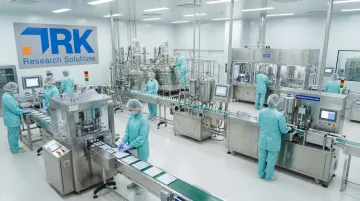
Key Advantages of CDMOs in Drug Product Manufacturing
The advantages below focus on measurable, operational impact, not abstract value statements. Each one ties to outcomes sponsors track closely: development speed, capital efficiency, batch quality, and regulatory pass rates.
Advantage 1: Accelerated Development and Time-to-Market
Established CDMOs maintain pre-validated equipment, trained technical staff, and documented SOPs. That eliminates the lead time a sponsor would otherwise spend building or qualifying facilities from scratch.
In practice, this means a sponsor's formulation moves from lab-scale batches to clinical batches to commercial scale-up within an existing quality system, rather than starting technology transfer cold. That distinction can shave months off validation timelines and reduce first-batch failure risk.
Why this is an advantage:
Building new sterile manufacturing capacity typically takes 2-3 years, according to McKinsey's analysis of sterile pharma manufacturing capacity. One CDMO case cited in that same research cut lead time by 20% and doubled existing-site capacity within 12 months, without new capital investment. Reduced lead time on formulation and scale-up shortens the path to IND/CTA filing and downstream clinical or commercial supply.
KPIs impacted:
- Time-to-clinic and time-to-market
- Technology transfer duration
- Batch cycle time
When this matters most: Sponsors with limited internal manufacturing infrastructure, tight regulatory filing deadlines, or multiple pipeline candidates competing for the same internal resources feel this advantage first and most acutely.
Advantage 2: Cost Efficiency and Capital Optimization
Partnering with a CDMO converts large fixed capital costs — facility construction, specialized equipment, dedicated staffing — into variable, project-based spend. CDMOs achieve this through shared infrastructure across multiple client programs, spreading overhead that a single sponsor would otherwise carry alone.
According to a 2024 Parenteral Drug Association analysis of CDMO-sponsor partnerships, outsourcing can add manufacturing capacity without requiring a large new-facility capital investment. That's a meaningful distinction for a small biopharma company weighing a $30 million facility build against a project-based manufacturing agreement.
Why this is an advantage:
Capital that would otherwise sit in idle manufacturing assets stays available for R&D or commercialization instead.
KPIs impacted:
- Cost per batch
- Capital expenditure
- Cost of goods sold (COGS)
- Overhead allocation
When this matters most: Smaller biopharma companies, generics manufacturers, and sponsors managing multiple product lines without wanting to over-invest in fixed assets see the sharpest benefit here. DRK positions its CDMO engagements around flexible, customizable partnership structures rather than fixed rate cards, which lets sponsors scale commitment to program stage.
Advantage 3: Regulatory Compliance and Risk Mitigation Across Global Markets
Established CDMOs operate under GMP/cGMP-aligned quality systems with direct experience preparing for FDA, EMA, and other regulatory inspections. That reduces sponsor exposure to compliance failures, since the CDMO brings pre-existing audit trails, validated documentation practices, and trained QA/QC teams to the table.
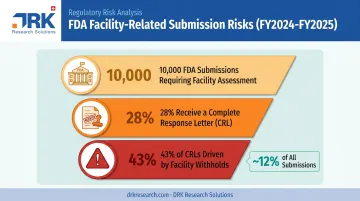
The stakes here are not theoretical. Of nearly 10,000 FY2024-FY2025 FDA submissions requiring facility assessment, 28% had received a Complete Response Letter by May 2026, and facility withholds accounted for 43% of those CRLs, or roughly 12% of all submissions, according to the FDA's Report on the State of Pharmaceutical Quality. Manufacturing-site compliance issues can directly block an approval, regardless of how strong the clinical data looks.
Why this is an advantage:
Consistent quality systems reduce the likelihood of deviations, recalls, or warning letters that delay or halt launches.
KPIs impacted:
- Batch rejection rate
- Deviation and CAPA frequency
- Audit findings
- Regulatory approval timelines
When this matters most: Sponsors targeting multiple regulatory jurisdictions simultaneously, or entering emerging and regulated markets, need this most. It's an area where partners with genuine multi-regional footprints add particular value. DRK operates across Europe, the Middle East, Asia, Africa, and the Americas. That footprint, backed by regulatory expertise spanning EU GMP, MHRA, PIC/S, WHO PQ, and US FDA frameworks, supports exactly this kind of cross-market submission work.
What Happens When CDMO Support Is Missing or Ignored
Managing drug product manufacturing entirely in-house, without adequate scale, expertise, or redundancy, tends to produce a predictable set of problems:
- Inconsistent batch quality from under-resourced or under-validated processes
- Higher error and deviation rates as stretched internal QA/QC teams miss issues that earlier detection would have caught
- Reactive firefighting during scale-up, rather than a planned technology transfer with built-in contingencies
- Rising per-unit costs from underutilized or aging infrastructure that never reaches efficient volume
- Difficulty entering new regulatory markets without established partnerships or local submission experience
None of these show up as a single dramatic failure. They accumulate. A missed deviation here, a slower-than-planned scale-up there, and suddenly a launch timeline that looked solid on paper slips by two quarters.
How to Get the Most Value from a CDMO Partnership
CDMO partnerships deliver the most value when sponsors pick a partner with proven regulatory reach across their actual target markets, not just a generically strong reputation. That means evaluating a CDMO the same way you'd evaluate a clinical site: track record, jurisdiction-specific experience, and documented process discipline.
A few practices separate sponsors who get real value from those who treat the CDMO as a transactional vendor:
- Involve the CDMO early in formulation, not just at scale-up, so process decisions account for manufacturability from the start
- Evaluate integrated capabilities, such as combined CRO/CDMO models that reduce handoff friction between clinical development and manufacturing
- Review technology transfer documentation and batch records jointly, on a regular cadence rather than only at project milestones
- Align regulatory strategy across teams so dossier preparation and manufacturing timelines move in sync
Organizations like DRK Research Solutions illustrate why this matters. Pairing global clinical trial experience with generics and hybrid product manufacturing for regulated markets keeps formulation, technology transfer, and eCTD dossier preparation under one coordinated team instead of scattered across vendors.

Sponsors interested in that kind of integrated engagement can start with a consultation through DRK's team.
Conclusion
The real value of a CDMO partnership sits in operational control, manufacturing consistency, and regulatory clarity across markets, not in a line item on a slide about "strategic outsourcing."
These advantages compound over time as sponsors scale from clinical to commercial supply with a stable manufacturing partner rather than switching vendors at each stage gate.
This compounding value depends on treating CDMO engagement as an ongoing strategic relationship rather than a one-time transactional decision. Sponsors who get the most out of these partnerships stay involved, review documentation jointly, and pick partners built for their specific regulatory footprint from day one.
Frequently Asked Questions
What is drug product manufacturing?
Drug product manufacturing is the process of converting an active pharmaceutical ingredient (API) into its final dosage form, such as a tablet, capsule, or injectable, ready for patient use. This includes formulation, fill-finish, and packaging steps.
What is the difference between GMP and cGMP in drug manufacturing?
GMP is the broader baseline quality framework for manufacturing. cGMP (current Good Manufacturing Practice) specifically requires manufacturers to use up-to-date systems and technologies, per the FDA's cGMP guidance.
How much does drug product manufacturing cost?
Costs vary widely based on dosage form complexity, batch scale, and target regulatory market. CDMO outsourcing typically shifts these costs from fixed capital investment to variable, project-based spend.
What is the difference between a CRO and a CDMO?
A CRO manages clinical research and trial execution, including protocol design and monitoring. A CDMO handles formulation development and manufacturing. Some organizations, including DRK, offer both under one roof.
When should a pharma company partner with a CDMO instead of building in-house capacity?
Outsourcing makes sense when internal capacity, timelines, or regulatory expertise for target markets fall short of what a dedicated facility build would require. This is especially true for smaller sponsors or multi-market launches.
How do CDMOs support generic and hybrid drug development for regulated markets?
CDMOs apply established formulation, bioequivalence, and regulatory submission expertise to help generic and hybrid products meet regulated-market requirements efficiently, including eCTD dossier preparation and GMP-compliant batch manufacturing.