
Introduction
A defective toaster gets refunded. A defective batch of medicine can kill someone. That's the gap pharmaceutical quality control exists to close.
Unlike most manufacturing sectors, pharma has zero margin for a "close enough" product. A single QC failure doesn't just cost money; it can put patients in the hospital.
The FDA issues hundreds of warning letters each year for GMP violations, according to its enforcement records.
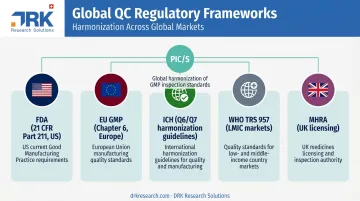
The problem? Global manufacturers face a patchwork of overlapping rules: FDA's 21 CFR Part 211, EU GMP Chapter 6, ICH guidelines, WHO standards, and MHRA expectations, all slightly different, all mandatory depending on where you sell.
This guide breaks down what QC actually means in pharma, how it differs from QA, the four core testing types, the science behind CQA and CPP, and the regulatory frameworks shaping compliance worldwide.
Key Takeaways
- QC verifies drug identity, strength, purity, and quality before release
- IQC, IPQC, FPQC, and Environmental Monitoring must work together, not separately
- CQA and CPP anchor Quality by Design, reducing reliance on end-stage testing
- Multinational sponsors must meet FDA, EMA, MHRA, and WHO requirements simultaneously
What Is Quality Control in the Pharmaceutical Industry?
Quality control is the scientific process of testing, sampling, and verifying that a drug product meets pre-defined specifications for identity, strength, quality, and purity before it ever reaches a patient. ICH Q7 puts it plainly: QC is "checking or testing that specifications are met."
That's not a suggestion. Under 21 CFR 211.22, the quality control unit has legal authority to approve or reject raw materials, halt a production line, or quarantine an entire batch when the data says something's off. This unit operates independently from production, which matters because it removes the incentive to let a shipment slide just to hit a deadline.
The Analytical Toolkit
Pharma QC labs rely on a specific set of tools to catch problems before they leave the facility:
- HPLC (High-Performance Liquid Chromatography) — measures potency and detects impurities
- Gas chromatography — identifies volatile compounds and residual solvents
- Mass spectrometry — confirms molecular identity with high precision
- Microbiological testing — screens for bioburden and sterility failures
QC doesn't operate alone. It's a defined subset within the broader Pharmaceutical Quality System (PQS) that GMP frameworks mandate, working alongside QA, manufacturing, and regulatory affairs.
When QC Fails, the Fallout Is Real
In December 2021, Edge Pharma issued a voluntary nationwide recall covering every unexpired lot of every compounded sterile and nonsterile drug it had distributed. FDA's recall notice confirms the cause was process issues that could compromise sterility assurance or product safety.
That's not a partial recall. That's an entire product portfolio pulled from the market, with patients told to stop use immediately and either return or discard everything. No dollar figure captures that kind of operational collapse.
QA vs QC in Pharma: Understanding the Key Differences
Confusing QA and QC is one of the most common mistakes in pharma discussions, and it matters more than people realize.
Quality Assurance (QA): The Proactive Architect
QA is process-oriented. It's the function that designs standard operating procedures, audits suppliers, and builds quality into every stage from R&D through distribution. The goal is preventing defects before they can occur, not catching them afterward.
Quality Control (QC): The Reactive Inspector
QC is product-oriented. It samples, tests, and verifies that actual output matches the specifications QA already established. Think of QC as the checkpoint, not the blueprint.
Here's the relationship, stripped down:
| Dimension | QA | QC |
|---|---|---|
| Focus | Process | Product |
| Timing | Preventive | Detective |
| Output | SOPs, audits, validated processes | Test results, batch release decisions |
QC is a functional component within the larger QA framework, not a standalone discipline. Treating it as separate is where compliance programs start to crack.
What Happens When Both Fail Together
The sartan nitrosamine crisis shows exactly what a combined QA-QC failure looks like. EMA documented EU-wide recalls, API prohibitions, and market-wide testing after nitrosamine impurities turned up in sartan APIs used for blood pressure medication.
The response required both disciplines to move together:
- QA-side correction: Manufacturing processes changed to prevent nitrosamine formation at the source
- QC-side correction: Marketing authorization holders were required to test for NDMA and NDEA before using APIs in production
- Regulatory consequence: EDQM suspended 11 certificates of suitability tied to the affected APIs
No single QC lab simply caught a bad batch here. The failure exposed a systemic gap where process design (QA) and testing protocols (QC) had both missed the same risk.
The 4 Main Types of Quality Control Testing in Pharma Manufacturing
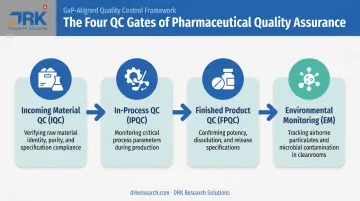
QC in pharma manufacturing runs across four distinct control gates, each covering a different stage of the manufacturing lifecycle.
Incoming Material Quality Control (IQC)
Every lot of raw material gets tested against its Certificate of Analysis before it's released to the warehouse. This covers:
- Active pharmaceutical ingredients (APIs)
- Excipients
- Packaging components and closures
Under 21 CFR 211.84, each component must be held until sampled, tested, and formally released. Anything that fails gets rejected on the spot.
In-Process Quality Control (IPQC)
While the batch is being made, IPQC runs real-time checks to catch drift before it becomes a defect. Common checkpoints include:
- Blend uniformity
- pH monitoring
- Tablet weight variation
- Dissolution behavior during processing
Finished Product Quality Control (FPQC)
Before a Qualified Person can release a batch, it undergoes final testing for potency, dissolution, sterility, and physical appearance. This is the last gate before the product reaches a pharmacy shelf.
Environmental Monitoring (EM)
For sterile manufacturing, EM tracks air particulates, surfaces, and personnel gowning continuously. EU Annex 1 sets specific action limits, for example, Grade A cleanrooms must stay at or below 3,520 particles/m³ at rest and in operation.
These four gates function as a connected system across the production lifecycle. Skipping continuity between them is exactly how validated control slips.
CQA and CPP: The Science Behind Quality Specifications
Two concepts sit underneath every QC specification: Critical Quality Attributes and Critical Process Parameters.
| Concept | Definition | Examples |
|---|---|---|
| Critical Quality Attribute (CQA) | A physical, chemical, biological, or microbiological property a drug product must maintain within an approved range to ensure quality | Dissolution rate, particle size, impurity levels |
| Critical Process Parameter (CPP) | A process variable whose variability directly affects CQAs | Temperature, mixing speed, pressure |
If a CPP drifts, a CQA is likely to follow.
This connection is the foundation of Quality by Design (QbD), formalized in ICH Q8(R2). The guideline is direct about it: quality cannot be tested into a product after the fact; it must be designed in from the start.
That's why real-time release testing exists: manufacturers use process data and in-line measurements to confirm quality as the batch moves through production, rather than relying solely on end-stage lab results. But it doesn't replace QC batch-release review; it supplements it. The quality unit still has the final say.
Global Regulatory Guidelines Governing Pharmaceutical Quality Control
No single rulebook governs pharma QC worldwide. Instead, sponsors navigate a set of overlapping frameworks that share principles but differ in specifics.
The Foundational Framework: cGMP
In the US, current Good Manufacturing Practices under 21 CFR Part 211 form the baseline. Key provisions include:
- 211.22: Establishes quality unit independence and rejection authority
- 211.84: Governs incoming material testing
- 211.110: Covers in-process sampling
- 211.160 and 211.165: Set laboratory control and finished-product release requirements
ICH's Harmonization Role
ICH guidelines don't replace national law, but they shape how regulators write it. ICH Q6A/Q6B define specifications, tests, and acceptance criteria for chemical and biotech products respectively, while ICH Q7 sets GMP expectations specifically for API manufacturing, including independent quality unit release authority.
Regional Frameworks Beyond the US
Beyond the US, several regional bodies enforce their own QC expectations:
- EU GMP Part I, Chapter 6: Covers QC sampling, documentation, and release, explicitly stating that QC independence from production is fundamental
- EMA: Implements ICH quality guidance for EU-wide scientific assessment
- WHO TRS 957: Guides QC laboratory practices for markets outside the US/EU, particularly relevant in low- and middle-income countries (LMICs)
- MHRA: Licenses and inspects under UK-specific rules, with recognition of other agencies' inspections depending on mutual recognition agreements
The Multinational Headache
Here's the practical problem: a sponsor running trials or manufacturing across three continents can't just pick one rulebook. FDA, EMA, and MHRA expectations must be reconciled simultaneously, not sequentially, because a single product might need to satisfy all three before it can move.
ICH and PIC/S (the Pharmaceutical Inspection Co-operation Scheme) reduce divergence, but neither replaces the need for market-specific procedures, licenses, and inspections. A harmonized guideline is a starting point, not a substitute for local compliance work.
Partnering for Global QC Compliance: How DRK Research Solutions Can Help
Navigating FDA, EMA, MHRA, WHO PQ, and PIC/S requirements at once isn't something most sponsors want to figure out alone, and they shouldn't have to.
DRK Research Solutions has spent over a decade supporting sponsors with GxP-compliant quality systems across Europe, the Middle East, Asia, Africa, and the Americas. Our regulatory consultants hold a documented track record across all five major frameworks: EU GMP, MHRA, PIC/S, WHO PQ, and US FDA.
Our GxP compliance services include:
- On-site mock audits and staff training for facility readiness
- Off-site regulatory evaluation
- Product dossier review and query handling
- Project management for compliance initiatives
Beyond compliance consulting, DRK's CDMO division specializes in generics and hybrid product development for regulated markets. That work spans:
- Lab-scale formulation development
- Analytical method development aligned to ICH and USP standards
- Technology transfer across oral solids, liquids, injectables, and more
- eCTD dossier preparation, delivered through partnerships with EU- and US-approved manufacturing facilities
If your team is managing QC compliance across multiple regulatory jurisdictions, connect with DRK's team to talk through where the gaps might be.
Frequently Asked Questions
What is quality control in pharma?
QC is the testing and verification process confirming a drug product's identity, strength, purity, and quality against pre-set specifications before it is released for distribution.
What are the 4 types of quality control?
The four core categories are Incoming Material QC (IQC), In-Process QC (IPQC), Finished Product QC (FPQC), and Environmental Monitoring, each covering a different stage of manufacturing.
What is the difference between QA and QC in pharma?
QA is the proactive, process-focused system designed to prevent defects. QC is the reactive, product-focused testing that verifies the final output actually meets those standards.
What is CPP and CQA in pharma?
CPP (Critical Process Parameter) refers to controllable process variables like temperature or mixing speed. CQA (Critical Quality Attribute) refers to product properties that must stay within approved limits. Quality by Design (QbD) links the two directly.
Why is quality control important in the pharmaceutical industry?
QC protects patient safety, prevents costly recalls and litigation, and maintains regulatory and public trust in medicines. A single lapse can trigger a nationwide market withdrawal.
Which regulatory guidelines govern pharmaceutical quality control globally?
The primary frameworks are cGMP (21 CFR Part 211) in the US, ICH Q6/Q7 guidelines for harmonization, EU GMP Chapter 6, and WHO/EMA standards for markets outside the US and EU.