The world's population aged 60 and older is projected to grow from 1.0 billion in 2020 to 1.4 billion by 2030, according to the World Health Organization. Many of these patients struggle to swallow tablets. At the same time, pediatric populations, hospital patients, and specialty care markets all demand dosage forms that are easier to administer and dose precisely.
Liquid formulations solve real problems: better bioavailability, flexible dosing, easier administration. But they introduce their own headaches. Stability, sterility, and scale-up complexities can quietly derail a promising development timeline.
This guide walks through the four core stages of liquid drug product development, the major formulation types, the challenges you'll likely face, and the strategic frameworks (QTPP and the "5 R's") that experienced teams use to avoid late-stage surprises.
Key Takeaways
- Liquid formulations boost bioavailability and patient compliance, but carry microbial, stability, and container-compatibility risks
- A structured process spanning pre-formulation, formulation design, analytical development, and stability testing underpins successful products
- QTPP defines measurable quality attributes; TPP captures the broader clinical and commercial vision
- Quality by Design (QbD) principles and phase-appropriate planning reduce late-stage formulation failures
- Partnering with an experienced CRO/CDMO can shorten timelines while ensuring multi-region regulatory compliance
What Is Liquid Drug Product Development?
Liquid drug product development is the process of designing dosage forms where an active pharmaceutical ingredient (API) is dissolved, dispersed, or suspended in a liquid vehicle. This covers oral, injectable, ophthalmic, and topical delivery routes.
Two strategic documents guide this work, and they are often confused.
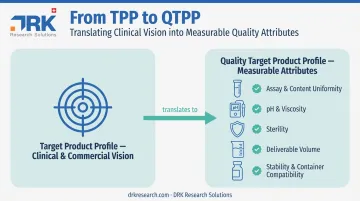
Target Product Profile (TPP): According to the FDA draft guidance on Target Product Profiles, a TPP is a format for summarizing a drug development program in terms of its intended labeling concepts. It is the big-picture vision — what the product needs to do clinically and commercially.
Quality Target Product Profile (QTPP): ICH Q8(R2) defines QTPP as a prospective summary of the quality characteristics a product should ideally achieve to ensure the desired safety and efficacy. In other words, QTPP takes the TPP's vision and translates it into measurable, testable attributes:
- Assay and content uniformity
- pH and viscosity
- Sterility or microbial quality
- Deliverable volume
- Stability and container compatibility
For suspensions, add particle size and redispersibility. For emulsions, add droplet size and phase stability. For sterile injectables, add endotoxin limits and particulate matter. Each of these attributes becomes a testable specification that formulation and analytical teams work against throughout development.
The Four Key Stages of Liquid Drug Product Development
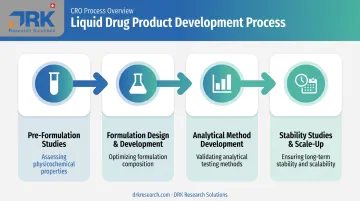
Liquid product development generally moves through four interconnected stages. Each stage builds the scientific and regulatory foundation the next one depends on.
Stage 1: Pre-Formulation Studies
This is where you characterize the API before making any formulation decisions. Key work includes:
- Solubility profiling across pH ranges and solvent systems
- pKa determination to predict ionization behavior
- Partition coefficient analysis for absorption prediction
- Stress testing under temperature, pH, and light exposure
These findings directly guide excipient selection later. An API prone to oxidation, for example, will need antioxidants built into the formulation from day one — not bolted on after a stability failure.
Stage 2: Formulation Design & Development
Here, teams apply Quality by Design (QbD) and Design of Experiments (DoE) methods to optimize the actual formula. This typically involves:
- Solubilization strategies (co-solvents, surfactants)
- Buffer systems for pH stability
- Preservative selection for microbial control
- Viscosity and osmolarity adjustments for patient comfort
The goal is balance. A formulation can be chemically perfect and still fail if it's unpalatable to a child or uncomfortable to inject.
Stage 3: Analytical Method Development
You can't control what you can't measure. This stage builds validated methods, such as HPLC and UV spectrophotometry, to track:
- Assay and potency
- Degradation products
- Content uniformity
- Microbial limits
These methods aren't a one-time setup. They evolve alongside the formulation and get revalidated as the product moves toward commercial scale.
Stage 4: Stability Studies & Scale-Up
ICH Q1A(R2) sets the benchmark here: at least 12 months of long-term stability data and 6 months of accelerated data across a minimum of three primary batches, according to the ICH Q1A(R2) guideline. Aqueous products in semipermeable containers also require water-loss evaluation, and photostability testing follows ICH Q1B protocols.
This stage covers:
- Accelerated and long-term testing across relevant climatic zones
- Freeze-thaw and in-use stability for real-world handling conditions
- Photostability assessment for light-sensitive APIs
- Technology transfer to commercial-scale manufacturing
Skipping or rushing any of these four stages tends to surface problems only after the formulation has already failed real-world testing, forcing costly rework. Building each stage properly the first time protects both the development timeline and the eventual regulatory submission.
Types of Liquid Drug Formulations and Their Applications
Not all liquid dosage forms serve the same patient population. Understanding the category shapes almost every downstream formulation decision.
Oral solutions & syrups. Common across pediatric and geriatric therapies. A 2025 WHO draft on pediatric medicines identifies aqueous solutions, suspensions, emulsions, and syrups as most appropriate for young children and patients who can't swallow tablets, largely because dose volumes can be adjusted precisely. Taste-masking and preservative selection are the two biggest formulation hurdles here.
Suspensions. The preferred choice for poorly water-soluble APIs. Success depends on:
- Controlled particle size distribution
- Redispersibility after settling
- Dose uniformity across the container's life
Injectable liquids. Both aqueous and non-aqueous vehicles fall under strict sterility, isotonicity, and often cold-chain requirements. USP <1> recognizes injectable solutions, emulsions, and suspensions, each with its own compendial suitability tests.
Ophthalmic and topical liquids. Eye drops demand sterility as a non-negotiable critical quality attribute. Topical liquids focus instead on permeation and skin compatibility.
Nanoemulsions and nanosuspensions are gaining traction across all these categories. By reducing particle or droplet size to the sub-micron range, these technologies improve solubility and enable more targeted delivery — though they introduce their own stability risks, including aggregation and phase separation.
DRK Research Solutions supports sponsors across each of these dosage forms, offering formulation development and analytical method development services that carry programs from early feasibility work through technology transfer.
Common Challenges in Liquid Formulation Development
Liquids fail in ways solids don't. Three challenges show up again and again.
API stability in liquid media. Dissolved or dispersed APIs are far more exposed to hydrolysis and oxidation than their solid counterparts. ICH Q1A requires stress testing across pH ranges, humidity, and light exposure specifically because of this vulnerability. Antioxidants and buffer systems are the standard mitigation tools.
Microbial contamination risk. Water-based systems are a natural breeding ground for microorganisms. This is why preservative efficacy testing (PET) (USP <51> in the US, Ph. Eur. 5.1.3 in Europe) sits at the center of any aqueous liquid development program. European testing, for example, evaluates bacteria and fungi at 6 hours, 24 hours, and 7, 14, and 28 days.
Container-closure compatibility and taste-masking. Multi-dose and pediatric products face a double challenge: packaging must protect against solvent loss, light exposure, and leaching, while taste-masking must work without compromising chemical stability.
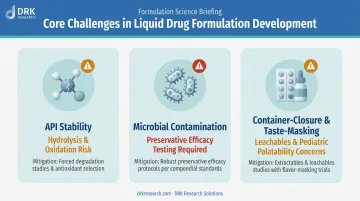
Extractables and leachables assessments (USP <1663> and <1664>) provide the framework for evaluating packaging risk before it becomes a stability failure.
Strategic Best Practices for Liquid Drug Product Development
Two frameworks separate teams that hit their timelines from teams that don't: Quality by Design and the "5 R's."
Quality by Design (QbD) links the QTPP to critical quality attributes and, ultimately, to a robust control strategy. Instead of testing quality into a finished batch, QbD builds it in from the start through risk assessment, design space definition, and process understanding.
A 2024 case study on an anti-ulcer oral suspension shows this in practice. Researchers applied QTPP definition, failure mode analysis, and factorial design, and found that wetting-agent and thickener concentrations were the critical drivers of viscosity. The resulting formulation met its quality profile within a one-month accelerated assessment window.
The "5 R's" framework, adapted from broader drug development decision-making, gives formulation teams a practical lens for liquid-specific choices:
- Right Target: Does the formulation deliver the API where it needs to act?
- Right Patient: Does a taste-masked pediatric syrup or an easy-swallow geriatric solution actually serve the intended user?
- Right Tissue: Does the delivery route (oral, ophthalmic, topical) reach the intended site effectively?
- Right Safety: Does the preservative and sterility strategy protect patients across the product's shelf life?
- Right Commercial Potential: Is the formulation manufacturable at the scale and cost the market demands?
Beyond frameworks, three practical habits matter:
- Design for manufacturability early. Late-stage reformulation almost always triggers bridging studies and regulatory delays.
- Align regulatory strategy with target markets. Build CTD-ready stability packages, PET data, and bioequivalence studies with FDA, EMA, and WHO-listed authorities in mind from the outset.
- Take a phase-appropriate approach. Keep early-phase formulations simple and fast-to-clinic, then evolve toward robust, market-representative formulations as you approach commercial supply.
Why Partner with an Experienced CRO/CDMO for Liquid Drug Product Development
Liquid formulation work demands specialized expertise that many smaller biotechs simply don't have in-house. This includes analytical chemists who understand degradation pathways, microbiologists who can design a PET protocol, and regulatory specialists who know what an EMA reviewer wants to see in a stability package.
Outsourcing this work to a specialized partner reduces risk and often shortens timelines considerably.
DRK Research Solutions has built its Product Development vertical on this exact premise. Since introducing CDMO services in 2022, DRK has focused on generics and hybrid product development for regulated markets, with flexible dosage form capabilities spanning:
- Liquids and suspensions
- Injectables
- Ophthalmics
- Nasal sprays
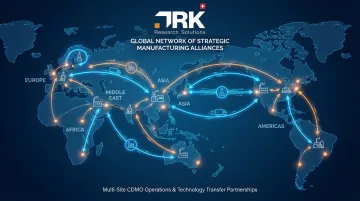
What sets the model apart is its structure. Rather than operating a single manufacturing site, DRK works through a global network of strategic alliances across Europe, the Middle East, Asia, Africa, and the Americas. This network includes partnerships with EU- and US-approved facilities for exhibit and commercial batch manufacturing. Services span:
- Lab-scale formulation development and optimization
- Analytical method development aligned with ICH and USP standards
- Technology transfer to manufacturing partners
- Full eCTD dossier preparation (Modules 2–5)
This structure reflects a broader mission rooted in the company's origins as a patient advocacy organization. The focus: expanding access to liquid therapies in underserved and low- and middle-income country markets, where age-appropriate, easy-to-administer formulations often matter most.
If you're planning a liquid drug product and want to talk through formulation strategy, DRK's scientific team can walk through your specific development needs.
Frequently Asked Questions
What are the four stages of liquid drug product development?
The four stages are pre-formulation studies, formulation design and development, analytical method development, and stability studies with scale-up. Each stage builds directly on the scientific findings of the one before it.
What are the different types of liquid drug formulations?
The main categories are oral solutions and syrups, suspensions, injectable liquids (aqueous and non-aqueous), and ophthalmic or topical liquids. Nanoemulsion and nanosuspension technologies increasingly enhance solubility across all these categories.
What is the difference between TPP and QTPP in liquid drug product development?
The TPP outlines the overall clinical and commercial vision for the product, expressed through labeling concepts. The QTPP defines the specific, measurable quality attributes — like pH, viscosity, and sterility — needed to achieve that vision.
What are the 5 R's of drug development and how do they apply to liquid drug product development?
The 5 R's are Right Target, Right Patient, Right Tissue, Right Safety, and Right Commercial Potential. For liquids, they translate into decisions like taste-masking for pediatric syrups (Right Patient) and preservative strategy (Right Safety).
How long does it typically take to develop a liquid drug product?
Timelines vary by complexity, but ICH stability requirements alone call for at least 12 months of long-term data and 6 months of accelerated data. Full development, including formulation and analytical work, often spans well over a year.
What role does a CDMO play in liquid drug product development?
A CDMO provides formulation expertise, analytical capabilities, and manufacturing scale-up support that many sponsors lack in-house. This combination helps accelerate development timelines while maintaining regulatory compliance across target markets.