This breakdown is written for pharmaceutical and biopharmaceutical sponsors, R&D leads, and project teams who need to know exactly what happens at each step, not just the textbook version. Many teams struggle with this stage because "early phase" gets used loosely in conversation but poorly defined operationally. What actually counts as done? Who signs off? What triggers a clinical hold?
We'll walk through each step, the factors that swing outcomes one way or another, and where specialized partners genuinely add value versus where they just add cost.
Key Takeaways
- Early phase drug development follows five steps: discovery through Phase II proof-of-concept
- Just 7.9% of Phase I molecules ever reach FDA approval, demanding disciplined execution
- Rigorous IND-enabling work and phase-appropriate planning reduce the risk of costly clinical holds later
- FDA and EMA require detailed safety documentation before any progression to human trials
What Is Early Phase Drug Development?
Early phase drug development covers the pre-commercial stretch from molecule discovery through initial human safety testing. It's the period where a candidate moves from a laboratory concept to something regulators are willing to let sponsors test in people.
The goal is to identify a viable, safe candidate with a defensible data package before anyone commits the capital required for large-scale, expensive late-phase trials. Proving the drug actually works comes later.
Early phase development differs from late-phase work (Phase III and commercial manufacturing), which focuses on demonstrating efficacy at scale and preparing for market. The core questions diverge:
- Early phase: Is this safe and worth pursuing?
- Late phase: Does this work well enough, for enough people, to approve?
Why Early Phase Development Is Critical for Pharma and Biopharma Companies
Early phase decisions determine whether a molecule advances or dies. There's no gray area here: the choices made during discovery, preclinical testing, and IND preparation set the ceiling for everything that follows.
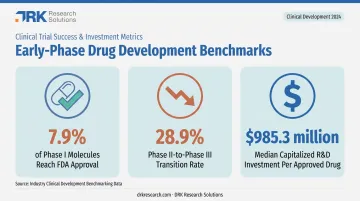
The numbers make the stakes obvious. According to BIO's 2021 analysis of clinical development success rates, which reviewed 12,728 transitions across 9,704 programs from 2011 to 2020, only 7.9% of drugs entering Phase I trials eventually secure FDA approval.
Phase II to Phase III transition was the steepest drop-off, at just 28.9% — the lowest of any clinical transition studied.
Financially, the stakes compound quickly. A 2020 JAMA study analyzing 63 approved drugs found a median capitalized R&D investment of $985.3 million per approved drug, with a mean of $1,335.9 million. Most of that spend happens after early phase decisions have already narrowed (or wasted) the field.
Without a disciplined early phase process, sponsors typically run into:
- Poor formulation choices that surface as stability or bioavailability problems mid-trial
- Incomplete safety characterization that triggers questions regulators should never have to ask twice
- Weak IND packages missing required toxicology or manufacturing detail
- Delayed regulatory clearance, sometimes stretching timelines by months
This rigor isn't optional. It's baked into GLP and IND requirements, and it's also just sound risk management before committing to costlier downstream investment.
The Key Steps of Early Phase Pharmaceutical Drug Development
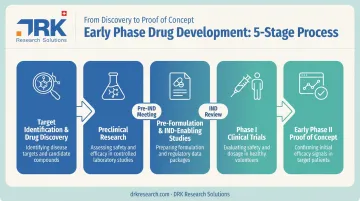
End to end, early phase moves from identifying a disease-relevant biological target to demonstrating human safety with an initial signal of activity. Along the way, it generates candidate compounds, in vitro and in vivo data, formulation prototypes, and a regulatory strategy that has to hold up under scrutiny.
The phase is controlled through two types of checkpoints: regulatory gates (pre-IND meetings, IND review) and internal go/no-go decisions made by the sponsor's own team. Miss either one, and a program stalls.
Step 1: Target Identification and Drug Discovery
Researchers first identify a biological target, a protein, gene, or pathway linked to disease, and confirm there's a credible mechanistic connection before investing further. Compound libraries are then screened against that target.
A molecule that shows activity becomes a "hit." From there, hit-to-lead work improves potency and selectivity, and lead optimization refines the candidate's drug-like properties while correcting weaknesses, according to a peer-reviewed review in the British Journal of Pharmacology. The output of this step is a single lead candidate ready for formal preclinical testing.
Step 2: Preclinical Research
Lead candidates now face structured in vitro and in vivo testing covering safety pharmacology, toxicology, pharmacokinetics, and pharmacodynamics. ICH M3(R2) guidance recommends core safety pharmacology assessment of cardiovascular, CNS, and respiratory systems, plus repeat-dose toxicity studies generally run in two mammalian species.
All of this happens under Good Laboratory Practice (GLP) standards, a mandatory requirement that makes the resulting data acceptable to regulators. The question this step answers: is the compound safe enough to justify human exposure?
Step 3: Pre-Formulation and IND-Enabling Studies
Here, teams assess the active pharmaceutical ingredient's (API) solubility, stability, and compatibility with excipients to design a workable dosage form. Dose-ranging toxicology studies run in parallel, and everything gets compiled into the data package required for an Investigational New Drug (IND) application.
An IND submission needs three core pieces, per FDA requirements:
- Animal pharmacology and toxicology data supporting reasonable safety
- Manufacturing information covering composition, stability, and controls
- Clinical protocols and investigator information, including informed consent commitments
This is where formulation development and analytical method development work matters most. DRK Research Solutions supports sponsors through this stage with lab-scale formulation development, ingredient selection, and analytical method development validated against ICH and USP standards, along with eCTD dossier preparation covering Modules 2 through 5. Weak execution here is a common source of avoidable delay.
Step 4: Phase I Clinical Trials (First-in-Human)
Once the IND clears (FDA allows studies to begin 30 days after submission unless a hold is issued), the compound enters a small group of healthy volunteers, or patients in certain therapeutic areas. Enrollment typically runs 20 to 80 participants.
The primary objectives are safety, tolerability, and pharmacokinetics, evaluated through dose-escalation designs. EMA guidance requires a justified starting dose, predefined maximum exposure, staggered dosing, and clear stopping rules before any escalation proceeds.
This is a stage where coordination gaps cause real damage. Manufacturing, bioanalysis, and clinical execution all have to sync tightly, and handoffs between separate vendors are where delays tend to hide.
An integrated CRO partner such as DRK Research Solutions coordinates bioanalysis and clinical execution under one structure, reducing the friction that comes from managing multiple disconnected providers during a phase where timing genuinely matters.
Step 5: Early Phase II (Proof of Concept)
A larger group of patients with the target condition now enters the study, this time to gather preliminary evidence of efficacy while continuing to monitor safety. ICH describes this therapeutic-exploratory stage as one that estimates dose-response and refines the target population ahead of pivotal Phase III design.
Get this step right, and the pivotal trial design that follows is built on solid ground rather than guesswork.
Key Factors That Influence Early Phase Development Success
Several variables shape whether an early phase program stays on track or stalls out:
- Inputs and materials: API purity, physicochemical properties, and excipient compatibility directly affect both formulation feasibility and toxicology outcomes.
- Operating conditions: Regulatory requirements differ across regions. FDA, EMA, MHRA, and local health authorities each shape study design and documentation expectations differently.
- Equipment and system dependencies: Access to GLP-compliant labs, bioanalytical facilities, and clinical trial supply manufacturing capacity can bottleneck timelines if not secured early.
- Scale and throughput: Cohort sizes in dose-escalation studies, and how fast data gets reviewed between cohorts, directly determine how quickly go/no-go decisions get made.
- Partner and vendor structure: Fragmented, multi-vendor arrangements introduce handoff risk. A single-source, integrated model keeps data flowing without reconciliation delays across separate systems.
- Safety, quality, and regulatory constraints: GxP compliance, IRB/ethics committee approval, and pharmacovigilance obligations are non-negotiable in first-in-human research.
DRK's teams work across ICH-GCP, EU GMP, US FDA, MHRA, WHO PQ, and PIC/S frameworks, which matters given how much operating conditions vary by region.
Clinical supplies management—covering storage, repackaging, and labeling under trial-specific blinding requirements—also falls under equipment and system dependencies. Sponsors often underestimate this until a shipment gets delayed.
Common Misconceptions and Pitfalls in Early Phase Development
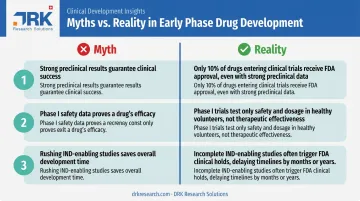
Myth: "Strong preclinical results guarantee clinical success." They don't. Preclinical models are predictive, not definitive. Plenty of candidates with clean toxicology and promising in vivo data still fail once human biology gets involved.
Myth: Confusing Phase I safety data with proof of efficacy. This trips up sponsors and investors constantly. Phase I exists to characterize safety, dosing, and pharmacokinetics, not to demonstrate that a drug works. Early effectiveness signals are a bonus, not the point. Controlled efficacy testing is what Phase II is built for.
Myth: Underfunding or rushing IND-enabling studies to save time. This almost always backfires. A 2020 FDA analysis of oncology INDs submitted between 2014 and 2017 found that fewer than 10% were placed on clinical hold during the 30-day review window.
Deficiencies were concentrated in clinical, pharmaceutical-quality, and nonclinical categories. Held INDs were disproportionately first-in-human submissions or came from sponsors with limited regulatory experience, exactly the profile that results from cutting corners under time pressure.
Conclusion
Early phase drug development follows a structured sequence: target discovery, preclinical testing, IND-enabling work, Phase I, and early Phase II. Each stage builds toward establishing safety and initial viability before major capital gets committed.
Understanding each step, and the specific risks attached to it, helps sponsors make sharper go/no-go calls. This clarity helps avoid the costly failures that often surface later in development.
Partnering with an experienced, globally integrated CRO/CDMO like DRK Research Solutions helps sponsors navigate this phase efficiently. DRK's support spans from first-in-human studies through commercial launch, expanding access to innovative therapies across the markets where it operates.
Frequently Asked Questions
What is the early phase of drug development?
It spans discovery, preclinical research, and Phase I through early Phase II clinical trials. The focus throughout is establishing safety and initial feasibility before larger efficacy trials begin.
What are the four stages of pharmaceutical product development?
Broadly: discovery and development, preclinical research, clinical research (Phases I-IV), and regulatory review with post-market monitoring. FDA technically separates review and post-market monitoring into distinct steps.
How long does early phase development typically take?
It varies with molecule complexity and regulatory requirements, but Phase I trials average around 15 months and Phase II around 30 months individually. Early phase is one segment within the overall 10-15 year development timeline.
What is the difference between Phase I and Phase II clinical trials?
Phase I focuses on safety, tolerability, and dosing in a small group of 20-80 participants. Phase II tests preliminary efficacy and continued safety in a larger patient population, often several hundred subjects.
What is an IND application and why is it required?
An Investigational New Drug application is submitted to regulators like the FDA to gain authorization to test a compound in humans. It's built on preclinical safety data, manufacturing information, and clinical protocols.
Why do many drug candidates fail during early phase development?
Common causes include unexpected toxicity, poor pharmacokinetics, and lack of an early efficacy signal. Only 7.9% of molecules entering Phase I ultimately reach FDA approval, showing just how steep attrition is at this stage.