Sponsors face a dual challenge here. They must design a dosage form that actually works — stable, bioavailable, deliverable at the right release rate — while simultaneously satisfying scheduling, security, and reporting obligations that non-controlled products never touch. Miss either half and the program stalls.
This guide walks through what controlled drug product development actually means, the four stages every program moves through, common controlled-release technologies, and how global regulatory variance changes the calculus. We'll also cover what to look for in a development partner when a scheduled substance is involved.
Key Takeaways
- Controlled substances and controlled-release formulations are distinct, yet many programs require both skill sets.
- Each development stage adds parallel regulatory workstreams once a scheduled substance is involved.
- DEA quota timelines and multi-country scheduling differences frequently cause underestimated delays.
- Partnering with an integrated CRO/CDMO provider reduces costly handoffs between vendors.
What Is Controlled Drug Product Development?
Controlled drug product development means designing, formulating, and manufacturing pharmaceutical products that contain substances regulated under a national drug-scheduling framework. Examples include the US Controlled Substances Act (CSA), the UK Misuse of Drugs Act, and similar regimes elsewhere.
Here's where confusion often creeps in. "Controlled substance" refers to a legal classification tied to abuse and dependency potential. "Controlled-release" refers to an engineering choice: a dosage form built to release its active ingredient at a specific rate or location.
A product can be one, both, or neither. An extended-release oxycodone tablet is both; a standard immediate-release ibuprofen tablet is neither. This guide covers both concepts because sponsors developing scheduled products often need controlled-release expertise in the same program.
The scale here isn't trivial. A DEA rulemaking noted that controlled substances have historically made up between 10% and 11% of all prescriptions written in the United States. That figure underscores how much of the pharmaceutical supply chain touches scheduling requirements in some form, though current utilization has shifted since the estimate was published.
The Five DEA/CSA Schedules Explained
The CSA sorts substances into five schedules based on medical use, abuse potential, and dependency risk:
| Schedule | Criteria | Representative examples |
|---|---|---|
| I | High abuse potential, no accepted medical use | Heroin, LSD |
| II | High abuse potential, accepted medical use with restrictions | Oxycodone, fentanyl |
| III | Moderate abuse potential, accepted medical use | Ketamine, buprenorphine |
| IV | Low abuse potential relative to Schedule III | Alprazolam, diazepam, other benzodiazepines |
| V | Lowest abuse potential, accepted medical use | Cough preparations with limited codeine content |
Under CSA Section 811(c), regulators weigh factors including actual abuse potential, pharmacological effects, current scientific knowledge, and documented history of abuse before assigning or reassigning a schedule.
Here's the complication for global programs: the same molecule can land in different schedules depending on the country. Ketamine sits in Schedule III in the US, but the UK classifies it as Class B, Schedule 2 under its own framework. That mismatch alone can reshape a multi-region development plan before formulation work even begins.
The Four Key Stages of Pharmaceutical Product Development
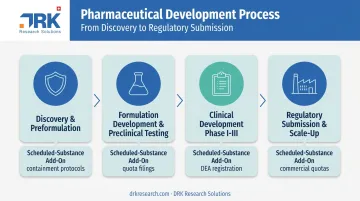
Every pharmaceutical product moves through four broad stages. When a scheduled substance is involved, each stage picks up an extra layer of paperwork and infrastructure that non-controlled products skip entirely.
- Discovery & Preformulation — Characterizing the API's physicochemical properties and compatibility. For scheduled substances, this stage also demands containment protocols and controlled handling procedures from day one, not as an afterthought.
- Formulation Development & Preclinical Testing — Dosage form design, stability testing, and toxicology work. Abuse-deterrent formulation strategy typically needs to be baked in here if the API carries diversion risk.
- Clinical Development (Phase I–III) — Before any trial material ships, sponsors need DEA (or local equivalent) registration and clinical-supply quota approval. Multi-region trials multiply this burden across jurisdictions.
- Regulatory Submission, Scale-Up & Commercial Manufacturing — Technology transfer, process validation, and NDA/ANDA-type (or equivalent) submissions, plus securing commercial manufacturing quotas well ahead of launch.
Stage 3 is where investigational product logistics matter most. Storage, warehousing, and re-packaging and labeling for investigational product need to hold up under both trial protocol requirements and chain-of-custody expectations for scheduled materials. DRK Research Solutions provides these clinical supplies services as part of its broader trial support.
This operational groundwork becomes non-negotiable once a scheduled substance enters the supply chain.
The common thread: at every stage, a scheduled substance adds parallel workstreams that run alongside the standard development timeline, not after it. These typically include:
- Quota paperwork and controlled-substance registrations filed in parallel with standard approvals
- Security infrastructure for storage, handling, and transport of scheduled materials
- Specialized documentation supporting chain-of-custody and diversion-control requirements
Controlled-Release Formulation Technologies & Real-World Examples
Controlled-release (CR) formulations are engineered to release an active ingredient at a predetermined rate, time, or location. The goals: better efficacy, fewer doses per day, or, for scheduled substances specifically, reduced abuse potential.
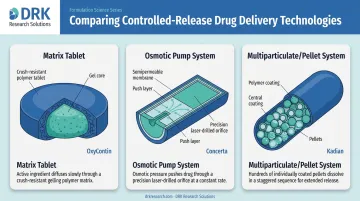
The clearest example is extended-release opioid matrix tablets. OxyContin's FDA label describes inactive ingredients designed to resist crushing, breaking, and rapid dissolution, making injection or intranasal abuse harder to pull off. A historical precedent, reformulated Opana ER, used a polyethylene oxide matrix that formed a viscous gel on contact with liquids, a deliberate deterrent against tampering.
Two other CR mechanisms show up repeatedly in marketed products:
- Osmotic pump systems use a trilayer core surrounded by a semipermeable membrane, as seen in Concerta. Water enters, expands the osmotic layers, and pushes methylphenidate out through a laser-drilled orifice at a steady rate.
- Multiparticulate/pellet systems, like Kadian, deliver morphine sulfate through polymer-coated extended-release pellets packed inside a capsule. Each pellet acts as its own mini release unit.
These mechanisms all share one requirement: rigorous analytical validation. Evaluating a formulation partner for CR work means asking about dissolution testing capability built specifically for extended-release profiles, not just standard immediate-release methods. DRK's Product Development team runs analytical method development aligned to ICH and USP standards as part of its formulation support. This work generates the stability and quality control data that CR programs depend on.
Regulatory & Compliance Essentials for Manufacturing Controlled Substances
Manufacturing a scheduled substance requires separate DEA (or equivalent national) registrations depending on the activity: manufacturing, distribution, import/export, and even controlled-substance analytical testing each need their own registration. One registration doesn't cover all four.
The DEA Quota System
For Schedule I and II substances, DEA sets annual Aggregate Production Quotas that cap how much can be produced for US medical, scientific, and industrial use nationwide. Manufacturers layer individual quota requests on top of that ceiling:
- Individual manufacturing quota (DEA Form 189), filed by May 1 of the preceding year
- Procurement quota (DEA Form 250), filed by April 1 of the preceding year
New registrants can apply outside these windows, and existing quotas can be adjusted anytime. DEA doesn't publish a guaranteed processing timeline for quota increases, so sponsors should build generous buffer time into project schedules rather than assume a fixed turnaround.
Storage, Security & Diversion Control
Physical security requirements scale with schedule risk:
- Schedule I-II materials require vault-level protection: at minimum 8 inches of reinforced concrete or equivalent masonry, steel rods tied every 6 inches, and alarm systems capable of resisting extended forced-entry attempts
- Schedule III-V materials can use lighter secured-cage storage: steel fabric walls, reinforced posts, and access limited to a minimal number of authorized employees
Operationally, this means multiple weighing checkpoints tracking API concentration through every processing step, often with a designated DEA liaison present during weighing, production runs, and returns.
The stakes for getting this wrong are real. In 2025, PharMerica paid $778,000 to settle alleged CSA recordkeeping violations after a DEA inspection found incomplete records for 8 of 8 audited controlled substances. Evidence of diversion can trigger an immediate DEA-ordered shutdown — recordkeeping gaps alone are enough to draw serious enforcement attention.
Global Considerations: Navigating Multi-Country Controlled Substance Regulations
Scheduling harmonization mostly stops at narcotics governed by the International Narcotics Control Board, which monitors (but doesn't unilaterally dictate) how individual countries implement UN drug-control conventions. Beyond that scope, especially for cannabis- and psychedelic-derived compounds, national approaches diverge sharply.
Consider MDMA, where national scheduling diverges sharply:
| Jurisdiction | Regulatory Body | MDMA Classification | Approved Use |
|---|---|---|---|
| United States | DEA | Schedule I | No accepted medical use |
| Australia | TGA | Schedule 8 | Prescribed for PTSD (MDMA) and treatment-resistant depression (psilocybin) since July 2023 |
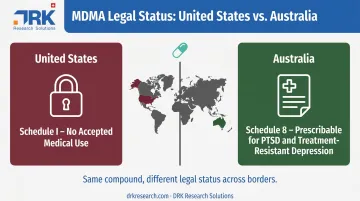
The same compound carries a no-accepted-use classification in one country and a prescribable-medicine status in another.
That kind of divergence means multi-region programs can't rely on one centralized supply hub. Sponsors typically need:
- Country-specific import/export licenses for each jurisdiction in the program
- Localized depots rather than a single distribution point
- On-the-ground regulatory knowledge that understands local scheduling nuance, not just the letter of the CSA
This is where a partner's footprint matters practically. DRK Research Solutions operates across Europe, the Middle East, Asia, Africa, and the Americas, with local teams positioned in each region.
For sponsors expanding access into underserved LMIC markets while managing varying schedules across those same territories, that regional presence removes a layer of guesswork from the planning process.
Partnering with the Right CRO/CDMO for Controlled Drug Products
Selecting a development partner for a controlled substance program comes down to a few concrete criteria:
- Demonstrated compliance track record: has the partner navigated DEA or equivalent national registrations before, and can they show it?
- Adequate secure storage infrastructure: appropriate to whatever schedule your API falls under, not a generic warehouse
- In-house formulation and analytical capability: spanning the range from Schedule I research materials through Schedule V products
An integrated CRO+CDMO model, spanning trial design through commercial manufacturing, avoids the costly technology transfers that happen when a sponsor has to hand a program between multiple vendors mid-development. Every handoff is a chance to lose institutional knowledge, delay timelines, or introduce quality inconsistencies.
DRK Research Solutions illustrates this integrated model, combining CRO and CDMO capability under one roof, including generics and hybrid product development for regulated markets.
In practice, DRK manages technology transfer, process validation oversight, and eCTD dossier preparation directly, while executing exhibit and commercial batch manufacturing through a network of GMP-compliant partner facilities. For sponsors, that means a single point of accountability from early formulation through commercial supply, without needing to coordinate separately with a CRO, a formulation lab, and a manufacturing site.

Frequently Asked Questions
What is drug product development?
Drug product development is the end-to-end process of turning an active pharmaceutical ingredient into a safe, effective dosage form ready for commercial manufacturing. It spans everything from initial formulation work through clinical testing and scale-up.
What are the four main stages of pharmaceutical product development?
The four stages are discovery and preformulation, formulation development with preclinical testing, clinical development across Phases I-III, and regulatory submission paired with commercial manufacturing scale-up.
Can you give me an example of a controlled-release formulation?
Extended-release opioid matrix tablets are a classic example, engineered to slow drug release and resist crushing to reduce misuse. Osmotic pump systems, like those used in Concerta, are another common approach.
What is the difference between a controlled substance and a controlled-release drug product?
A controlled substance refers to legal scheduling status based on abuse and dependency potential. A controlled-release product refers to engineered release mechanics. Many products, like extended-release opioids, are both at once.
How long does DEA quota approval typically take for a new controlled substance project?
DEA doesn't publish a fixed turnaround time for initial quota requests or increases. Sponsors should expect a multi-week process at minimum and build significant buffer time into project schedules rather than assume expedited handling.
Why do controlled substance regulations vary so much between countries?
Each country assesses a substance's abuse potential and medical use independently, and these assessments don't always align. That's why a molecule like ketamine can carry different schedules depending on where it's manufactured or sold.