
Common challenges include buffer systems that lose capacity over time, container-closure interactions that nobody flagged during development, and specification ranges copied from a similar product rather than justified with the sponsor's own data. Regulators expect documented, product-specific evidence, not assumptions.
This article breaks down what pH stability actually represents, the operating ranges and tolerance limits that govern it, how it's measured and validated, and what happens when formulations drift outside their approved boundaries.
Key Takeaways
- pH stability determines a formulation's resistance to hydrolysis, oxidation, and other degradation reactions
- Every formulation needs a nominal pH range, tolerance limits, and a data-backed safety margin
- Buffers, excipients, packaging, and storage conditions can each push pH outside its validated window
- FDA's 21 CFR 211.166 and ICH Q1A require documented pH monitoring throughout stability programs
- Operating outside validated pH limits risks potency loss and regulatory rejection
What pH Stability Represents in Drug Formulation
pH stability is the ability of a formulation to hold its target hydrogen ion concentration, and resist drift from it, under specified storage and use conditions. That's different from a pH reading. A batch can start perfectly on spec and still be unstable if the pH creeps over eighteen months of shelf life.
Under ICH's framework, a critical quality attribute (CQA) is any property that must stay within a defined limit or range to protect product quality. pH only qualifies as a CQA when product-specific risk assessment shows it actually affects safety, efficacy, or stability, not automatically for every drug product (ICH Q8(R2)).
Why pH Governs, Rather Than Just Reflects, Stability
pH sits upstream of several other quality attributes:
- Ionization state: pH relative to a drug's pKa determines what fraction exists in charged versus uncharged form
- Solubility: weak-base solubility drops as pH rises toward the pKa, while weak-acid solubility rises with pH, per a USP Stimuli article on solubility criteria
- Degradation kinetics: ICH Q1A requires hydrolysis testing across a wide pH range for solutions and suspensions, alongside heat, humidity, oxidation, and light stress
For compounds carrying amine groups, protonation state can also slow oxidative degradation. This is why pH functions as a design input during formulation and as a monitored output during stability testing, not a passive number sitting on a spec sheet.
Factors That Influence pH Stability in Real-World Formulation
Lab-derived pH ranges do not always survive contact with real-world storage, shipping, and handling conditions. Several variables push pH away from its nominal target during actual shelf life:
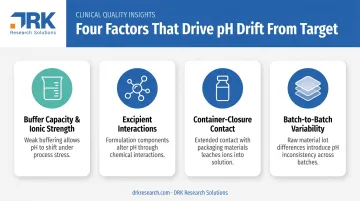
- Buffer capacity and ionic strength: pKa shifts with temperature, pressure, and solvent polarity, so nominal buffer values will not predict behavior in the finished formulation.
- Excipient interactions: Ionizable excipient groups can act as unintended pH modifiers, changing degradation rates as they age or as lots vary.
- Container-closure contact: A 2024 study in the Journal of Materials Research and Technology found substantial sodium and potassium leaching from pharmaceutical glass at pH 5, 7, and 9 over one to six months, with severity depending on the glass treatment used.
- Batch-to-batch variability: Reactive impurities in excipient lots can differ enough to change compatibility outcomes between otherwise identical formulations.
Liquid vs. Solid Dosage Form Risks
These variables affect dosage forms unevenly. Liquid dosage forms carry more of this risk than solids, largely because FDA has noted that liquids interact with packaging far more than powders or tablets, given sustained, direct contact.
Solid dosage forms face a related but distinct issue: microenvironmental pH, created by moisture, excipients, and salt forms, rather than a measurable bulk pH.
Environmental exposure (temperature, humidity, light) compounds all of this. That is why stability protocols evaluate pH alongside assay, degradants, and appearance rather than treating it as a standalone checkpoint.
The pH Stability Range in Drug Formulation
The pH stability range isn't pulled from a textbook. It's built from formulation design, the API's own acid-base chemistry, and the specification limits a sponsor justifies with their own data.
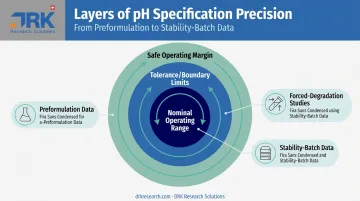
Nominal Operating Range
The typical target range for a given dosage form comes from preformulation pH-solubility studies combined with forced-degradation work across acidic, basic, oxidative, thermal, and photolytic stress conditions. This range assumes controlled storage: labeled temperature, humidity, and the actual market container-closure system, not a generic lab environment.
Allowable Tolerance and Boundary Limits
Sponsors validate upper and lower pH limits using at least three primary batches manufactured with the proposed formulation and a production-representative process, per ICH Q1A(R2). A few distinctions matter here:
- Release specifications can be tighter than shelf-life specifications, giving room for expected drift
- In-process pH limits are process controls meant to assure final quality — they aren't automatically the approved shelf-life boundary
- A short-term, in-process excursion is not equivalent to continuous, out-of-spec exposure across the full shelf life
Safe Operating Margin
Margins exist to absorb measurement uncertainty, manufacturing variability, and expected drift over time. Ibuprofen oral suspensions are a common example: sponsors establish a validated pH band during development through stress testing and pH-solubility mapping, then confirm it holds across real-time and accelerated stability batches.
The exact compendial figures sit inside product-specific monographs and vary by formulation, which is why a generic "safe range" borrowed from a different product is a risky shortcut. Operating close to an unvalidated boundary removes the buffer that protects against ordinary batch-to-batch variation.
Key Properties, Measurement, and Validation of pH Stability
pH stability is defined as much by how a formulation behaves under stress as by how reliably that behavior can be measured and documented.
Stability and variability. Thermal exposure, light, and time each push pH in different directions depending on the formulation. Repeatability across stability time points (0, 3, 6, 12, 18, 24 months) is what reveals drift, not any single reading.
Coupling with adjacent variables. Adjusting pH to improve solubility can simultaneously accelerate hydrolysis, or vice versa. There is rarely a free adjustment — every pH change carries a trade-off somewhere else in the formulation.
Specification and documentation. Acceptance criteria appear in stability protocols and batch specifications as a range, justified with development data, pharmacopoeial standards, and accelerated/long-term stability results. Rated (target) values and tested (measured) values need to be distinguished clearly in batch records.
Measurement Methods Compared
| Method | Strength | Limitation |
|---|---|---|
| Colorimetric indicator | Fast, low-cost qualitative screen | No validated numeric accuracy for compendial acceptance without product-specific validation |
| Potentiometric (lab electrode) | Multi-point calibration plus independent verification typically confirms accuracy within ±0.05 pH unit at measurement temperature (Thermo Fisher USP <791> guide) | Requires electrode conditioning, temperature control, and calibration bracketing |
| Inline/in-process electrode | Continuous process monitoring | Needs qualification and correlation back to the release lab method, not automatically interchangeable |
CROs with product development capabilities, such as DRK Research Solutions, support formulation teams through analytical method development built to ICH and USP standards. That work pairs with structured stability testing that tracks pH alongside assay, degradants, and appearance across development batches. That combination of validated methodology and consistent documentation is what turns a pH reading into defensible stability data.
Implications and Common Misinterpretations of pH Stability
Implications of Formulating Outside the Recommended pH Range
Pushing pH past its validated boundary doesn't fail quietly. It shows up as:
- Performance loss: reduced potency and increased formation of degradation products, particularly once assay shifts by 5% or a degradant crosses its own acceptance criterion
- Accelerated failure modes: precipitation as ionization state changes, discoloration, or altered dissolution behavior
- Regulatory consequences: a failing product must be rejected, and skipping a written, pH-inclusive stability program under 21 CFR 211.166 invites regulatory action
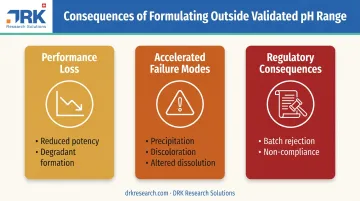
These consequences often trace back to how teams interpret pH stability data in the first place.
Common Misinterpretations of pH Stability in Practice
A handful of assumptions cause more formulation problems than any single technical error:
- Treating one pH reading as proof of stability: a compliant release value says nothing about drift at month 18
- Assuming lab conditions mirror field conditions: controlled climate-chamber data doesn't automatically predict behavior in humid warehouses or variable shipping lanes
- Ignoring interaction effects: pH shifts rarely stay isolated; they ripple into solubility and dissolution performance
- Over-tightening specifications: a narrower range than the data supports can force reformulation trade-offs without adding real protection
Conclusion
pH stability directly governs degradation pathways, solubility, and therapeutic performance throughout a product's shelf life. Understanding the nominal range, the validated boundary limits, and how the formulation performs under real storage conditions matters far more than any single published value.
For sponsors building or defending a pH-inclusive stability program, DRK Research Solutions provides formulation development and analytical method validation support. This includes structured stability testing aligned with global regulatory expectations across its operating regions.
Frequently Asked Questions
How does pH affect drug stability?
pH determines a drug's ionization state, solubility, and degradation rate. Shifts in pH can accelerate hydrolysis or oxidation, making it one of the strongest drivers of both chemical and physical stability.
What is the pH stability of ibuprofen?
Ibuprofen suspensions are formulated within a narrow pH band established through preformulation and stress testing rather than a single universal figure. Exact compendial limits are product- and monograph-specific.
What is 21 CFR 211.166 stability testing?
It is the FDA regulation requiring a written stability program, including pH and other quality attributes, to support labeled storage conditions and expiration dating for a marketed drug product.
What pH range is considered stable for most oral drug formulations?
There is no universal number. Ranges vary by API and dosage form and must be established through preformulation studies, forced-degradation testing, and manufacturing-variability data specific to that product.
How often should pH be tested during stability studies?
ICH-aligned protocols typically call for testing every 3 months in year one, every 6 months in year two, and annually through the proposed shelf life for products with at least a 12-month shelf life.
What happens if a formulation's pH drifts outside specification during shelf life?
It can trigger degradation, prompting batch rejection or regulatory non-compliance. This is exactly why safe operating margins, built from real stability data, matter more than the nominal target alone.