Demand for sterile injectables, biologics, and parenteral products keeps climbing worldwide, pushing manufacturers and CDMOs to scale compliant sterile capacity faster than ever. This article breaks down what sterile manufacturing actually means, how it differs from aseptic processing, the cleanroom standards behind it, and what to look for when choosing a manufacturing partner.
Key Takeaways
- Sterile products must meet a 10⁻⁶ sterility assurance level (SAL): one risk per million units
- Terminal sterilization is the gold standard; aseptic processing suits heat-sensitive products
- Cleanroom grades (A–D) and environmental monitoring anchor contamination control
- Media fills, endotoxin testing, and batch record review gate product release
- Choosing the right CDMO partner reduces compliance risk and time-to-market
What Is Sterile Manufacturing in Pharma?
Sterile manufacturing is the production of pharmaceutical products in conditions that eliminate viable microorganisms. Regulators don't ask for "mostly clean." They demand a documented sterility assurance level (SAL) of 10⁻⁶ or better, meaning no more than one chance in a million that a unit harbors a living microorganism. This standard comes from the EU's 2022 GMP Annex 1.
This isn't a bureaucratic formality. Injectables, biologics, and ophthalmic products bypass the body's natural defenses (skin, mucus membranes, stomach acid) and deliver contaminants directly into the bloodstream or eye. A dose that would be harmless if swallowed can be fatal if injected.
Why Sterility Assurance Matters for Patient Safety
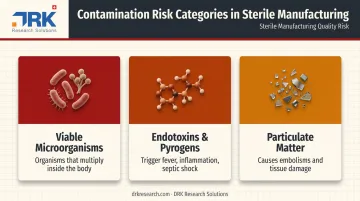
Manufacturers must control three distinct contamination risks:
- Viable microorganisms: bacteria, fungi, or spores that can multiply inside the body
- Endotoxins and pyrogens: lipopolysaccharides from bacterial cell walls that trigger fever, inflammation, or septic shock even after the organism itself is dead
- Particulate matter: undissolved foreign material that can cause embolisms or localized tissue damage
The consequences of getting this wrong aren't theoretical. In October 2023, FDA issued a warning letter after finding 18 non-sterile artificial-tear batches from a single manufacturer. The resulting Pseudomonas aeruginosa outbreak affected more than 80 patients, caused 4 deaths, and left at least 14 people with permanent vision loss. Investigators traced the failure back to inadequate aseptic filling controls and deficient media fill validation.
The Regulatory Framework Behind Sterile Manufacturing
Incidents like this are exactly what regulatory frameworks are designed to prevent. No single agency governs sterile manufacturing globally, but the major frameworks converge on the same core requirements:
| Region | Governing Standard |
|---|---|
| United States | 21 CFR Parts 210/211 |
| European Union | EU GMP Annex 1 (2022) |
| Canada | Health Canada GUI-0119 |
| Global (WHO) | WHO TRS 1044, Annex 2 |
Every one of these frameworks demands validated sterilization and aseptic processes, plus a documented Contamination Control Strategy (CCS) covering the facility, equipment, personnel, and monitoring program. It's not enough to sterilize correctly once. Manufacturers must prove, continuously, that the process stays in control.
Aseptic Processing vs. Terminal Sterilization: Understanding the Difference
These two terms are often used interchangeably, but they represent fundamentally different approaches to ensuring drug sterility.
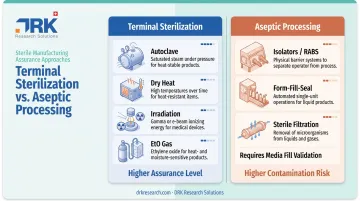
Terminal sterilization treats the drug after it's already sealed in its final container: a vial, syringe, or bag. Aseptic processing takes components that were sterilized separately (the drug solution, the vial, the stopper) and assembles them under controlled conditions, without ever sterilizing the finished, sealed unit.
Regulators have a clear preference. Terminal sterilization offers a higher assurance of sterility because it's the last step, applied to the product exactly as the patient will receive it. Aseptic processing, by contrast, depends on maintaining sterility through multiple handling steps, each one a potential entry point for contamination.
Terminal Sterilization Methods
Four methods dominate:
- Moist heat/autoclave: the preferred method when formulation and packaging tolerate heat, typically 121°C for at least 15 minutes
- Dry heat: used for heat-resistant glassware and components, often above 220°C
- Gamma or e-beam irradiation: applied when heat isn't an option; reference dose is 25 kGy, with validated alternatives requiring proof of equivalent sterility assurance level (SAL)
- Ethylene oxide (EtO) gas: reserved mainly for packaging materials, since EtO is toxic and leaves residues that must be controlled
Aseptic Processing Techniques
Many products simply can't survive terminal sterilization. Biologics denature under heat. Lyophilized drugs and pre-filled syringes need a gentler touch. For these, manufacturers rely on:
- Isolators and RABS (restricted access barrier systems) to physically separate operators from the product
- Form-fill-seal and blow-fill-seal technology, which forms, fills, and seals containers in one continuous automated sequence
- Sterilizing-grade filtration through 0.22-micron filters, removing microorganisms from heat-labile solutions before fill
Because aseptic processing depends on human and mechanical intervention at every step, it carries meaningfully higher contamination risk than terminal methods. That's why regulators require validation through aseptic process simulation, better known as media fills: the exact line runs with growth media instead of drug product to confirm the process consistently produces sterile units.
Cleanroom Classifications and Environmental Monitoring
Sterile manufacturing lives or dies on air quality. The ISO 14644-1 and EU GMP grading system defines four zones, each permitting different activities.
| Grade | ISO Equivalent | Typical Use |
|---|---|---|
| A | ISO 5 | Open product/container exposure, aseptic filling |
| B | ISO 5 (at rest) | Background environment surrounding Grade A |
| C | ISO 7 | Preparation of solutions, less critical stages |
| D | ISO 8 | Component handling, equipment prep |
Grade A zones use HEPA-filtered unidirectional airflow, typically 0.36–0.54 meters per second, sweeping particles away from the product before they can settle. Pressure differentials between adjoining rooms (commonly 10 to 15 Pascals) keep air flowing from cleaner to less-clean zones, so contaminants never migrate backward.
Monitoring That Never Stops
Environmental monitoring programs track both viable (living) and non-viable particles continuously, with defined alert and action levels. A single colony-forming unit detected in a Grade A zone triggers a full investigation. There's no "close enough" here.
The definitive validation tool remains the media fill study. EU Annex 1 requires at least three successful initial runs covering every shift, repeated roughly every six months for each process, line, and shift combination. Any single contaminated unit fails the entire study.
Modern facilities increasingly lean on isolators, RABS, and robotics specifically to shrink the human footprint in Grade A zones, since people remain the single biggest contamination variable in any cleanroom.
Common Examples of Sterile Pharmaceutical Products
Sterile manufacturing spans a wide range of dosage forms, each with its own preferred production method:
- Injectable vials — terminally sterilized when the formulation allows, otherwise sterile-filtered and aseptically filled
- Prefilled syringes — filled and closed entirely within Grade A conditions, given the open exposure during assembly
- Ampoules — frequently produced via blow-fill-seal, with fusion-sealed closures requiring validated integrity testing
- Large-volume parenterals/IV bags — often blow-fill-seal, either terminally sterilized or aseptically filled depending on the formulation
- Ophthalmic preparations — a common blow-fill-seal application, though the 2023 EzriCare Artificial Tears outbreak showed that multi-dose ophthalmics demand the same rigor as injectables
Container-closure integrity matters just as much as the fill process itself. A perfectly sterile product in a compromised stopper or seal is still a contaminated product waiting to happen. That's why stoppers, caps, and seals undergo their own validation, sampling, and shipping-condition testing throughout shelf life.
Quality Control and Regulatory Standards Governing Sterile Manufacturing
Before any sterile batch reaches a patient, it passes through several independent testing gates:
- Bioburden/microbial testing — sampling unsterilized bulk product before final sterilization
- Particulate matter testing — light-obscuration and microscopic counting per USP <788>
- Endotoxin testing — LAL-based methods confirming pyrogen levels stay below threshold
- Final sterility testing — membrane filtration or direct inoculation before batch release
None of this matters without paperwork discipline. Under 21 CFR 211.192, the quality unit must review and approve every production and control record before a sterile batch can ship. Any unexplained discrepancy triggers a documented investigation, sometimes extending to other batches made on the same line.
The stakes for skipping these steps are steep. The 2023 Global Pharma Healthcare warning letter cited exactly this failure mode:
- Deficient aseptic-machine qualification
- Inadequate media fill studies
- Insufficient container-closure integrity testing
The outcome was a multinational recall, an import alert, and patient harm serious enough that regulators still reference the case years later.
Partnering with the Right CDMO for Sterile Manufacturing
Building in-house sterile capacity is expensive and slow. Cleanrooms, isolators, validated filling lines, and the specialized staff to run them represent years of capital investment before a single commercial batch ships. That's why most sponsors, especially biotechs and mid-sized pharma companies, work with an experienced CDMO instead of building from scratch.
What to evaluate in a manufacturing partner:
- A proven GxP compliance history, not just certifications on paper
- Multi-regional regulatory expertise across FDA, EU GMP, MHRA, WHO PQ, and PIC/S frameworks
- Capability spanning clinical-stage development through commercial-scale production
- A demonstrated track record of technology transfer without losing product quality along the way
DRK Research Solutions works with sponsors across this continuum. Operating from Switzerland, the UK, the US, and hubs across Asia, the Middle East, and Africa, DRK supports formulation development, analytical method development, technology transfer, and eCTD dossier preparation. The company also connects sponsors to EU- and US-approved manufacturing partners for exhibit and commercial batch production.
This combination of development support and manufacturing network access serves sponsors bringing generics and hybrid products to underserved and emerging markets. Regulatory pathways and local infrastructure vary widely from one country to the next, making that network especially valuable.
For sponsors navigating sterile product development, that kind of end-to-end continuity, from first-in-human studies through commercial supply, often matters more than any single facility's square footage.
Frequently Asked Questions
What is sterile manufacturing?
Sterile manufacturing is the production of pharmaceuticals in an environment free of viable microorganisms, validated to a sterility assurance level of 10⁻⁶ or better. It applies to injectables, biologics, and other products that bypass the body's natural defenses.
How are sterile products manufactured?
Manufacturers use one of two approaches: terminal sterilization, which treats the sealed final product, or aseptic processing, which assembles pre-sterilized components under cleanroom conditions. Both rely on strict environmental monitoring and validation.
What is the difference between sterile and aseptic production?
"Sterile" describes an end state, meaning the product is free of viable microorganisms. "Aseptic" describes the controlled process used to prevent contamination during manufacturing, since the product itself isn't sterilized after final assembly.
What are examples of sterile products?
Common examples include injectable vials, prefilled syringes, ampoules, large-volume parenteral IV bags, and ophthalmic solutions. Each typically uses a different combination of terminal sterilization or aseptic filling depending on formulation sensitivity.
How is sterility assurance level (SAL) measured?
SAL is a probability metric, commonly expressed as 10⁻⁶, meaning no more than one in a million units carries a viable microorganism. It's used to validate that a sterilization or aseptic process consistently achieves this benchmark.
Why is aseptic processing considered riskier than terminal sterilization?
Aseptic processing depends on human and mechanical intervention at multiple steps, each one a possible contamination entry point. That's why it requires rigorous validation through media fill studies, repeated roughly every six months per line and shift.