Introduction
Cell and gene therapy approvals have multiplied in recent years, yet manufacturing remains the single biggest bottleneck standing between an approved therapy and the patients who need it.
The pipeline numbers explain why: the Alliance for Regenerative Medicine tracked nearly 2,000 active global clinical trials and almost 3,000 developers by late 2024, according to its 2024 sector snapshot. FDA alone was reviewing more than 2,500 active cell and gene therapy INDs during the same period.
That growth has outpaced the infrastructure built to support it. Sponsors face a constant balancing act between quality, speed, and innovation while scaling from a handful of clinical batches to consistent commercial supply.
This guide breaks down ATMP fundamentals, the manufacturing process, where programs typically stall, and the optimization strategies, regulatory pathways, and cost drivers that shape a manufacturing plan from day one.
Key Takeaways
- ATMPs span gene, cell, and tissue-engineered therapies, each regulated differently from traditional biologics.
- Manufacturing moves through upstream production, downstream purification, and fill-finish, each carrying distinct risks.
- Facility flexibility, vendor diversification, and early characterization separate efficient programs from stalled ones.
- FDA and EMA classify ATMPs differently, directly shaping manufacturing timelines and cost.
What Are Advanced Therapy Medicinal Products (ATMPs)?
Advanced therapy medicinal products are built from genes, cells, or tissues rather than chemical compounds. They target diseases once considered untreatable, including certain cancers, inherited genetic disorders, and severe tissue damage, by altering biology directly instead of managing symptoms.
Types of ATMPs
- Gene therapy medicines insert or modify recombinant genes to correct genetic disorders, treat cancers, or manage chronic disease.
- Somatic-cell therapy medicines use cells or tissues manipulated to change their biological characteristics before administration.
- Tissue-engineered medicines modify cells or tissues to repair, regenerate, or replace damaged human tissue.
- Combined ATMPs pair a cellular or tissue component with a medical device, such as cells embedded in a biodegradable scaffold.
Regulatory Classification: FDA vs. EMA
The FDA doesn't use a single "ATMP" label. CBER's Office of Therapeutic Products oversees these products as cellular therapies, gene therapies, or tissue-engineered products, generally under the biologics pathway.
EMA takes a more unified approach. ATMPs go through a mandatory centralized procedure, with the Committee for Advanced Therapies (CAT) drafting a scientific opinion that the Committee for Medicinal Products for Human Use (CHMP) then adopts.
The numbers show how much momentum this category carries. FDA's current OTP list includes 50 licensed products, while EMA reported 20 currently authorized ATMPs as of May 2025. That's a crowded field competing for the same limited pool of manufacturing capacity, specialized talent, and raw materials.
The ATMP Manufacturing Process Explained
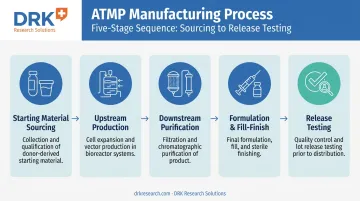
Every ATMP moves through the same broad arc, even though the specifics differ sharply by modality. The stages run in sequence: sourcing starting material, upstream production, downstream purification, formulation and fill-finish, then release testing before a dose ever reaches a patient.
Upstream Processing
Cell therapies isolate target cells, often via leukapheresis for autologous CAR-T, then expand and genetically modify them as needed. Gene therapies take a different route, manufacturing plasmid DNA first and using it to produce viral vectors, most commonly AAV, at the scale required for dosing.
Vector yield variability remains one of the biggest sources of delay across the industry, regardless of which modality a program is built on.
Downstream Processing & Purification
Once cells or vectors are produced, they need separation from process impurities and concentration to a usable dose. Several techniques dominate this stage:
- Tangential flow filtration (TFF): concentrates the product and exchanges buffers through ultrafiltration and diafiltration.
- Affinity chromatography: captures the target product while removing bulk process impurities.
- Ion-exchange chromatography: separates molecules by charge to strip out residual host-cell proteins.
- Size-exclusion chromatography: removes empty capsids and aggregates based on molecular size.
These steps often run in sequence, tightening purity with each pass.
Formulation, Fill-Finish & Release Testing
The product is formulated into a stable, patient-ready form, then filled aseptically, frequently in small batches that can't tolerate the terminal sterilization used for conventional drugs. Before release, every batch must pass sterility, identity, and potency testing.
For autologous therapies, this entire arc happens on a clock patients are actively waiting on. A 2025 meta-analysis published in Blood Advances found median vein-to-vein times of 30.6 days for axi-cel, 35.9 days for liso-cel, and 48.4 days for tisa-cel. That spread comes down almost entirely to manufacturing and logistics differences between products.
Shaving even a few days off that timeline matters enormously for patients with aggressive disease.
Common Challenges & Optimization Strategies in Advanced Therapy Manufacturing
Facility Flexibility and Supply Chain Resilience
Cell and gene therapy technology evolves faster than facilities can be built. A suite designed around one vector serotype or one cell process can become outdated before it's even validated.
Modular, multi-product facility design, built around segregated suites and prefabricated cleanroom modules, lets sponsors add capacity without halting existing production. A documented case in Shanghai used plug-and-produce modules to run parallel patient batches while expanding capacity mid-operation.
Facility flexibility only solves half the problem. Raw material variability, whether it's plasmid lots, cytokines, or single-use bags, is a persistent risk. Qualifying multiple bioreactor and filtration suppliers, instead of locking into one vendor, reduces the odds that a single component shortage stalls an entire manufacturing campaign.
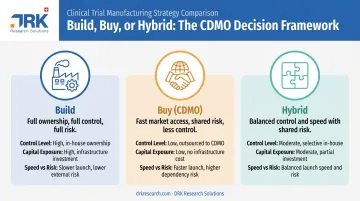
Build vs. Buy vs. Hybrid
- Build: maximum control, but ties up capital and concentrates risk in one facility.
- Buy (outsource to a CDMO): lowers technical risk, though usually at a premium and with less scheduling control.
- Hybrid: pairs owned capacity for core processes with outsourced overflow capacity, balancing capital exposure against flexibility.
Equipment choice follows a similar trade-off. Single-use systems reduce cross-contamination risk and speed changeovers between campaigns, which matters in facilities running multiple products. Stainless steel still wins on cost-of-goods at very large, sustained scale, so most ATMP manufacturers run single-use for early-phase and multi-product suites, then revisit the calculation once a program confirms commercial volume.
Scaling From Clinical to Commercial
Tech transfer and comparability studies are where many programs lose months. Regulators expect any manufacturing change, whether site, scale, equipment, or analytical method, to be evaluated against identity, purity, potency, and safety. Early process characterization and Quality by Design (QbD) principles reduce this risk:
- Define the target product profile.
- Identify product-specific critical quality attributes.
- Map critical process parameters and material attributes against those attributes.
- Build risk-based, in-process controls and a comparability strategy before scale-up, not after.
Digital systems tie this process together at scale. Manufacturing execution systems, predictive maintenance, and electronic quality management systems connect batch records, deviations, and equipment data. That combination turns a facility network into something scalable and audit-ready, rather than a collection of disconnected paper trails.
Regulatory & Cost Considerations for ATMP Manufacturing
Regulatory Considerations
GxP expectations tighten at every development phase, and manufacturing changes must stay aligned with regulatory strategy. A mismatch here is one of the most common causes of IND or CTA delays. Two pathways can help sponsors move faster:
- FDA's RMAT designation: for regenerative medicines treating serious conditions with preliminary clinical evidence of benefit. FDA targets a 60-day decision on the designation request.
- EMA's PRIME scheme: offers earlier, more intensive CAT/CHMP engagement for medicines addressing unmet need.
- PRIME's track record is mixed: seven of the first 18 PRIME-designated medicines were ATMPs, though roughly 56% of applicants who entered accelerated assessment reverted to the standard timetable.
Navigating these regulatory pathways well is only part of the equation. Once a designation is secured, cost pressures shape manufacturing decisions just as strongly.
Cost Considerations
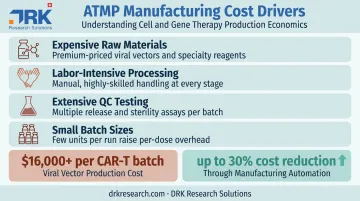
ATMP manufacturing costs run high for structural reasons:
- Expensive raw materials: viral vectors, plasmids, specialized cell lines.
- Labor-intensive processing: much of the workflow still requires skilled manual intervention.
- Extensive QC testing: sterility, potency, identity, and, for vector-based products, replication-competent virus testing.
- Small batch sizes: especially for autologous products, where each batch serves exactly one patient.
A 2025 peer-reviewed review put the viral-vector component alone at more than $16,000 for a single CAR-T patient batch, according to a cost-effectiveness analysis published in PMC. That figure excludes cell culture, labor, QC, and logistics costs. Automation can offset some of that cost: one modeled analysis found bolt-on automation cut manufacturing cost by 23%, with more comprehensive automation approaching a 30% reduction.
For many sponsors, outsourcing to an experienced CDMO lowers the upfront capital expenditure that a dedicated in-house facility would otherwise demand, trading some control for speed and reduced risk exposure.
Why Partner with an Experienced CRO for Advanced Therapy Programs
Advanced therapy programs rarely stall because the science doesn't work. They stall because clinical, regulatory, and manufacturing timelines fall out of sync with each other. That's where an experienced CRO partner earns its keep, particularly one that understands how manufacturing decisions ripple into trial design and regulatory submissions.
DRK Research Solutions supports sponsors across the clinical development lifecycle, from first-in-human study design through Phase IV, with regulatory strategy spanning EU GMP, US FDA, MHRA, WHO PQ, and PIC/S frameworks. For advanced therapy sponsors specifically, that means:
- Coordinating trial design and site feasibility around the realities of vein-to-vein timelines and batch scheduling.
- Managing regulatory submissions and dossier preparation as manufacturing processes evolve between phases.
- Supporting technology transfer documentation and comparability planning alongside a sponsor's chosen manufacturing partner.
DRK's operational network spans Europe, the Middle East, Asia, Africa, and the Americas, with local teams in Switzerland, the UK, the USA, Pakistan, Malaysia, Nepal, and the UAE. That footprint helps sponsors run multi-regional trials and reach patients in markets that larger, single-region CROs often overlook.
That geographic reach comes with a clear scope boundary: DRK's current CDMO and product development services focus on generics and hybrid product development, not cell, gene, or tissue-engineered manufacturing. For advanced therapy programs, DRK's role centers on clinical operations, regulatory strategy, and coordination alongside specialized manufacturing partners, not ATMP production itself.
If you're planning an advanced therapy program and need a partner to align clinical and regulatory strategy with a demanding manufacturing timeline, contact DRK Research Solutions to discuss your program's specific needs.
Frequently Asked Questions
How much does it cost to manufacture cell therapy?
Costs vary widely by modality, batch size, and raw material sourcing. As one benchmark, the viral-vector component alone for a single CAR-T patient batch can exceed $16,000, before labor, QC, and logistics are added.
What is the ATMP manufacturing process?
The core stages are sourcing starting material, upstream production (cell expansion or vector manufacturing), downstream purification, and formulation/fill-finish with release testing. Each stage carries distinct risk points shaping overall timeline and cost.
What are advanced therapy products?
ATMPs are medicines based on genes, cells, or tissues, falling into three main categories: gene therapy medicines, somatic-cell therapy medicines, and tissue-engineered medicines, plus combined products that pair cells with a device.
What is the FDA classification of ATMP?
The FDA does not use the EU's "ATMP" label. CBER's Office of Therapeutic Products regulates these products as gene therapies, cellular therapies, or tissue-engineered products, typically under the biologics pathway.
What is the difference between autologous and allogeneic cell therapy manufacturing?
Autologous therapies use a patient's own cells, requiring personalized, small-batch production with strict chain-of-identity controls. Allogeneic therapies use banked donor cells, allowing larger, more scalable "off-the-shelf" batches.
How long does it typically take to manufacture a cell or gene therapy?
Timelines vary by product. Median vein-to-vein times range from about 31 days for axi-cel to roughly 48 days for tisa-cel, while gene therapy vector production timelines depend heavily on serotype and scale.