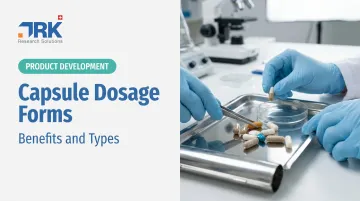
That's a costly oversight. Hard capsules can be hand-filled for small clinical batches, avoiding the compression and coating optimization that tablets require. For teams racing toward a Phase I readout, that difference matters.
This article breaks down what capsules are, the major types available, and the practical benefits and trade-offs formulation teams need to weigh before choosing a dosage form.
Key Takeaways
- Capsules skip compression and coating steps, which can simplify early-phase manufacturing
- Four main capsule types exist: hard gelatin/HPMC, softgel, modified-release, and enteric, each suited to different APIs
- Taste-masking and sprinkle-friendly formats support pediatric and geriatric dosing, though preferences vary by patient
- Choosing the right format requires formulation science expertise, not a one-size-fits-all default
What Are Capsule Dosage Forms?
A capsule is a dosage form that encloses an active pharmaceutical ingredient (API) and its excipients inside a shell. Tablets, by contrast, are formed by compressing powder blends directly under pressure. That structural difference drives most of the practical trade-offs between the two formats.
Capsules can accommodate a wider range of fill materials than most people assume:
- Powders and granules — the traditional dry-fill approach
- Pellets and microtablets — used for multiparticulate or modified-release systems
- Liquids and solutions — increasingly common in both hard and soft shells
- Semi-solid pastes — useful for poorly compressible or moisture-sensitive APIs
Shell material matters too. Traditional shells use gelatin, derived from animal collagen. Plant-based alternatives like HPMC (hydroxypropyl methylcellulose) have gained ground for sponsors targeting vegetarian, vegan, kosher, or halal markets.
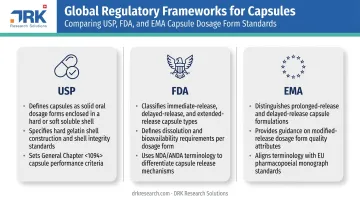
These material and shell choices don't exist in a regulatory vacuum. Major agencies each define capsule dosage forms in their own way:
- U.S. Pharmacopeia — formally defines hard gelatin shell construction
- FDA — recognizes capsule, delayed-release capsule, and extended-release capsule as distinct dosage-form terms in its structured product labeling system
- EMA — addresses prolonged- and delayed-release oral products under its own quality guidance
Capsules are well established across these systems, a fact that matters whether you're planning a trial in one country or a commercial launch across several.
Types of Capsule Dosage Forms
Not all capsules serve the same purpose. Selecting the right type comes down to your API's physical and chemical characteristics, plus your production scale.
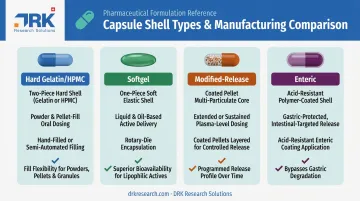
Hard Gelatin (and Non-Gelatin) Capsules
Hard capsules use a two-piece cap-and-body structure that snaps together to enclose the fill. They were originally built for dry solids, but formulators now routinely fill them with liquids and semi-solids as well.
For early-stage and clinical supply work, hard capsules offer a real practical advantage: small batches can be hand-filled or filled with a precision powder dispenser, avoiding the capital investment and setup time automated equipment demands.
This makes them a natural fit for Phase I and Phase II studies, where dose flexibility and blinding matter more than commercial-scale throughput.
Plant-based HPMC shells have become a popular non-gelatin option here. They deliver comparable performance while meeting vegetarian, vegan, kosher, and halal certification requirements, an increasingly important consideration for global product launches.
Soft Gelatin Capsules (Softgels)
Softgels are a one-piece, hermetically sealed shell, thicker and more flexible than hard capsule walls, thanks to plasticizers like glycerin or sorbitol blended into the gelatin matrix. This construction makes softgels ideal for oils, solutions, and semi-solid suspensions that hard shells can't easily contain without leakage risk.
The catch: softgel production requires specialized rotary-die equipment that forms two gelatin ribbons, meters the fill between them, then seals and cuts the finished capsule. That equipment investment makes softgels less practical for very small production runs or early feasibility work compared to hand-filled hard capsules.
Modified-Release Capsules
Modified-release capsules use coatings, polymers, or semipermeable membranes to control how fast the drug releases once swallowed. Depending on the design, release can be engineered as rapid, sustained, or delayed. Mechanisms include diffusion through a membrane, erosion of a matrix, or osmotic pumping — sometimes in combination.
These systems typically place coated pellets, granules, or a matrix formulation inside a standard hard shell, giving formulators a tunable release profile without redesigning the entire dosage form from scratch.
Enteric Capsules
Enteric capsules use acid-resistant shells or coatings, most notably cellulose acetate phthalate, to survive stomach acid intact and release the API only once it reaches the intestine's higher pH environment. This protects acid-sensitive drugs from degradation and can also protect the stomach lining from irritating compounds.
Performance here is product-specific. Regulatory bodies expect gastro-resistance to be demonstrated directly, not assumed from the polymer choice alone.
Key Benefits of Capsule Dosage Forms
Manufacturing and Formulation Advantages
Capsules remove the high-pressure compression and film-coating steps that tablets require, which reduces the risk of damaging heat- or moisture-sensitive APIs and cuts down on process failure points.
Early clinical-supply capsules can often use neat API or a simple API-plus-filler blend, bypassing the tablet compression and coating optimization work entirely, according to Pharmaceutical Technology's review of clinical capsule development.
That said, simplicity isn't automatic. Powder flow, blend density, and capsule size still control fill-weight accuracy, and manual filling can introduce its own variability if these factors aren't controlled early.
Capsules also offer genuine formulation flexibility:
- Hold powders, pellets, liquids, or multiparticulate blends
- Separate physically or chemically incompatible components within a single dose
- Accommodate dose adjustments more easily during early clinical phases than a tablet press setup allows
Bioavailability and Patient Experience
Lipid-based and self-nanoemulsifying drug delivery systems (SNEDDS) can meaningfully improve absorption of poorly soluble APIs. In one rat crossover study, a fenofibrate SNEDDS formulation produced roughly 1.7-fold higher relative oral bioavailability compared to suspended powder, with Cmax and AUC both substantially higher.
This supports lipid-system formulation strategies broadly. It doesn't mean every capsule outperforms every tablet, since the comparison studied a delivery system, not shell type.
Patient experience is similarly nuanced. Capsules can mask unpleasant tastes and odors effectively, and sprinkle-capsule formats help pediatric and geriatric patients who struggle with whole-dose swallowing.
But swallowability itself isn't a settled advantage: a 2024 patient acceptability review found tablets were actually preferred over capsules in two separate patient surveys (84% and 79% preference, respectively). The right call depends on the patient population and the specific formulation, not a blanket assumption.
Stability and Protection
Shells act as a physical barrier against moisture, light, and oxygen, with the degree of protection varying by shell material and formulation. For potent or hazardous APIs, dissolving or suspending the compound into a liquid fill before capsule sealing can reduce airborne powder exposure during later manufacturing steps compared to handling loose powder throughout the process.
Capsule Formulation and Manufacturing Considerations
Choosing between hard and soft shell formats isn't a coin flip. It depends on preformulation study data covering the API's solubility, moisture sensitivity, and compatibility with shell materials. An API that's hygroscopic, for instance, can embrittle a gelatin shell over time, while reactive aldehydes can cross-link gelatin outright.
Excipient selection follows the fill material and shell type. Key categories formulators evaluate include:
- Diluents — bulk up low-dose fills to a workable fill weight
- Lubricants — improve powder flow during automated filling
- Wetting agents — aid dissolution of poorly soluble powders
- Disintegrants — help the shell break down and release contents
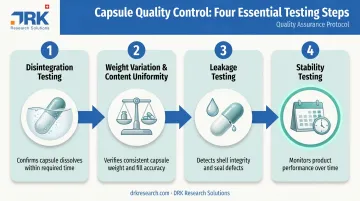
Before any batch ships, quality checks confirm the product performs as designed:
- Disintegration testing — confirms the shell breaks down within specified time limits
- Weight variation or content uniformity — verifies consistent dosing across units
- Leakage testing — critical for liquid-filled capsules, where low-viscosity fills can escape the shell seam
- Stability testing — verifies the product holds up in its intended packaging over its shelf life
None of these are one-size-fits-all checks. Testing requirements shift based on the specific monograph, release profile, and regulatory market the product targets. Navigating these requirements often calls for specialized support. DRK Research Solutions' product development team assists sponsors with analytical method development and regulatory compliance across these testing stages.
Choosing the Right Capsule Development Partner
Picking a development partner who only knows one capsule format is a limiting choice. Sponsors need proven formulation science across multiple capsule types:
- Hard capsules
- Soft capsules
- Modified-release capsules
- Enteric capsules
A strong partner recommends the format that fits the API, not just the format they happen to run.
Global regulatory experience matters just as much, especially for multi-regional programs. A partner needs to understand not just FDA and EMA expectations, but also localized pathways for markets that are often underserved by mainstream drug development.
DRK Research Solutions meets that bar as an end-to-end CRO/CDMO, offering:
- Formulation development
- Technology transfer
- eCTD dossier preparation
- Generics and hybrid product development for regulated markets
Its network spans Europe, the Middle East, Asia, Africa, and the Americas, giving sponsors a practical path to shorten capsule development timelines. This reach also extends product access into low- and middle-income countries, where regulatory pathways can otherwise stall a promising product for years.
Frequently Asked Questions
What is the main difference between a capsule and a tablet?
Capsules enclose an API and excipient blend inside a shell, while manufacturers form tablets through direct compression. This affects manufacturing complexity, since capsules skip compression and coating steps that tablets require.
Are capsules better than tablets for bioavailability?
Capsules can improve absorption for poorly soluble drugs when formulated with lipid-based or SNEDDS fill systems. There's no universal rule, though — the right choice always depends on the specific API's solubility profile.
Can capsules be made without gelatin?
Yes. Plant-based shells like HPMC offer gelatin-free alternatives that meet vegetarian, vegan, kosher, and halal certification requirements, with performance comparable to traditional gelatin shells.
How long does capsule formulation development typically take compared to tablets?
Capsules generally move faster in early phases since they can skip compression and coating optimization. This makes them especially useful when clinical timelines are tight, but scale-up to commercial production still requires its own development work.
What quality tests are required for capsule dosage forms?
Key tests include disintegration, weight variation or content uniformity, leakage testing (particularly for liquid fills), and stability testing. Exact requirements vary by product, monograph, and target regulatory market.
Which type of capsule is best for liquid-filled formulations?
Both liquid-filled hard capsules and softgels can hold liquid fills. The right choice depends on fill viscosity, shell compatibility, and whether your batch size favors hand-filling or rotary-die softgel equipment.