In February 2024, AstraZeneca announced a $300 million cell-therapy manufacturing facility in Rockville, Maryland, built specifically to support late-stage cancer trials and commercial launches. That single investment tells you where the industry's real bottleneck now sits: not in the lab, but on the production floor.
Sponsors face a familiar squeeze. Costs are climbing, processes remain technically demanding, and capacity slots are booked out months in advance, even as pipelines mature toward approval. This article breaks down current market size projections, the forces driving growth, the trends reshaping production, regional dynamics, and the persistent challenges standing between promising science and available treatment.
Key Takeaways
- CGT manufacturing is projected to reach tens of billions in value by the early 2030s, driven by double-digit CAGR growth.
- CDMOs are repositioning from capacity vendors into strategic partners that help sponsors navigate regulatory and technical complexity.
- Automation, closed-system processing, and AI-supported quality control are the primary levers for scaling production and cutting costs.
- North America and Europe lead today's market, but Asia Pacific and underserved regions are driving the next growth wave.
Cell and Gene Therapy Manufacturing Market: Size and Growth Forecast
Market size estimates vary depending on what analysts count. Here's how three leading firms frame the opportunity:
| Research Firm | Scope | Base Year Value | Forecast Value | CAGR |
|---|---|---|---|---|
| Grand View Research | Full cell and gene therapy manufacturing | $7.3B (2022) | $47.1B (2030) | 26.3% |
| Roots Analysis | Full cell and gene therapy manufacturing | $15.1B (2025) | $160.0B (2035) | 26.64% |
| Precedence Research | Cell therapy manufacturing only | $5.55B (2025) | $21.02B (2035) | 14.24% |
The gap between $47 billion and $160 billion isn't a contradiction. It comes down to scope. Roots Analysis models both cell and gene therapy manufacturing across every workflow and mode, while Precedence deliberately excludes gene therapy entirely. Always check what's included before comparing numbers across reports.
Beyond scope differences, clinical volume is the real driver behind these forecasts. CGT programs have expanded well beyond rare disease into oncology, neurology, and chronic disease indications, and each new therapeutic area adds trial volume that eventually needs manufacturing support.
Regulatory approvals are translating that pipeline growth into commercial demand. As of Q3 2025, industry tracking counted 38 approved gene therapies (including genetically modified cell therapies) and 71 approved non-genetically modified cell therapies — 109 products across both categories, according to ASGCT and Citeline's landscape tracking.
The market hasn't grown in a straight line, though. Industry analysis found CGT manufacturing demand peaked at 256% of pre-pandemic levels by clinical trial count in mid-2021, while capacity investment grew more than twice as fast as active trials between 2019 and 2024. The result was a classic overbuild: facilities came online faster than the pipeline could fill them.
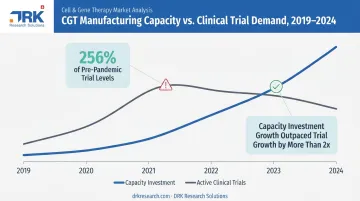
That imbalance is now correcting. Real capital is flowing back into dedicated capacity, with AstraZeneca's Rockville facility among the clearest signals, as sponsors and CDMOs recalibrate around actual near-term demand rather than pandemic-era projections.
Key Growth Drivers Powering Market Expansion
Several forces are converging to push manufacturing demand higher, even as the market works through its post-pandemic correction.
Regulatory pathways are compressing timelines. The FDA's Regenerative Medicine Advanced Therapy (RMAT) designation saw 91 requests and 50 grants in FY2025, up from 59 requests and 43 grants the year before.
Europe's equivalent, EMA's PRIME scheme, received 58 eligibility requests in 2024, a 12% increase over 2023. Neither agency publishes an exact time-saved figure, but both frameworks accelerate sponsor interaction with regulators, which pulls manufacturing planning forward.
Outsourcing keeps growing, though not indefinitely. A 2023 ISR survey found CGT sponsors outsourced an average of 64% of manufacturing activity to CDMOs, with respondents expecting that figure to settle closer to 49% within five years.
That's not a retreat from outsourcing. It reflects sponsors selectively insourcing specific steps once programs reach commercial scale, while still relying on outside partners for specialized or overflow capacity.
This is exactly where experienced CRO and CDMO partners earn their keep. Building in-house viral vector suites or cell processing infrastructure requires capital that most emerging biotechs simply don't have.
Organizations such as DRK Research Solutions illustrate the adjacent value proposition: regulatory dossier preparation, GxP compliance support across major standards (EU GMP, US FDA, MHRA, WHO PQ, PIC/S), and a multi-region site network spanning Europe, the Middle East, Asia, Africa, and the Americas.
Smaller sponsors developing advanced therapies often need this regulatory and operational scaffolding just as much as they need bioprocessing capacity itself.
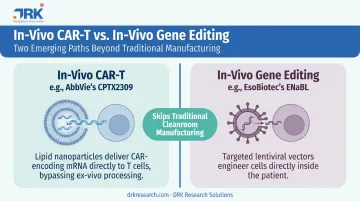
Technology is shifting the manufacturing model. Non-viral delivery methods, lipid nanoparticles especially, and allogeneic ("off-the-shelf") therapies are gaining ground because they scale more predictably than patient-specific autologous processes. In-vivo approaches take this further:
- In-vivo CAR-T, like AbbVie's Capstan-derived CPTX2309, delivers CAR-encoding mRNA via targeted lipid nanoparticles directly to a patient's T cells, skipping ex-vivo cell manipulation entirely.
- In-vivo gene editing, such as EsoBiotec's ENaBL platform using targeted lentiviruses, engineers cells inside the patient rather than in a cleanroom.
Both approaches could meaningfully lower manufacturing complexity and cost, though neither has reached commercial scale yet.
The pipeline backing all of this remains substantial: Q3 2025 tracking counted 4,341 therapies from preclinical through pre-registration, with 3,243 ongoing gene, cell, or RNA clinical trials. That volume is the clearest forward indicator that manufacturing demand isn't slowing down.
Major Trends Reshaping the CGT Manufacturing Landscape
Consolidation and Capacity Rightsizing
Early viral vector overinvestment left parts of the market with more capacity than clinical demand could absorb. Industry analysis found the sector was losing roughly 20 active trials per month from the 2021 peak, compared to a historical net addition of nine per month. That reversal left CDMOs built for a pipeline that partially failed to materialize.
The response has been consolidation rather than expansion. WuXi AppTec agreed in December 2024 to sell its WuXi Advanced Therapies unit to Altaris, one of several deals reshaping who controls viral vector and cell processing capacity. Expect more M&A as:
- Larger CDMOs pursue end-to-end capabilities to reduce sponsor handoffs
- Smaller biotech innovators seek partnership access rather than building their own facilities
- Strategically located, right-sized facilities replace scattered overbuilt capacity
Automation, Digitalization and AI-Driven Quality Control
Autologous manufacturing has historically resembled a craft process, one technician, one patient, one batch, with all the variability that implies. Closed, automated systems are changing that. Bristol Myers Squibb's $380 million capacity-reservation agreement with Cellares in April 2024 secured multiple Cell Shuttle manufacturing systems for fully automated, high-throughput CAR-T production and quality control.
Digital modeling is following the same trajectory. MIT researchers published a digital twin for recombinant AAV production in 2024 that models baculovirus genetic instability to optimize process parameters. It's a meaningful research advance, but the distinction matters: this reflects process-modeling progress, not proven commercial real-time release testing at scale. That capability is still emerging, not standard practice.
The CDMO's Evolution from Service Provider to Strategic Innovation Partner
The most consequential shift may be behavioral rather than technical. Leading manufacturing partners are increasingly investing in capacity and competencies before sponsors ask for them, rather than reacting to individual requests. That proactive posture is becoming something of a great equalizer.
A small biotech with a single promising asset can now access the same automated platforms, quality systems, and regulatory know-how that a large pharma company would build in-house.
For sponsors navigating that shift, regulatory and technology transfer support matter as much as the hardware itself. DRK Research Solutions works this way with CGT sponsors, pairing clinical trial operations with regulatory compliance consulting and technology transfer support so smaller teams can access expertise usually reserved for larger pharma companies.
Market Segmentation and Regional Analysis
Segmentation by Therapy Type, Manufacturing Scale and Mode
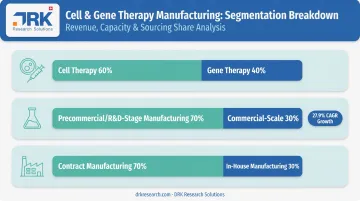
Cell therapy currently holds the larger revenue share, roughly 60% of the manufacturing market according to both Grand View Research and Roots Analysis. Gene therapy, however, is forecast to grow faster, driven by viral vector platform advancements and a surging clinical trial count.
On scale, precommercial and R&D-stage manufacturing accounts for close to 70% of activity by volume, but commercial-scale manufacturing is growing faster: Grand View Research projects it expanding from $2.01 billion in 2022 to $14.17 billion by 2030, a 27.9% CAGR.
Contract manufacturing dominates by share (around 70%), but in-house manufacturing is posting the higher growth rate as larger, well-capitalized sponsors bring select production steps back in-house once therapies reach commercial volumes.
Regional Market Dynamics and the Emerging Market Opportunity
North America leads decisively, holding 44-45% of the global market depending on the report. Europe follows, operating under the EU's Advanced Therapy Medicinal Products framework (Regulation EC No. 1394/2007), which requires centralized marketing authorization for all ATMPs.
Asia Pacific is the fastest-growing region in every model reviewed, driven by accelerated local regulatory frameworks. Japan's conditional, time-limited approval pathway for regenerative medical products lets developers reach patients faster, with efficacy confirmed post-launch. South Korea's Advanced Regenerative-Bio Act, effective August 2020, created expedited pathways specifically for cell, gene, tissue-engineering, and fusion therapies.
Beyond these established markets sits a real gap. The Middle East, Africa, and parts of Asia have limited manufacturing infrastructure and constrained clinical trial capacity, which directly limits patient access to advanced therapies.
This is where organizations with established multi-regional LMIC networks add value. DRK Research Solutions, for instance, operates hubs across Malaysia, the UAE, and Africa, connecting sponsors with local regulatory expertise and clinical trial capacity to help expand patient access to advanced therapies in underserved regions.
Challenges Facing CGT Manufacturers
Manufacturing cost and complexity remain the primary barrier, especially for emerging biotechs without deep capital reserves. A 2025 peer-reviewed review put the cost of a single-patient viral vector batch above $16,000, before accounting for cell culture and T-cell transport costs layered on top.
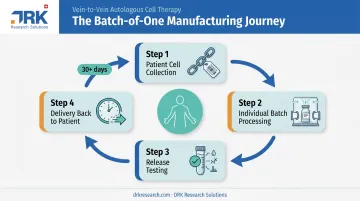
Autologous "scale-out" logistics create a unique operational burden. Unlike conventional batch manufacturing, where one process serves many patients, autologous therapy requires:
- Collecting a specific patient's cells with a fully documented chain of custody
- Processing that individual batch without cross-contamination risk
- Running release testing for sterility, identity, viability, and vector-related safety markers
- Delivering the finished product back to the same patient, often within a strict window
The complete vein-to-vein process can take up to 30 days or longer, and any delay or error affects one identifiable patient, not an anonymous lot.
Viral vector bottlenecks compound the problem, with downstream processing lagging far behind other biologics:
- Chromatography recovery for viral vectors generally runs below 50%, compared to over 90% for standardized monoclonal antibody processes, according to McKinsey's analysis of viral vector therapies at scale
- CDMO start-up times for new viral vector programs can exceed 18 months, even though production itself takes roughly a month
- Charles River's Lentivation platform claims to cut lentiviral vector timelines from 18 months to under seven, though that's a manufacturer benchmark rather than an industry-wide average
Frequently Asked Questions
What is driving the growth of the cell and gene therapy manufacturing market?
Rising regulatory approvals, expanding clinical pipelines beyond rare disease into oncology and neurology, and increased CDMO outsourcing are the primary drivers. Expedited regulatory pathways like RMAT and PRIME are also pulling manufacturing demand forward.
How big is the cell and gene therapy manufacturing market expected to become?
Estimates vary by scope: Grand View Research projects $47.1 billion by 2030 (26.3% CAGR), while Roots Analysis forecasts $160 billion by 2035. Precedence Research puts cell-therapy-only revenue at roughly $21 billion by 2035.
What is the difference between cell therapy and gene therapy manufacturing?
Cell therapy manufacturing processes living cells, like CAR-T, requiring patient-specific handling and strict chain-of-custody controls. Gene therapy manufacturing produces viral vectors or non-viral delivery vehicles carrying genetic material, with challenges around yield and capsid quality.
Why are pharmaceutical companies outsourcing cell and gene therapy manufacturing to CDMOs?
Building specialized manufacturing infrastructure requires enormous capital and technical expertise most sponsors lack internally. CDMOs offer faster time-to-market, established regulatory relationships, and existing GMP-compliant facilities without the multi-year build-out.
What are the biggest challenges in cell and gene therapy manufacturing?
High costs, technical complexity, and batch-of-one autologous manufacturing logistics top the list. Viral vector bottlenecks, including low downstream recovery and long CDMO lead times, further risk trial and launch timelines.
Which region leads the cell and gene therapy manufacturing market?
North America leads with roughly 44-45% market share, backed by dense CDMO infrastructure and a mature regulatory environment. Asia Pacific is forecast to grow fastest, driven by expedited pathways in Japan and South Korea.