Many formulation teams underestimate how much this thin polymer layer influences stability, patient compliance, and time-to-market. Skipping proper coating development often leads to costly rework, failed stability batches, or regulatory delays late in the process.
This guide covers what film coating actually is, the materials and types used, how it compares to other tablet coatings, the step-by-step manufacturing process, and how partnering with an experienced CDMO like DRK Research Solutions can streamline formulation and coating development for both regulated and emerging markets.
Key Takeaways
- Film coating protects the API, eases swallowing, masks taste, and can control drug release
- Coatings split into two categories: non-functional (aesthetic/protective) and functional (modified/delayed release)
- Sugar coating has largely given way to film coating due to faster processing and better stability
- The process runs through five stages: core prep, solution prep, equipment setup, spray-coating, and cooling/discharge
- Material and manufacturing partner choices directly affect stability, approval timelines, and patient outcomes
What Is Film Coating and Why Does It Matter?
Film coating is a thin, uniform polymer layer sprayed onto a rotating bed of tablet cores. The coating solution, typically dissolved or dispersed in water, is atomized onto tablets while hot air evaporates the solvent, leaving behind a continuous film. According to Colorcon's guide to the pharmaceutical coating process, the formulation combines a film-forming polymer, plasticizer, and pigment system to achieve this result.
Film coating is the modern successor to sugar coating. It is now used across the majority of oral solid dosage forms manufactured worldwide, largely because it is faster, lighter, and more consistent batch-to-batch.
Why Film Coating Matters: Key Benefits
The coating is not cosmetic. It performs several jobs at once:
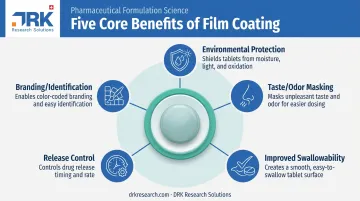
- Environmental protection – shields the API from moisture, light, and oxidation, extending shelf life and preserving potency
- Taste and odor masking – critical for pediatric and geriatric populations who are more sensitive to bitter or chalky APIs
- Improved swallowability – reduces chipping and abrasion during handling and transport
- Release control – functional coatings determine where and when a drug releases in the GI tract
- Branding and identification – color and finish reduce medication errors and help patients distinguish products
Patient-facing evidence supports the swallowability angle specifically. A randomized pediatric study of 320 children found swallowability-based acceptability of at least 87% and pleasant or neutral palatability of 96.6% across film-coated mini-tablets. This is a meaningful signal, even though no direct film-coated-versus-uncoated adherence study currently exists in the literature.
Materials & Types of Film Coatings Used in Pharma
Every film coating formulation rests on three material categories working together: polymers, plasticizers, and pigments.
Core Materials: Polymers, Plasticizers & Pigments
| Material | Role | Common Examples |
|---|---|---|
| Film-forming polymer | Mechanical strength, solubility, release control | HPMC, HPC, ethylcellulose, PVA |
| Plasticizer | Prevents cracking and brittleness | PEG, triethyl citrate |
| Pigment/opacifier | Light protection, branding, color | Titanium dioxide |
HPMC provides strength and works well in aqueous immediate-release systems. Ethylcellulose is hydrophobic and better suited for moisture-resistant, controlled-release films. Plasticizers matter more than formulators sometimes assume: without them, coatings crack and peel under stress during storage or transport.
Types of Film Coatings: Functional vs. Non-Functional
Non-functional coatings handle appearance, taste masking, and moisture/light protection without changing how the drug releases. Functional coatings modify release timing, site, or rate, such as delayed-release, sustained-release, or pulsatile systems.
Three application methods exist:
- Organic solvent-based – fast drying, but raises safety and environmental concerns
- Aqueous coating – the current industry standard for safety reasons, despite longer drying times
- Solvent-free/dry powder coating – an emerging method still gaining commercial traction
Newer approaches like electrostatic dry powder coating and 3D-printed partial shells are showing promise in published research, though widespread commercial adoption is still limited.
Film-Coated vs. Other Tablet Types: What's the Difference?
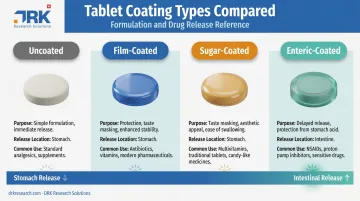
Formulation teams and even prescribers often ask how film-coated tablets differ from "normal" tablets. The short answer: surface finish, taste masking, swallowability, mechanical strength, and stability all shift once a coating is applied.
Film-Coated vs. Uncoated Tablets
Uncoated tablets are cheaper and faster to manufacture but more prone to chipping, poor taste, and dusting. Film-coated tablets cost more upfront but typically reduce total cost of ownership through fewer returns, complaints, and stability failures. The added film layer typically increases tablet weight by just 2-4%, a modest tradeoff for the extra durability and patient acceptability it delivers.
Film-Coated vs. Sugar-Coated Tablets
Sugar coating requires sealing, sub-coating, smoothing, coloring, and polishing stages, a process that studies show is far more labor-intensive and time-consuming than film coating. It also adds more weight to the tablet and absorbs moisture more readily, which is why film coating has largely displaced it in modern manufacturing.
Film-Coated vs. Enteric-Coated Tablets
Enteric coating is a functional subtype designed to resist gastric acid and release the drug in the intestine, commonly used for NSAIDs or acid-sensitive compounds. Standard film coatings, by contrast, dissolve quickly in the stomach.
| Type | Surface Appearance | Purpose | Release Location | Common Applications |
|---|---|---|---|---|
| Uncoated | Matte, powdery | None | Stomach (immediate) | Basic generics, cost-sensitive products |
| Film-coated | Smooth, glossy | Protection, taste masking | Stomach (immediate) | Most modern oral solids |
| Sugar-coated | Thick, rounded | Taste/appearance masking | Stomach (immediate) | Legacy formulations |
| Enteric-coated | Smooth, resistant | Acid protection, targeted release | Intestine | NSAIDs, acid-sensitive APIs |
The Pharmaceutical Film Coating Process: Step by Step
Film coating happens in five distinct stages, and skipping rigor at any one of them shows up as a defect later.
- Tablet core preparation – Formulators must optimize core hardness, friability, and shape upfront. A friable or sharp-edged core simply won't survive the mechanical stress of the coating pan.
- Coating solution preparation – Appropriate mixing equipment must fully disperse polymers, plasticizers, and pigments in the solvent. Poor dispersion causes nozzle blockages and surface defects downstream.
- Equipment set-up – Operators calibrate pan type, airflow, spray gun positioning, pan speed, temperature, and spray rate to match the specific tablet size and batch requirements.
- Coating application – Operators pre-warm the tablets, then spray fine coating droplets while continuously tumbling and drying the batch until it hits the target weight gain and appearance.
- Cooling and discharge – Tablets cool gradually to ambient temperature before discharge. Skip this step and you risk sticking or surface damage.
There's no universal setpoint for pan speed, spray rate, or weight gain across all products. Manufacturers must develop each range against the specific formulation and equipment in use.
Why Partner with a CDMO for Film Coating & Formulation Development
Film coating success depends on tight integration between core formulation, API characteristics, and coating chemistry. Get the plasticizer ratio wrong, or mismatch the polymer to the core's mechanical properties, and you end up reworking batches, sometimes after stability testing has already started. That's expensive and slow.
This is where an experienced CDMO partner de-risks scale-up. DRK Research Solutions, a CRO and CDMO with a decade-plus track record, supports generics and hybrid oral solid dosage development through:
- Lab-scale formulation development and optimization, including systematic excipient selection, process optimization, and early risk assessment
- Analytical method development validated against ICH and USP standards for quality control and stability testing
- Technology transfer support, including scale-up studies and on-site troubleshooting at manufacturing partners
- eCTD dossier preparation covering Modules 2–5 for regulatory submission
DRK's Chief Scientific Officer, Vipan Dhall, Ph.D., leads scientific strategy across these development programs, with a team operating across Europe, the Middle East, Asia, Africa, and the Americas.
That regional footprint matters for sponsors targeting both regulated markets and low- and middle-income countries, where local regulatory pathways vary widely. A CDMO that understands both systems can shave months off a program that might otherwise stall waiting on a single region's requirements.
Frequently Asked Questions
What does film coating do to tablets?
Film coating protects the API from moisture, light, and oxidation while masking taste and odor. It also improves swallowability and, depending on the polymer used, can control the timing of drug release.
What's the difference between film-coated tablets and normal tablets?
"Normal" usually means uncoated. Uncoated tablets have a matte, powdery surface, are harder to swallow, and lack the stability and taste-masking benefits film coating provides.
Is film coating the same as sugar coating?
No. Both mask taste, but sugar coating requires more processing stages, adds more weight, and absorbs moisture more readily than modern film coating.
Can film-coated tablets be crushed or split?
Avoid crushing or splitting film-coated tablets unless a healthcare professional advises it, especially for delayed- or controlled-release coatings. Altering the coating can disrupt the drug's intended release profile.
What materials are commonly used in a film coating formulation?
Typical formulations include polymers like HPMC or ethylcellulose, plasticizers such as PEG or triethyl citrate, and pigments or opacifiers like titanium dioxide.
What causes defects in film-coated tablets?
Common defects include peeling, edge erosion, and breakage. These usually trace back to core formulation issues, poor tablet shape, or improperly calibrated process parameters like spray rate or pan speed.