This article is written for formulation scientists, R&D teams, and pharma or biopharma decision-makers building solid oral products. Get preformulation wrong, and you risk stability failures, poor bioavailability, manufacturability headaches, or regulatory delays — all discovered far too late.
Preformulation gets referenced constantly in literature but rarely explained operationally. Here's how the process actually works, what factors shape its outcomes, and when it deserves less emphasis than teams assume.
Key Takeaways
- Preformulation characterizes an API's physical, chemical, and mechanical behavior before formulation begins
- The three-stage process covers characterization, compatibility/stability testing, and feasibility assessment
- Particle size, polymorphism, hygroscopicity, and powder flow determine tablet performance
- Skipping this work risks tableting failures and costly late-stage reformulation
- ICH Q8(R2) treats preformulation data as the foundation for risk-based formulation decisions
What Is Preformulation and Why It Matters in Solid Dosage Form Development
What Is Preformulation?
Preformulation is the stage where a drug substance's physical and chemical properties, alone and combined with likely excipients, get systematically characterized. The goal is generating the data needed to choose the right API form, excipients, and manufacturing route before formulation design even starts.
It's easy to conflate this with formulation development, but the two do different jobs:
- Preformulation characterizes the molecule: its inherent properties, independent of any specific product
- Formulation development takes that data and builds the actual dosage form around it
Think of preformulation as answering "what is this molecule capable of," while formulation development answers "how do we build a product around it."
Why Preformulation Is Used in Solid Dosage Form Development
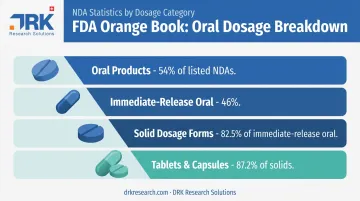
Solid oral dosage forms dominate the pharmaceutical market. A 2023 analysis of the FDA Orange Book found that oral products made up roughly 54% of listed NDAs, with immediate-release oral products alone accounting for about 46%. Within that immediate-release oral category, 82.5% were solid dosage forms, and tablets plus capsules made up 87.2% of those solids (PMC10719485).
Tablets and capsules aren't simple to manufacture. They demand:
- Consistent powder flow through hoppers and dies
- Adequate compressibility without capping or lamination
- Uniform content across every dosage unit
- Long-term solid-state stability through shelf life
Skip proper preformulation, and these requirements tend to fail in predictable ways: tableting defects, sluggish dissolution, degradation during storage, or content uniformity that drifts out of specification. None of these are abstract risks: they're the actual failure modes preformulation exists to prevent.
There's also a regulatory dimension. ICH Q8(R2) frames pharmaceutical development as a systematic, science- and risk-based process, explicitly requiring that drug-substance properties (solubility, water content, particle size, crystal form) be identified and linked to product performance (ICH Q8(R2)). Preformulation isn't optional under a Quality-by-Design framework. It's the evidence base the framework runs on.
This groundwork feeds directly into DRK Research Solutions' product development work: preformulation data informs the formulation development, analytical method development, and technology transfer services our team provides to sponsors advancing solid oral products toward regulatory submission.
How the Preformulation Process Works (Conceptual Flow)
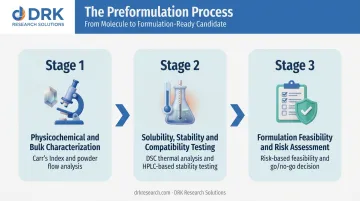
Preformulation moves from raw API characterization to formulation-ready data over the course of early development. The process unfolds in stages, each one building on the data gathered before it.
Inputs typically include:
- The candidate API itself (often in limited quantity)
- Available literature or medicinal chemistry data
- Preliminary solubility and stability signals from discovery
During core evaluation, teams run systematic testing across physicochemical, bulk, and mechanical properties under controlled conditions, comparing results against a target product profile throughout. This work is controlled through structured protocols and analytical techniques: DSC, XRD, HPLC, and particle size analyzers, among others.
The output is a data package that informs three decisions: which API form to carry forward, which excipients are compatible, and what manufacturing process the material can tolerate.
Step 1: Physicochemical and Bulk Characterization
This step covers organoleptic properties, crystallinity and polymorphism, hygroscopicity, density, and powder flow. Flow behavior gets quantified using Carr's Index, Hausner ratio, and angle of repose, all defined in USP General Chapter <1174>:
| Flow Rating | Carr Index | Hausner Ratio | Angle of Repose |
|---|---|---|---|
| Excellent | 1-10% | 1.00-1.11 | 25-30° |
| Good | 11-15% | 1.12-1.18 | 31-35° |
| Fair | 16-20% | 1.19-1.25 | 36-40° |
| Passable | 21-25% | 1.26-1.34 | 41-45° |
| Poor | 26-31% | 1.35-1.45 | 46-55° |
USP notes that no single test adequately characterizes every powder. That's why teams typically run more than one. These numbers predict how the API will behave during compression, long before a formulation is designed around it.
Step 2: Solubility, Stability, and Compatibility Testing
This step evaluates intrinsic solubility, pH-solubility profiles, solid-state and solution stability, and drug-excipient compatibility. DSC thermograms are a common first screen: shifted or disappearing melting peaks, new thermal events, or altered enthalpy can flag an interaction risk.
DSC alone isn't sufficient, though. Thermal artifacts can produce false positives or negatives, so results typically get confirmed with HPLC, PXRD, or isothermal stress testing. One documented case involving fenretinide found that a one-day DSC prediction didn't match two-year room-temperature stability data, while a slower stress study at elevated temperature, run over two months, did.
Step 3: Formulation Feasibility and Risk Assessment
Findings from steps one and two get consolidated into a risk profile. That profile guides excipient selection, dosage form design, and manufacturing process parameters, reducing the likelihood that a formulation designed later has to be reworked because of something that could have been flagged upfront.
Where Preformulation Is Applied and What Affects Its Outcomes
Where Preformulation Fits in the Development Lifecycle
Preformulation isn't a one-time event. It shows up at three points:
- Candidate drug selection: early screening to rule out molecules with intractable solubility or stability problems
- Early development: full pharmaceutical profiling ahead of formal formulation design
- Late development: extensive polymorph and stability characterization before scale-up or tech transfer
It's also revisited any time a new salt form, polymorph, or manufacturing route enters the picture. A formulation locked in early doesn't stay locked in if the API's crystal form changes downstream.
This recurring need for reassessment is why specialized CDMOs increasingly fold characterization work directly into formulation and manufacturability planning, rather than treating it as a separate exercise.
DRK Research Solutions' CDMO services, for example, support generics and hybrid product development for regulated markets. Early physicochemical data feeds into ingredient selection, process design, and the technology transfer work that follows as batches scale toward commercial volume.
Key Factors That Affect Preformulation Outcomes in Solid Dosage Forms
Several variables determine whether preformulation data holds up once a formulation moves toward manufacturing:
- Inputs and materials: API polymorphic form, particle size distribution, and moisture content all influence solubility and downstream processing behavior
- Operating conditions: temperature, humidity, and pH ranges used in testing must reasonably mimic real storage and gastrointestinal conditions
- Equipment dependencies: the precision of DSC, HPLC, and particle size instrumentation directly affects how reliable the characterization data actually is
- Scale considerations: findings from small-scale testing need validation as batch size increases toward commercial manufacturing
- Regulatory constraints: frameworks like ICH Q8(R2) expect excipient and process choices to be justified with characterization data, not assumed
Common Issues, Misconceptions, and When Preformulation May Not Be the Priority
Common Issues and Misconceptions
The biggest misconception: treating preformulation as a checklist rather than a decision-making tool. Rather than a box to tick before "real" formulation work begins, it provides the evidence that shapes which API form and excipients get selected in the first place.
A related failure pattern: testing only a narrow slice of properties. Teams often focus heavily on solubility while under-testing powder flow or compatibility, then discover tableting problems only after scale-up.
Two documented examples illustrate why this matters:
- Ritonavir capsules failed dissolution testing after a thermodynamically stable, less-soluble polymorph (Form II) unexpectedly appeared in 1998, forcing a full reformulation
- Oxytetracycline tablets made with one polymorph showed roughly 55% dissolution at 30 minutes, versus 95% for a different polymorph of the same drug (documented in a formulation science review)
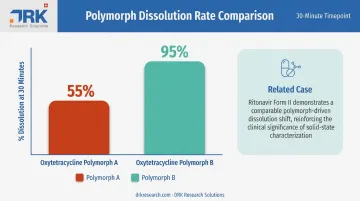
Neither failure was a formulation error. Both were preformulation gaps — solid-form behavior that wasn't fully characterized before the product moved forward.
Preformulation and formulation produce different outputs, and confusing the two causes downstream problems. Preformulation produces data and characterization. Formulation produces an optimized, manufacturable product. A completed characterization panel doesn't mean the formulation is finished.
When Preformulation May Not Be the Priority
Full-scale preformulation doesn't always earn its cost. It's reasonable to scale back when:
- Reformulating a well-characterized, already-marketed API into a new strength of an existing solid dosage form
- API supply is extremely limited during very early discovery, before extensive testing is even feasible
- Existing literature data or a platform formulation technology can answer the same questions more efficiently than fresh characterization
One signal that preformulation is running "by default" rather than by need: repeating a full characterization panel on a well-understood, compendial API with no specific development question driving the work. If nobody can articulate what decision the data will inform, that's a sign the testing plan needs rethinking, not expanding.
Conclusion
Preformulation systematically characterizes an API's physicochemical and mechanical properties to inform every downstream decision in solid dosage form development, from API form selection to excipient compatibility to manufacturing process design.
Understanding this process, rather than running it as a formality, is what prevents costly late-stage failures in stability, bioavailability, and manufacturability. Risk-based application (testing what the development question actually requires, not a blanket panel) separates efficient programs from ones that rediscover problems at scale-up.
For teams navigating this across multiple regulatory jurisdictions, working with an experienced partner matters. DRK Research Solutions' CDMO team supports generics and hybrid product development for regulated markets, helping pharmaceutical teams apply preformulation data effectively as products move toward commercial manufacturing.
Frequently Asked Questions
What is the difference between preformulation and formulation development?
Preformulation characterizes the API's inherent physical and chemical properties in isolation. Formulation development uses that data to design and optimize the actual dosage form, including excipients and process parameters.
How long does preformulation typically take for a solid dosage form?
Timelines vary by molecule complexity. Initial DSC compatibility screens can return results within days, while confirmatory stability studies often take several weeks to a few months.
What analytical techniques are used in preformulation studies?
Common techniques include:
- DSC for thermal behavior
- XRD for crystal form identification
- HPLC for stability-indicating assays
- Particle size analysis for uniformity prediction
- Dynamic vapor sorption for hygroscopicity assessment
Can preformulation studies predict a drug's shelf life?
Stability testing within preformulation helps identify likely degradation pathways and appropriate storage conditions. It informs formal shelf-life studies but doesn't replace the dedicated stability programs required for regulatory submission.
Is preformulation required for generic drug development?
Yes. Generic development still requires preformulation to confirm the API's properties align with reference listed drug expectations, guiding excipient and process selection needed to support bioequivalence and regulatory submission.
What happens if preformulation is skipped or rushed?
Skipping preformulation raises the risk of tableting failures, unexpected stability issues, and dissolution problems that surface later in development — often requiring costly reformulation or triggering regulatory delays.