Introduction
Clinical trial material (CTM) manufacturing is the cGMP-driven process of producing investigational drug doses for use in human clinical trials. Every tablet, vial, or infusion bag a patient receives in a Phase I-III study has to be made, tested, and documented under regulatory scrutiny before it ever reaches a trial site.
For pharmaceutical and biopharmaceutical sponsors, this is often the bottleneck standing between a promising molecule and first-in-human dosing.
CTM manufacturing gets referenced constantly in development timelines, yet it's poorly understood operationally. Sponsors know they need it. Fewer understand what actually happens inside the process, what can derail it, or when a fragmented vendor approach starts costing them months.
This article breaks down how CTM manufacturing works, what factors shape its outcomes, and when a full end-to-end CDMO partnership makes the difference between hitting your IND timeline and missing it.
Key Takeaways
- CTM manufacturing produces regulator-ready doses for Phase I-III trials, not commercial-scale batches
- Trials demand consistency, sterility, and audit-ready documentation that fragmented in-house setups often miss
- The process spans planning, qualification/validation, manufacturing/QC, and packaging/distribution
- API complexity, equipment dependencies, and phase-specific regulations shape outcomes
- A single integrated CDMO partner cuts handoff risk between design and supply
What Is Clinical Trial Material (CTM) Manufacturing?
CTM manufacturing is the cGMP-compliant production of investigational drug product, placebo, or comparator specifically intended for administration to human trial participants. Nothing about it is theoretical. Every batch has to generate valid safety and efficacy data while supporting an IND or IMPD submission.
The goal is straightforward to state, harder to execute: consistently safe, fully traceable doses that regulators and investigators can trust.
How CTM Differs from Commercial Manufacturing
CTM batches tend to be smaller and more variable than commercial runs, because the formulation, process, and even packaging design may still be evolving as product knowledge grows. Commercial manufacturing, by contrast, locks in a validated process for large, repeatable production runs.
That difference matters because "phase-appropriate" doesn't mean "less rigorous." It means the form of evidence changes, not whether evidence is required at all.
CDMO Function vs. CRO Function
Sponsors sometimes conflate the two, so it helps to define each clearly:
- CDMO (Contract Development and Manufacturing Organization): Manufactures the investigational drug product itself.
- CRO (Contract Research Organization): Designs and executes the clinical trial, manages sites, and collects the resulting data.
These are separate disciplines, but sponsors increasingly look for partners who cover both. The handoff between "the material is ready" and "the trial can start" is exactly where delays tend to pile up.
DRK Research Solutions built its combined CRO+CDMO model around closing that gap, coordinating formulation, technology transfer, and dossier preparation alongside clinical trial planning rather than treating them as separate vendor relationships.
Why CTM Manufacturing Demands a Specialized CDMO Approach
Sponsors are under real pressure to get CTM production right the first time. A failed batch or a clinical hold doesn't just cost money; it pushes back the entire trial calendar, and every month of delay compounds against a patent clock that's already ticking.
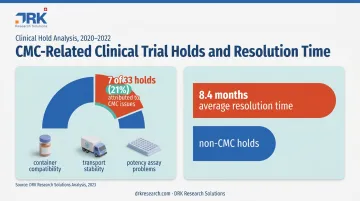
The stakes are documented, not hypothetical. A 2023 peer-reviewed review of publicly announced cell and gene therapy clinical holds found that 7 of 33 holds (21%) between 2020 and 2022 were attributed to CMC (Chemistry, Manufacturing, and Controls) issues, including container compatibility, transport stability, and inadequate potency assays.
Holds requiring CMC amendments took an average of 8.4 months to resolve.
What Clinical Trials Specifically Demand
- Batch-to-batch consistency, even as formulations and processes are still maturing
- Sterility for injectables, verified through aseptic controls and media-fill simulation
- Scalability beyond R&D volumes, without losing product characterization
- Audit-ready documentation, covering every batch from raw material to release
What Goes Wrong Without Specialized Support
Without dedicated CTM infrastructure, sponsors run into contamination risk, IND/CTA delays, failed inspections, or trial data that gets invalidated because dosing wasn't consistent across batches. None of these are edge cases. They're the predictable result of treating CTM production like a scaled-up lab experiment.
Is cGMP Mandatory or Just Best Practice?
Both, depending on phase. Under FDA's CGMP guidance for Phase 1 investigational drugs, qualifying Phase I material is exempt from the detailed Part 211 regulations, but not from the underlying statutory cGMP obligation. FDA still requires written procedures, controlled equipment, testing, and batch records for every lot.
That flexibility disappears once a program reaches Phase II or III. At that point, the exemption no longer applies, and Parts 210 and 211 govern manufacturing in full.
In the EU, the framework is even more explicit: investigational medicinal product manufacturing must cover the full chain from manufacture through packaging, labeling, and Qualified Person certification, with no informal Phase I carve-out.
This regulatory reality is exactly why fragmented vendor models are losing favor. Every handoff between a formulation lab, a fill/finish site, and a packaging vendor is a point where documentation gaps or timeline slippage can creep in.
DRK's global CRO+CDMO footprint across Europe, the Middle East, Asia, Africa, and the Americas is structured to reduce that friction, keeping trial design and material supply planning connected instead of run on separate tracks.
How CDMOs Execute End-to-End CTM Manufacturing
At a high level, the workflow moves from API and drug substance intake through formulation, fill/finish or solid-dose processing, quality control testing, and final release for shipment to trial sites, all under one CDMO's oversight.
Inputs feeding this process include:
- Active pharmaceutical ingredient (API) and excipients
- Primary packaging components (vials, blister packs, syringes)
- Validated analytical methods
- Batch documentation templates
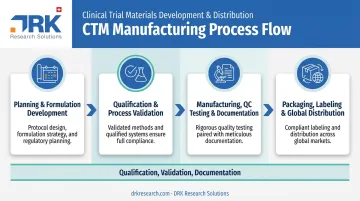
Throughout, three pillars run in parallel with the manufacturing itself: qualification, validation, and documentation. None of them are one-time checkpoints. They're continuous controls that touch every batch. Here's how these controls play out across four sequential stages:
Planning & formulation development: The CDMO builds a proactive schedule and formulation strategy before a single batch is made, accounting for overfill and destructive sampling when calculating batch size. Skip this math and trial sites can end up short on material when they need it most.
Qualification & process validation: Equipment and personnel get qualified for the specific molecule at hand, and the manufacturing process is validated through media runs and test batches before the real CTM run happens. For sterile products, this typically means aseptic process simulation with microbial growth media to confirm sterility.
Manufacturing, QC testing & documentation: The GMP batch gets executed, followed by in-process and release testing against defined identity, strength, quality, and purity criteria. These records compile into the documentation package required for the IND or IMPD submission, covering manufacturing controls, deviations, and batch sign-off.
Packaging, labeling & global distribution: CDMO scope extends into primary and secondary packaging, randomization and blinding where applicable, cold-chain logistics, and distribution to trial sites across multiple countries at once. DRK's offices across Switzerland, the UK, USA, Pakistan, Malaysia, Nepal, and the UAE support this kind of multi-regional trial supply, keeping coordination close to where trial sites operate.
Key Factors That Influence CTM Manufacturing Success
Not every CTM program carries the same risk profile. A few variables consistently determine how smoothly production goes.
Inputs and materials:
- API stability under storage and processing conditions
- Molecule complexity: small molecule, biologic, or gene therapy, each carrying different CMC burdens
- Excipient and packaging component sourcing, particularly for less common dosage forms
- Formulation complexity, including modified-release, combination, or high-potency products
Operating conditions and equipment:
| Factor | Why It Matters |
|---|---|
| Aseptic vs. non-sterile lines | Sterile products require ISO 5/Grade A environments and media-fill validation |
| Cleanroom classification | Determines background contamination control requirements |
| Disposable/closed systems | Can reduce contamination risk, but still require integrity and extractables testing |
Scale, frequency, and regulatory constraints:
- Batch size relative to the number of trial sites and enrollment pace
- Phase-specific cGMP obligations, which tighten as a program advances
- Cold-chain and multi-region distribution requirements for global trials
There's no universal ranking where biologics are automatically riskier than small molecules. Control intensity depends on the specific modality, route of administration, sterility requirement, and how much product knowledge exists at that stage of development.
Common Misconceptions & When Full CDMO Support May Not Be Necessary
A few myths persist around CTM manufacturing, and they tend to cause real scheduling problems when sponsors act on them.
Misconception 1: "CTM manufacturing is just making more of the drug." It isn't. Moving from R&D-scale to CTM production requires new regulatory, analytical, and QA infrastructure that a lab bench simply doesn't need.
Misconception 2: "cGMP compliance can wait until Phase II or III." FDA expects phase-appropriate quality systems starting in Phase I, particularly for injectables and biologics where sterility and potency risks are higher from day one.
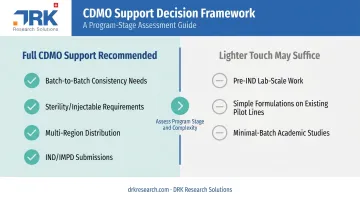
These corrections don't mean every program needs full CDMO support, though. Some scenarios genuinely call for a lighter touch:
When full CDMO engagement may not be necessary:
- Very early pre-IND lab-scale work that never touches a patient
- Simple formulations already handled by existing in-house pilot lines
- Minimal-batch, academic-sponsored studies with narrow scope
Whether CTM production runs in-house or through a global CDMO, the outcome hinges on the same thing: disciplined planning and quality-first execution. That's what protects trial timelines, patient safety, and regulatory standing, regardless of who holds the pipette.
Frequently Asked Questions
What is the difference between a CRO and a CDMO?
A CRO manages clinical trial design, execution, and data collection, while a CDMO manufactures the investigational drug product itself. DRK Research Solutions, for example, connects both functions through its integrated CRO-CDMO partner network, reducing handoff delays between trial design and manufacturing.
What is the difference between GMP and CMC?
GMP (Good Manufacturing Practice) refers to the quality standards and regulations governing how drugs are manufactured. CMC (Chemistry, Manufacturing, and Controls) is the regulatory documentation package describing how a specific product is made, tested, and controlled.
How does an IND differ from an NDA?
An IND (Investigational New Drug application) authorizes human clinical testing of an investigational drug. An NDA (New Drug Application) comes later, submitted after trials are complete to seek marketing approval for commercial sale.
What are the four pharmaceutical manufacturing activities?
The core activities are formulation/production, quality control and testing, packaging and labeling, and documentation/record-keeping. All four run in parallel across every phase of clinical development.
What is the difference between clinical trial material and commercial drug product?
CTM is produced in smaller, more variable batches for investigational use, with formulations that may still be evolving. Commercial drug product uses a locked formulation manufactured at validated large scale.
How long does it take to manufacture a batch of clinical trial material?
Timelines vary widely by molecule complexity and trial phase. Factoring in formulation development, qualification, and validation steps, most programs run from several months to over a year before the first batch is release-ready.