Drug repurposing, also called drug repositioning, has moved from a fallback idea to a genuine parallel strategy in therapeutic development. Traditional discovery averages 10.5 years from Phase I to approval, according to a Biotechnology Innovation Organization (BIO) analysis of nearly 10,000 clinical programs. Repurposed drugs, backed by existing human safety data, can compress that timeline considerably.
This article covers what drug repurposing actually means, the computational and AI-driven techniques now powering candidate discovery, real examples like sildenafil and semaglutide, the challenges sponsors still face, and how specialized CRO/CDMO partners such as DRK Research Solutions support these programs across regulated and emerging markets.
Key Takeaways
- Repurposing reuses existing safety and PK data, cutting timelines compared to new drug development.
- AI and knowledge-graph platforms replace serendipity with systematic screening, as with baricitinib's COVID-19 discovery.
- Genetically supported drug targets show meaningfully higher approval odds than targets without genetic backing.
- IP limits, dosage-driven trial restarts, and pricing controversy remain real obstacles to speed.
- Specialized CRO/CDMO partners help sponsors manage multi-regional regulatory and manufacturing complexity for repositioned therapies.
What Is Drug Repurposing?
Drug repurposing means finding a new therapeutic indication for a drug already approved for a different disease. Instead of starting from zero, researchers build on pharmacokinetic, safety, and manufacturing data that already exists.
Regulators draw a clear line here. The European Medicines Agency classifies a genuinely new therapeutic indication as a Type II variation, a distinct category from marketing-authorization extensions covering changes like new strength, dosage form, or route of administration.
The FDA doesn't use one universal category for "repurposing" either. Composition, labeling, and indication changes each follow their own supplement pathway.
This distinction matters because repurposing isn't a shortcut around clinical evidence. A repositioned drug still needs new trials to prove efficacy in the new indication. What changes is the amount of preclinical and early safety work sponsors can skip.
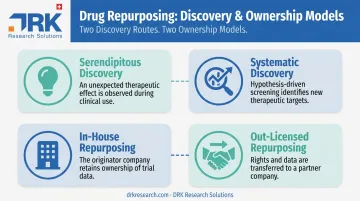
Two broad discovery routes exist: serendipitous discovery, which happens when researchers or clinicians notice an unexpected off-target effect during use for the original condition, and systematic discovery, which applies hypothesis-driven or computationally guided screening to deliberately search for new drug-disease matches.
In-House vs. Out-Licensed Pathways
Repurposing programs generally follow one of two ownership models. In-house repurposing sees the originator company advance its own approved drug into a new indication, keeping full access to proprietary trial data and manufacturing history.
Outbound or out-licensed repurposing transfers rights to explore a new indication to a different company, often one with specific therapeutic-area expertise.
In-house programs are commonly assumed to move faster since the sponsor already holds the proprietary PK/PD and safety records rather than needing to reconstruct them. Published head-to-head comparisons of timeline differences between the two models remain limited, though, so this should be read as an industry pattern rather than a firm rule.
Why Drug Repurposing Matters in Modern Drug Development
The numbers behind conventional drug development explain why repurposing has become so attractive. BIO's analysis of over 12,700 phase transitions found only a 7.9% likelihood that a Phase I candidate reaches approval, with clinical development alone averaging 10.5 years.
A 2022 systematic review found repurposing commonly cited at 3-12 years total development time versus 10-17 years for de novo products, though it cautions that exact savings figures conflict across studies.
Cost estimates follow a similar pattern, with wide variation depending on approach:
- DiMasi's widely cited benchmark puts new-compound development near $1.395 billion out-of-pocket
- DNDi has developed treatments based on existing drugs for as little as €4 million to €32 million, a needs-driven estimate rather than an industry-wide figure
Rare Diseases and the Patent Cliff
Repurposing carries particular weight for rare-disease patients. Of more than 7,000 identified rare diseases, only 5-7% have an FDA-approved treatment, leaving a gap full de novo development often can't justify commercially.
Patent expirations push in the same direction from the business side. IQVIA projects more than $90 billion in losses from expiring exclusivity between 2025 and 2029, prompting manufacturers to look at existing portfolios for new indications that extend a molecule's commercial life.
COVID-19 as a Rapid-Response Case Study
The pandemic offered a clear proof of concept. Baricitinib, already approved for rheumatoid arthritis, received FDA emergency authorization alongside remdesivir in November 2020 and gained full approval for hospitalized COVID-19 patients in May 2022.
Remdesivir itself began as an investigational Ebola antiviral before its October 2020 approval as Veklury, a reminder that not every fast-tracked pandemic story starts from an already-marketed drug.
That pandemic-era urgency didn't fade once emergency authorizations expired. Programs like NCATS' New Therapeutic Uses initiative and DNDi's needs-driven partnerships carry that momentum forward, connecting academic institutions, government agencies, and sponsors with repurposing candidates that wouldn't otherwise attract commercial investment. This matters most for underserved populations in low- and middle-income countries, where commercial incentives alone rarely drive drug development.
Modern Discovery Techniques Powering Drug Repurposing
Finding the next repurposing candidate used to depend largely on an alert clinician noticing something unexpected. That's changing fast.
Computational and AI-Driven Screening
Computational drug repurposing integrates drug-target, disease-gene, pathway, and clinical data to flag drug-disease associations at scale. Knowledge-graph platforms illustrate the scale involved: the Hetionet database integrates over 47,000 nodes and 2.25 million relationships to rank potential drug-disease pairs.
Baricitinib is the textbook example of AI-assisted discovery. BenevolentAI's knowledge-graph platform flagged the rheumatoid arthritis drug early in 2020, pairing its known anti-inflammatory action with a plausible mechanism against viral entry. The AI ranking didn't replace clinical trials; it pointed researchers toward a candidate worth testing, and subsequent trials confirmed the signal.
Validating Candidates: Screening, Genetics, and Real-World Data
Three complementary approaches help confirm which AI-flagged candidates deserve further investment:
- High-throughput screening (HTS) tests thousands of approved compounds against a new disease target in parallel. The Drug Repurposing Hub has quality-controlled nearly 2,000 approved or marketed drugs for this purpose.
- Human genetics matches disease-associated genes to existing drug targets, one of the strongest predictors of success. Research in Nature shows genetically supported targets have up to a 2.6-fold higher approval probability.
- Real-world evidence from electronic health records compares outcomes across patient populations already prescribed a drug for unrelated reasons. This approach gained visibility during COVID-19, though data gaps remain a challenge.
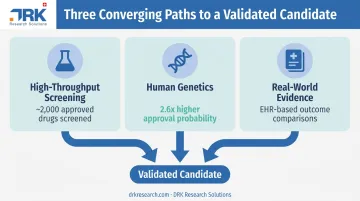
Together, these tools mark a shift: the industry is moving from opportunistic, trial-and-error repurposing toward systematic, hypothesis-driven, data-first discovery pipelines.
Real-World Examples of Repurposed Drugs
Few stories illustrate repurposing's potential better than the drugs already sitting in patients' medicine cabinets.
| Drug | Original Path | Repurposed For |
|---|---|---|
| Sildenafil | Angina/hypertension candidate | Erectile dysfunction (1998), pulmonary arterial hypertension (2005) |
| Thalidomide | Sedative, withdrawn in 1961 | Erythema nodosum leprosum (1998), multiple myeloma (2006) |
| Nitisinone | Herbicide research, tyrosinemia type 1 treatment | Alkaptonuria, a rare genetic disease |
| Semaglutide | Type 2 diabetes, Ozempic (2017) | Weight management, Wegovy (2021); CKD risk reduction (2025) |
Nitisinone's journey stands out because patient advocates drove it. Alkaptonuria had no approved treatment for decades. Patient organizations supported natural-history studies and recruitment efforts for years. That work eventually led to a CHMP positive opinion for adult alkaptonuria in 2020, proof that repurposing doesn't only happen inside pharma boardrooms.
Semaglutide shows the other end of the spectrum: one molecule creating multiple, sequential commercial pathways. What started as a diabetes therapy became a weight-management blockbuster. By 2025, it gained a third approval to reduce sustained kidney-function decline in patients with type 2 diabetes and chronic kidney disease. A single molecule, developed for one condition, now serves three distinct patient populations.
Key Challenges in Drug Repurposing
Repurposing isn't a guaranteed shortcut. Sponsors run into three recurring obstacles.
Intellectual property limitations. Once a compound's original patent expires, protection for a new indication often narrows to a method-of-use patent. Generic manufacturers can sometimes carve out the patented indication through a "skinny label," weakening the incentive to invest in redevelopment.
Regulatory and dosing hurdles. A new indication frequently means a new dose. When researchers repurposed mebendazole, an antiparasitic, for recurrent high-grade glioma, they ran a fresh Phase I dose-escalation study to identify a workable oncology dose (4,800 mg/day), erasing much of repurposing's usual time advantage.
Pricing controversy. Firdapse's approval for Lambert-Eaton myasthenic syndrome is a well-known cautionary tale. Patients had previously received the compound free through compassionate use. After approval, the manufacturer set an annual list price of $375,000, prompting public criticism from lawmakers including Senator Bernie Sanders.
This case captures the tension every repurposing sponsor faces: recouping redevelopment costs without pricing out the patients the drug was meant to help.
The Role of CROs and CDMOs in Accelerating Drug Repurposing
A repurposing program still has to clear new trials, new dossiers, and often new manufacturing requirements, frequently across several regulatory jurisdictions at once. Sponsors without an in-house footprint in every target market face a choice: build the capability from scratch, or partner with an organization that already has it. That's why sponsors increasingly rely on experienced CRO/CDMO partners.
DRK Research Solutions works across this exact intersection. On the clinical side, the company runs multi-regional Phase II–IV trials that include:
- Site feasibility and protocol design support
- Regulatory submissions across multiple jurisdictions
- Trial monitoring and medical monitoring
- Post-authorization real-world evidence collection for new-indication studies
On the CDMO side, DRK's generics and hybrid product development services address a challenge many repurposing sponsors underestimate. A compound approved for one indication often needs a new dosage form, strength, or delivery route for its new use.
That can include:
- Lab-scale formulation development and optimization for the new therapeutic application
- Analytical method development and validation aligned to ICH and USP standards
- Technology transfer plus exhibit and commercial batch manufacturing through GMP-compliant partner facilities
- eCTD dossier preparation for complex generic and hybrid submissions across multiple markets
Built for Underserved Markets
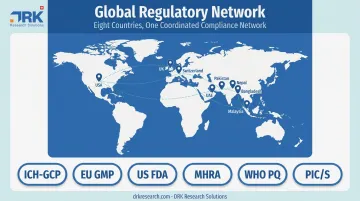
DRK's footprint spans Switzerland, the UK, the USA, Pakistan, Malaysia, Nepal, the UAE, and Bangladesh, with regulatory grounding in ICH-GCP, EU GMP, US FDA, MHRA, WHO PQ, and PIC/S standards. That combination matters most for repurposing programs aimed at underserved populations and low- and middle-income countries. Local regulatory expertise can shorten the path from a repositioned therapy's approval in one market to its availability in another.
Frequently Asked Questions
What is repurposing existing drugs?
Drug repurposing means finding a new therapeutic use for a drug already approved for a different disease, using its existing safety, efficacy, and manufacturing data to speed up development.
What is an example of a repurposed drug?
Sildenafil, originally studied for angina, is now approved for erectile dysfunction and pulmonary arterial hypertension. Thalidomide, once withdrawn as a sedative, is now approved for multiple myeloma.
How long does drug repurposing typically take compared to developing a new drug?
De novo development typically averages 10-17 years, while repurposing timelines are commonly cited at 3-12 years, though exact savings vary widely by pathway, indication, and company.
What are the biggest challenges in drug repurposing?
Sponsors commonly face weak IP protection for new indications, dosage changes that can trigger fresh Phase I trials, and pricing controversies when redevelopment costs land on patients.
Which therapeutic areas see the most drug repurposing activity?
A review of repurposing activity from 1985 to 2024 found oncology, psychiatry/neurology, and cardiology as the most active areas, with rare diseases also seeing notable activity.
How is artificial intelligence changing drug repurposing?
AI and computational models, such as knowledge-graph platforms, analyze pharmacological and clinical data to predict drug-disease matches, as seen with baricitinib's COVID-19 repurposing, replacing reliance on chance observation.