Scale-up gets plenty of attention on paper. Every process development plan mentions it. But the real test happens at pilot scale, where lab assumptions meet mixing dynamics, equipment geometry, and material behavior that a 2-liter flask simply can't predict.
This article breaks down why pilot plants function as a critical readiness checkpoint, not a theoretical stepping stone, before you commit capital to commercial manufacturing.
Key Takeaways
- Pilot plants validate process, equipment, and quality decisions before major investment
- Pilot runs generate engineering data no lab bench can replicate, cutting scale-up risk
- Skipping pilot trials often causes failed tech transfers and delayed launches
- Pilot-scale batches feed directly into CMC data required for regulatory filings
- A CDMO partner with the right pilot-scale controls shortens development timelines
What Is a Pilot Plant
A pilot plant is a scaled-down, controlled production system built to mimic commercial manufacturing before you invest in full-scale infrastructure. Regulators treat this concept seriously enough to define it formally.
The EMA's process validation guideline describes laboratory batches as potentially 100 to 1,000 times smaller than production batches. Pilot batches sit in between, providing the link between development and industrial production, and they're expected to generate data that's genuinely predictive of what happens at full scale.
Pilot plants typically get used for:
- Process development and optimization before locking in commercial parameters
- Technology transfer between development sites and manufacturing partners
- Clinical batch production for Phase II/III supply
- Pre-regulatory submission trials that generate registration-grade data
None of this makes the pilot plant an end goal. It's a de-risking mechanism. The objective is a validated, transferable process that can move to commercial scale without rework.
Key Advantages of Pilot Plants for Scale-Up Readiness
The advantages below focus on measurable, operational outcomes: risk reduction, data reliability, regulatory readiness, and cost control. Not abstractions. Each one ties directly to a decision your team has to make before committing to commercial-scale manufacturing.
Advantage 1: De-Risking Scale-Up Through Process Validation and Data Acquisition
Pilot plants generate real engineering data that lab-scale glassware simply cannot produce: heat and mass transfer rates, mixing efficiency, reaction kinetics under realistic vessel geometry. This data defines your critical process parameters (CPPs) and operating design space before anyone sizes industrial equipment.
Why this matters shows up clearly in a peer-reviewed dissolution study comparing a 2-liter lab vessel to a 4,000-liter commercial tank. At the slower mixing speeds typical of commercial equipment, propylparaben formed agglomerated lumps that hadn't appeared at lab scale. The researchers noted that incomplete dissolution like this can cause subpotent batches and outright batch failure.
That's the entire case for pilot-scale testing in one example. A problem invisible in the lab becomes a batch-failure risk at commercial volume, unless you catch it first.
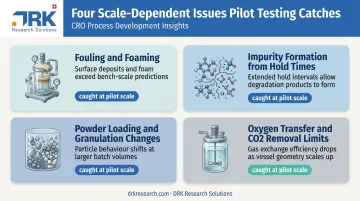
Scale-dependent issues pilot plants routinely surface:
- Fouling and foaming behavior under production-scale agitation
- Impurity formation tied to longer processing or hold times
- Powder loading and granulation changes from altered impeller geometry
- Oxygen transfer and CO2 removal limitations in bioreactor scale-up
Catching these issues at pilot scale means faster, more confident go/no-go decisions before capital gets locked into commercial infrastructure.
KPIs impacted:
- Batch yield consistency across scale-up runs
- Process robustness under variable raw material lots
- Deviation and OOS rates during early commercial production
- Time-to-first-commercial-batch
This advantage matters most for complex APIs, biologics, and novel formulations with limited prior scale-up history. A generic tablet with decades of process precedent carries far less risk than a first-in-class biologic where oxygen delivery and shear sensitivity are still being characterized.
Advantage 2: Accelerated Regulatory and Tech Transfer Readiness
Pilot-scale batches aren't just a manufacturing exercise. They generate the CMC data regulators actually require for IND, NDA, and market authorization filings.
The FDA's process validation framework structures this across three stages: process design informed by development and scale-up knowledge, process qualification that confirms reproducible commercial manufacture, and continued verification during routine production. Pilot-scale evidence feeds directly into Stage 1, shaping everything downstream.
ICH Q1A(R2) reinforces this at the registration level. It expects at least three primary drug-substance batches manufactured at no less than pilot scale, with at least two of three primary drug-product batches also at pilot scale. This is the baseline expectation for stability data supporting a filing.
Pilot runs also validate the operational pieces that make tech transfer smooth:
- Analytical methods that will be used for release and stability testing
- Cleaning protocols suited to the actual equipment train
- Batch documentation formats the receiving site can work with
This is where DRK Research Solutions' technology transfer and regulatory consulting services add value, translating pilot-scale data into the documentation sponsors' manufacturing partners need to act on. The goal is keeping sponsors audit-ready as they move across multiple geographies, not just compliant at the moment of filing.
KPIs impacted:
- Regulatory query rate during review
- Submission timeline adherence
- Tech transfer success rate on first attempt
- Batch record completeness at handoff
This advantage carries the most weight for multi-regional filings or sponsors entering new regulatory markets, including LMICs where WHO Prequalification and local agency requirements add complexity.
Advantage 3: Cost and Timeline Optimization Before Capital Commitment
Pilot plants let you test raw material sourcing, equipment sizing, and utility requirements at a fraction of commercial-scale cost. That's the practical financial argument for the checkpoint.
Iterative optimization at pilot scale, whether through DoE studies or simple trial batches, refines yield and process efficiency before you lock in expensive commercial infrastructure. This prevents one of the most common sources of wasted CAPEX: over-sizing or under-sizing equipment based on assumptions that never got stress-tested.
The EMA's guidance backs this up directly. Pilot batches are meant to challenge the intended routine manufacturing method, identify difficulties and critical points, and evaluate whether equipment and methods are actually suitable for large-scale production, before you build the large-scale line.
Where this pays off in practice:
- Avoiding equipment resizing after commercial construction begins
- Reducing experimental burden through model-based scale-up methods
- Catching batch-size transfer risks (production volume mismatches) before they become budget line items
- Preventing rework that pushes back your entire time-to-market timeline
This advantage matters most for high-value, low-volume products or first-in-class molecules, where commercial infrastructure decisions carry the highest financial risk and the smallest margin for guesswork.
KPIs impacted:
- CAPEX accuracy against initial projections
- OPEX forecasting reliability
- Raw material utilization rates
- Project timeline adherence from pilot to launch
What Happens When Pilot-Scale Testing Is Skipped or Rushed
Skip the pilot-scale checkpoint, or rush through it to save a few weeks, and the consequences tend to surface later and cost more. The pattern is consistent across process types:
- Inconsistent batch quality once the process moves to commercial scale, often traced to mixing or heat transfer differences nobody caught
- Higher deviation and out-of-specification (OOS) rates during early commercial production runs
- Reactive troubleshooting replacing proactive process control, because nobody built a scale-down model to predict the issue
- Escalating costs from equipment redesign or re-validation after the fact
- Delayed regulatory submissions due to incomplete or unreliable CMC data
A 2024 bioreactor scale-up study illustrates this well. Researchers found that optimizing power input per volume alone failed to reproduce shake-flask performance at 15-liter scale. Only when they shifted to optimizing gas flow per liquid volume did the process transfer cleanly, and they still had to validate that approach at 500 liters before trusting it.
That gap between shake-flask and 15-liter performance illustrates the core risk: a single scale-up assumption, applied without pilot-scale verification, can miss oxygen transfer and CO2 removal effects entirely. By the time it shows up, you're troubleshooting at commercial scale instead of catching it early.
How to Get the Most Value from a Pilot Plant
Pilot-plant investment pays off when it's treated as a structured readiness checkpoint, not a box to check on the way to commercial manufacturing. That distinction matters more than most process development plans acknowledge.
Value increases when pilot data gets systematically reviewed against defined scale-up criteria before you advance to the next phase. Skipping that review, even when the data exists, defeats the purpose of collecting it.
A few practical steps make the difference:
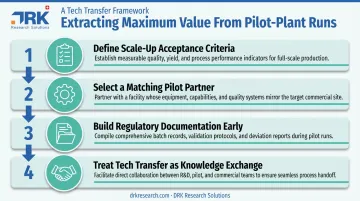
- Define scale-up acceptance criteria upfront: know what "ready" looks like before pilot runs start, not after
- Select a pilot partner whose equipment and controls mirror your intended commercial process: a mismatch here reintroduces the exact risk pilot testing is supposed to remove
- Build in regulatory documentation from the start: batch records, analytical method validation, and cleaning protocols should be filing-ready, not reconstructed later
- Treat tech transfer as a two-way knowledge exchange: the receiving site needs process rationale, not just a recipe
DRK Research Solutions applies this same discipline through its product development services. Rather than treating pilot data as paperwork, DRK's teams work alongside sponsors to define scale-up criteria, validate analytical methods, and prepare filing-ready documentation before tech transfer begins. For sponsors coordinating transfer across Europe, the Middle East, Asia, Africa, and the Americas, that upfront regulatory and scientific rigor is where pilot-scale investment actually pays off.
Conclusion
Pilot plants matter because they give you control, data clarity, and process consistency before you commit to full-scale manufacturing. That's not a theoretical benefit. It shows up in fewer deviations and cleaner tech transfers, with regulatory submissions built on evidence rather than extrapolation.
The advantages compound over time: fewer surprises at commercial scale, faster regulatory review cycles, and launch timelines that don't blow through budget mid-project.
Pilot-plant readiness is a capability worth building into every scale-up strategy, applied consistently from one program to the next.
Frequently Asked Questions
What is a pharmaceutical pilot plant?
A pharmaceutical pilot plant is an intermediate-scale facility that validates formulations and manufacturing processes before committing to full commercial production. It bridges lab-scale chemistry and industrial-scale operations.
Can you provide an example of a pharmaceutical pilot plant?
A typical example includes scaled-down reactors, filters, and dryers that produce clinical trial batches or registration batches. These systems mimic commercial equipment at a fraction of the volume.
What are the key differences between a pharmaceutical pilot plant and a commercial plant?
Pilot plants use smaller batch sizes and more flexible equipment aimed at learning and validation. Commercial plants run fixed, production-scale equipment that manufacturers specify in the regulatory application for continuous, routine manufacturing.
How does a pharmaceutical pilot plant differ from a lab?
Labs focus on chemistry feasibility using small quantities of material. Pilot plants test engineering behavior, such as mixing and heat transfer, at intermediate volumes that better represent commercial conditions.
Why is a pilot plant important for scale-up readiness?
Pilot plants de-risk scale-up by validating process data, product quality, and equipment robustness before large capital investment. They catch scale-dependent issues that lab-scale testing cannot reveal.
When should a pharmaceutical company invest in pilot-scale trials?
Pharmaceutical companies typically need pilot-scale trials before Phase II/III clinical supply and before finalizing commercial manufacturing plans. Regulatory guidance also expects pilot-scale batches to support registration stability data.