Standard fillers and binders can't fix any of that. Functional excipients can.
Formulators, CDMOs, and sponsors often see functional excipients discussed in academic terms, solubility enhancers, matrix formers, co-processed systems, without a clear picture of what these ingredients do for tablet performance, batch yield, or patient adherence. This article breaks down the operational case: where functional excipients solve real formulation problems, what happens when they're skipped, and how to select them systematically instead of by convention.
Key Takeaways
- Functional excipients improve solubility, control drug release, and simplify manufacturing—well beyond adding bulk.
- The biggest payoff: better bioavailability and higher patient compliance.
- The pharmaceutical excipients market reached $11.03 billion in 2025 and will hit $14.86 billion by 2030.
- Skipping careful excipient selection risks inconsistent dissolution, batch failures, and regulatory delays.
- Capturing full value takes systematic selection, ongoing testing, and a partner with real analytical strength.
What Are Functional Excipients
A functional excipient is any inactive ingredient chosen to perform a specific technical job, rather than just filling out a tablet's mass or holding it together. Where a plain filler like microcrystalline cellulose adds bulk, a functional excipient is selected because the API needs help: dissolving better, releasing more slowly, or compressing properly on a high-speed press.
You'll typically find functional excipients doing heavy lifting in:
- Poorly soluble APIs need surfactants, cyclodextrins, or solid dispersion carriers to get enough drug into solution
- Controlled-release tablets rely on polymers that manage how fast the drug reaches the bloodstream
- Orally disintegrating formats swap traditional swallowing for rapid-dissolving delivery systems
- Generics and hybrid products: excipient choice directly affects bioequivalence outcomes
Functional excipients are tools tied to a specific outcome: bioavailability, manufacturability, or compliance. The excipient itself is never the goal; the result it produces is.
Key Advantages of Functional Excipients in Oral Dosage Forms
The advantages below aren't theoretical. They map to metrics pharma companies and CDMOs track every day: dissolution rate, batch yield, dosing frequency, and time-to-market. Each one reflects a documented formulation mechanism, not a generic claim on a spec sheet.
Enhanced Drug Solubility and Bioavailability
Poor aqueous solubility is one of the most common reasons a promising molecule stalls in development. A 2015 peer-reviewed study found that nearly 90% of molecules in the discovery pipeline are poorly water-soluble. That's a massive share of candidate drugs at risk of never reaching a patient's bloodstream in a therapeutic dose.
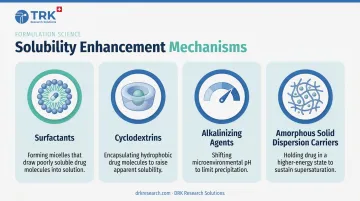
Functional excipients attack this problem through several distinct mechanisms:
- Surfactants form micelles above their critical micelle concentration, pulling poorly soluble drug molecules into solution while also improving wetting
- Cyclodextrins trap hydrophobic drug molecules inside a hydrophilic ring structure, raising apparent solubility
- Alkalinizing agents shift the microenvironmental pH around a weakly acidic or basic drug, limiting precipitation
- Amorphous solid dispersion carriers hold the drug in a higher-energy state within a polymer matrix, supporting supersaturation above normal crystalline solubility
Better solubility means more drug actually reaches systemic circulation. That reduces the risk of therapeutic failure, supports lower and more efficient dosing, and cuts down on costly reformulation cycles late in development.
KPIs impacted: dissolution rate, Cmax/AUC bioavailability metrics, batch rejection rate, time-to-approval.
When it matters most: BCS Class II/IV APIs, first-in-class molecules, and generics that must demonstrate bioequivalence against a reference product.
Controlled Release and Improved Patient Compliance
Missed doses aren't a minor inconvenience. The FDA has stated that medication nonadherence may contribute to nearly 25% of hospital admissions, 50% of treatment failures, and around 125,000 U.S. deaths annually. Multiple daily doses, particularly for chronic conditions, are a major driver of that gap.
Polymeric matrix formers and pH-dependent coatings give formulators control over when and where a drug releases:
| Excipient system | How it works |
|---|---|
| HPMC hydrophilic matrix | Hydrates on contact, forms a gel barrier, releases drug via diffusion and gradual erosion |
| Ethylcellulose coating | Forms a water-insoluble membrane; release occurs by diffusion through pores |
| pH-dependent coating | Stays intact in stomach acid, dissolves at higher intestinal pH for targeted release |
Fewer daily doses translate directly into fewer missed doses and steadier plasma concentrations. For prescribers and payers, a once-daily version of a drug that previously required three doses is also a clear point of product differentiation.
KPIs impacted: dosing frequency, adherence rate, plasma concentration variability, market positioning.
When it matters most: chronic disease management, geriatric and pediatric populations, and short-half-life APIs that would otherwise need multiple daily doses.
Multifunctionality and Manufacturing Efficiency
Every additional raw material in a formulation adds testing, documentation, and validation work. Co-processed excipients collapse several functions into a single material. BASF's Kollitab DC 87L, for example, combines filler, binder, disintegrant, and lubricant functionality into one co-processed system, built around lactose monohydrate, a polymer binder, crospovidone, and a lubricant component.
The practical benefit isn't just fewer ingredients on a bill of materials. Co-processed excipients also deliver process-level advantages:
- Reduce the number of raw materials requiring separate quality-control testing
- Simplify blending steps and reduce process validation burden
- Improve powder flow and compressibility on high-speed tablet presses
- Lower the documentation load carried into regulatory submissions
Fewer excipients mean fewer variables to control, which reduces batch-to-batch variability and speeds up technology transfer between sites.
KPIs impacted: raw material count, process cycle time, tablet defect/rejection rate, scale-up success rate.
When it matters most: high-volume generics, rapid technology transfer projects, and CDMO-led programs working against tight regulatory timelines.
What Happens When Functional Excipients Are Overlooked
Generic or convention-based excipient selection creates downstream problems that are expensive to fix. Common consequences include:
- Inconsistent dissolution and bioavailability across production batches
- Higher tablet defect rates, including capping and lamination during compression
- Reactive reformulation discovered late in development, delaying regulatory submission
- Rising costs from repeated stability or bioequivalence testing cycles
- Scale-up failures when a lab-scale formulation doesn't behave the same way at commercial volume
None of these show up on day one. They surface during stability studies, scale-up runs, or worse, during a regulatory review. By then, the fix is far more expensive than it would have been at the design stage.
How to Get the Most Value from Functional Excipients
Maximum value comes from selection driven by the API's actual characteristics, not habit or unit cost. That means starting with:
- BCS classification: solubility and permeability class shapes which excipient category even applies
- Particle size distribution: affects dissolution rate and excipient interaction
- Stability profile: determines whether an amorphous dispersion or a crystalline approach is viable long-term
Testing shouldn't wait until final validation, either. Running dissolution and stability checks throughout development, not just at the end, catches performance gaps while they're still cheap to fix.
This is where an experienced development partner earns its keep.
DRK Research Solutions supports generics and hybrid product development with:
- Lab-scale formulation optimization matched to the API's specific properties
- Validated analytical method development for accurate performance data
- Dissolution and stability testing built into every development stage, not bolted on at the finish line
- Structured technology transfer and eCTD dossier preparation for regulatory submission

That groundwork helps sponsors match the right functional excipient to a specific API and move from lab formulation to commercial-scale manufacturing without surprises.
Conclusion
The real value of functional excipients lies in solving concrete problems, not in a classification chart. They help formulators:
- Get enough drug into solution for adequate absorption
- Control when and how the drug releases
- Keep the formulation manufacturable at commercial scale
These advantages compound: better solubility drives better bioavailability, which supports simpler dosing and stronger adherence. Each improvement feeds the next, shaping whether a product succeeds commercially and clinically.
Functional excipient selection continues well past initial formulation, through stability testing, scale-up, and technology transfer, right up to commercial launch. That ongoing scrutiny is what separates excipient choices that merely pass initial testing from those that hold up at commercial scale.
Frequently Asked Questions
What is the difference between a regular excipient and a functional excipient?
All excipients are inactive ingredients, but functional excipients are specifically selected to perform a technical role, such as improving solubility or controlling release, rather than simply adding bulk or binding the tablet together.
Which functional excipients are most effective for improving bioavailability?
Surfactants, cyclodextrins, and amorphous solid dispersion carriers are among the most commonly used solubility enhancers. Each works through a different mechanism, so the right choice depends on the API's specific solubility limitations.
Are functional excipients safe for use in oral dosage forms?
Functional excipients undergo extensive safety evaluation and regulatory review through frameworks like the FDA's Inactive Ingredient Database and IPEC's safety guides. Even so, variability and drug-excipient interactions still need to be managed on a case-by-case basis.
How do formulators choose the right functional excipient for a specific API?
Selection depends on the API's BCS solubility class, particle size, compatibility, stability profile, route of administration, and pharmacopeial compliance. It's a data-driven process tailored to each API's unique profile.
Can functional excipients reduce the number of daily doses a patient needs to take?
Yes. Controlled-release matrix formers like HPMC and ethylcellulose coatings extend drug release over time, allowing many APIs that would otherwise need multiple daily doses to move to once- or twice-daily dosing.
What role do functional excipients play in generic drug development?
They're central to achieving bioequivalence and manufacturability targets that regulators require. This makes functional excipient selection a core part of formulation-focused generic and hybrid product development programs.