Many sponsors still try to handle it in-house. They hit a wall fast: no dedicated MS/NMR bench time, no chemist with de novo route-design experience, no bandwidth to turn a reference standard around in weeks instead of months.
This article looks at why sponsors increasingly send complex impurity synthesis to CDMOs — not as a theoretical nicety, but as an operational and regulatory necessity. We'll cover what impurity synthesis actually involves, the advantages that show up in real submission timelines and cost data, what happens when sponsors skip outside help, and how to structure a CDMO partnership that pays off.
Key Takeaways
- Impurity synthesis produces reference standards for identifying and quantifying trace impurities.
- CDMOs combine synthetic chemistry with MS, NMR, and HPLC expertise most in-house teams lack.
- Outsourcing shortens timelines, lowers fixed lab costs, and reduces regulatory query risk.
- Sponsors without CDMO support face repeated synthesis failures as pipelines scale.
- Value depends on early engagement, tight documentation, and multi-regional regulatory expertise.
What Is Impurity Synthesis?
Impurity synthesis is the process of chemically recreating a specific impurity, usually at milligram-to-gram scale, so it can function as a reference standard. That standard then anchors identification, quantification, and safety assessment work throughout a drug's development life.
It shows up across:
- Drug substance and drug product development
- ANDA, NDA, and MAA filings
- Stability studies tracking degradation over shelf life
- Analytical method validation
- Genotoxic and nitrosamine risk assessments
Behind each of these applications lies a synthesis challenge: small-molecule APIs are rarely simple to make. Most are chiral and must be synthesized as a single enantiomer. The route to the final compound often runs through several transformations, and each one is a potential source of a new impurity (Pharmaceutical Technology).
Impurity synthesis serves one purpose: producing an accurate impurity control strategy that satisfies ICH Q3A, Q3B, and Q3C expectations. Without it, a filing simply doesn't move forward.
Key Advantages of Relying on a CDMO for Complex Impurity Synthesis
These advantages aren't abstract lab-capability claims. They're outcomes sponsors already track: submission timelines, cost per reference standard, regulatory query rates, and batch release delays. Three advantages consistently show up across sponsor programs.
Advantage 1: Specialized Expertise for Structurally Complex Impurities
Chiral compounds, genotoxic substances, and multi-step degradation products don't behave like routine QC samples. Figuring out their structure often means designing a synthetic route from scratch, then confirming it against spectral data rather than comparing it to something already sitting in a library.
Take a chiral degradation product turning up mid-stability study. Confirming it isn't already a known impurity requires chiral HPLC, optical rotation work, and NMR comparison: capability most sponsor QC labs use occasionally, not routinely.
CDMOs pair dedicated synthetic chemistry teams with MS, NMR, and HPLC platforms under one roof. A route gets designed, the resulting compound gets matched against expected spectral data, and synthesis scales reliably without switching vendors mid-project.
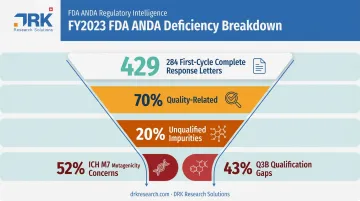
Why this matters: Getting the structure right the first time isn't a nice-to-have. In FY2023, FDA reported 284 first-cycle major ANDA complete response letters covering 429 major deficiencies, and more than 70% were quality-related.
Unqualified impurities accounted for 20% of drug-product-related major deficiencies, and within that category, ICH M7 mutagenicity concerns made up 52% and Q3B qualification gaps made up 43% (FDA, FY2023 Quality Major Deficiencies in ANDAs). Those figures describe FDA's own deficiency categories, not a blanket delay rate, but they show that getting impurity characterization wrong is a common way a deficiency letter gets written.
KPIs this advantage moves:
- Accuracy of impurity identification on first attempt
- First-time-right synthesis rate
- Number of regulatory queries tied to impurity data
When it matters most: Novel chemical entities, complex generics and hybrid products, and any impurity with an ambiguous or unknown structure that needs de novo route design rather than a known synthesis pathway.
Advantage 2: Regulatory Compliance and Global Submission Readiness
Every impurity reference standard eventually has to satisfy more than one regulator. ICH Q3A and Q3B set the baseline for identifying and qualifying impurities in new drug substances and products, ICH Q3C governs residual solvents, and FDA and EMA both now expect confirmatory nitrosamine testing layered on top.
FDA's default acceptable intake approach lands at 26.5 nanograms per day when its listed methods can't establish a compound-specific limit (FDA nitrosamine guidance). That's tight enough that a poorly characterized standard can sink an otherwise solid submission.
CDMOs build compliance into the workflow from the first route-design meeting through the final Certificate of Analysis. That means validated methods, full traceability, and documentation formatted the way reviewers actually expect, not retrofitted afterward.
FDA's own drug master file review notes cite recurring gaps behind these delays:
- Missing residual-solvent or inorganic-impurity data
- Incomplete nitrosamine risk assessments
- Unclassified process versus degradation impurities
- Insufficient ICH M7 controls
For sponsors expanding beyond their home market, a CDMO with genuine multi-regional experience matters even more. Filing requirements differ across Europe, the Middle East, Asia, Africa, and the Americas, and a partner already working in those regions can flag local nuances before they become review-cycle surprises.
KPIs this advantage moves: submission approval timelines, number of regulatory information requests, and compliance audit pass rates.
When it matters most: Multi-regional filings, generics and hybrid product development for regulated markets, and first-in-class molecules entering new geographies.
Advantage 3: Speed, Scalability, and Cost Efficiency Without Capital Investment
A fully equipped impurity synthesis lab isn't cheap. Dedicated synthetic chemistry space, an NMR instrument, an MS platform, and chemists trained in de novo route design don't come free. That capital is hard to justify for work that surfaces a handful of times a year rather than every week.
CDMOs spread that infrastructure across many sponsor projects at once:
| Factor | Building In-House | Partnering With a CDMO |
|---|---|---|
| Capital investment | High (lab, MS/NMR, chemists) | Minimal (shared infrastructure) |
| Utilization | Often sporadic | Spread across multiple sponsors |
| Turnaround | Queued behind other lab work | Flexible, project-driven |
| Budget impact | Fixed cost | Variable, per-project cost |
Why this matters: Outsourcing turns a fixed capital cost into a variable project cost, freeing R&D budget for work only the sponsor can do internally. Speed gains can be substantial, too.
One case study comparing conventional impurity isolation against supercritical fluid chromatography found the conventional route took 12 to 14 months, while SFC isolation took less than a week, with structure confirmed by NMR and MS (Pharmaceutical Technology, 2013). That's a comparison of isolation techniques, not outsourcing versus in-house builds, but it illustrates the timeline compression a lab with the right technology and staff can deliver.
Outsourcing also unlocks parallel work: impurity synthesis can run alongside formulation development or clinical activities instead of queuing behind whatever the internal lab is doing that month.
KPIs this advantage moves: cost per impurity standard, time-to-availability of reference material, and R&D resource utilization.
When it matters most: Growing pipelines, resource-constrained biotech sponsors, and projects running against tight regulatory deadlines.
What Happens When Sponsors Skip CDMO Support for Complex Impurities
Skipping specialized support doesn't make the impurity problem disappear. It just resurfaces later, usually at a worse time.
- Inconsistent impurity identification: without de novo route design and spectral matching, analytical data ends up unreliable across batches.
- Higher structural confirmation error rates: leading to repeated synthesis attempts that burn weeks or months per impurity.
- Reactive firefighting: unexpected impurities surfacing late in development or mid-stability study, forcing scrambles instead of plans.
- Rising costs: from idle in-house equipment and expertise gaps nobody has time to fill.
- Scaling difficulty: as pipelines grow or multi-market filings stack up, a team built for occasional work can't keep pace.
None of this shows up as one dramatic failure. It compounds steadily, one delayed submission and one repeated synthesis attempt at a time, until impurity work becomes the bottleneck for the entire development timeline.
How Sponsors Get the Most Value from a CDMO Partnership
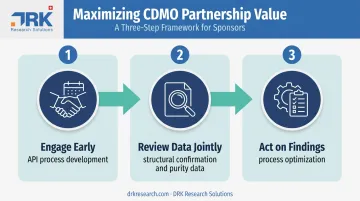
Sponsors who get the most from CDMO partnerships treat impurity synthesis as part of the development process, not a service called in after something breaks. Three practices separate partnerships that work from ones that don't:
- Engage early. Bring the CDMO in alongside API process development, not after an unexpected impurity shows up during stability testing.
- Review data jointly. Examine structural confirmation, purity data, and documentation together, then fold the findings into the overall impurity control strategy — not hand them over as a standalone report.
- Act on findings. Use impurity characterization to drive process optimization and mitigate degradation risk, not let it sit unused in a file.
That last point is where an integrated CRO-CDMO model earns its keep. A partner like DRK Research Solutions, working across Europe, the Middle East, Asia, Africa, and the Americas, connects impurity and analytical findings to the broader regulatory dossier and clinical strategy already in motion. This approach treats characterization as a connected data point, not a siloed lab deliverable.
When one organization coordinates CMC documentation, eCTD submissions, and analytical method development, impurity data has a direct path into the filing instead of getting lost between vendors.
Conclusion
Complex impurity synthesis has become a control problem as much as a chemistry problem. Sponsors need consistent identification, defensible documentation, and a process that doesn't buckle when a pipeline grows or a filing expands into a new region.
These advantages compound as pipelines grow and filings stack up across jurisdictions:
- Specialized synthetic and analytical expertise
- Compliance built into the workflow
- Cost and speed efficiency without new capital investment
CDMO partnership delivers the most value as an ongoing relationship, established well before a crisis forces the issue. DRK Research Solutions supports sponsors with CMC analytical method development, regulatory dossier preparation, and multi-regional regulatory strategy across its network spanning Europe, the Middle East, Asia, Africa, and the Americas.
This work connects impurity and analytical findings to the broader submission from an early stage through filing.
Frequently Asked Questions
What is impurity synthesis?
Impurity synthesis is the process of chemically recreating a specific impurity, usually at small scale, so it can serve as a reference standard. That standard supports identification and quantification work, which in turn feeds safety assessments throughout development.
What are the three types of impurities?
ICH Q3A groups impurities into organic (process-related and degradation), inorganic (residual metals, catalysts, salts), and residual solvents. Degradation products, covered under ICH Q3B, form a closely related fourth category.
What is an example of an impurity?
A common example is a process-related by-product carried over from an intermediate step, or a degradation product forming during storage due to heat or moisture. Genotoxic and nitrosamine impurities are a closely watched subcategory of both.
Why do pharmaceutical sponsors outsource impurity synthesis to CDMOs?
Sponsors outsource because building specialized synthetic and analytical expertise in-house rarely makes financial sense. Working with a CDMO also means faster turnaround on reference standards, without the capital cost of dedicated labs and instrumentation.
What analytical techniques do CDMOs use to characterize synthesized impurities?
HPLC separates and quantifies impurities, while mass spectrometry identifies the separated components. NMR spectroscopy then confirms structure and supports purity determination, and most complex programs run all three techniques together.
How does impurity synthesis support regulatory submissions like ICH Q3A/Q3B?
Well-characterized impurity standards provide the evidence regulators expect: validated identification and accurate quantification against reporting and qualification thresholds. That same data underpins analytical method validation within the dossier.