The stakes are real. A mismatched CDMO choice can delay IND or NDA timelines, inflate cost of goods sold, or trigger regulatory setbacks that take months to unwind. The global pharmaceutical CDMO market is valued at $166.0 billion in 2025 and is projected to reach $293.6 billion by 2033, growing at a 7.4% CAGR. More sponsors are outsourcing, and competition for the right partner is only getting tighter.
This article gives sponsors a practical framework for evaluating CDMO process development capabilities across technical, regulatory, and operational criteria.
Key Takeaways
- Process development bridges lab-scale discovery and commercial manufacturing while preserving quality and compliance
- Core building blocks include route optimization, scale-up, tech transfer, and analytical method validation
- Evaluate CDMOs on technical depth, scalability, and regulatory history
- Prioritize partners with strong analytical capability, global reach, and transparency
- The right partner reduces timeline risk, controls cost, and improves commercialization odds
What is CDMO Process Development?
CDMO process development is the discipline of designing, optimizing, and validating manufacturing methods that reliably convert a lab-scale molecule into a reproducible, regulatory-compliant commercial process.
Scope varies depending on the project. A small molecule API demands different process controls than a biologic or a generic/hybrid product. It also shifts across development phases, from preclinical feasibility work through commercial launch.
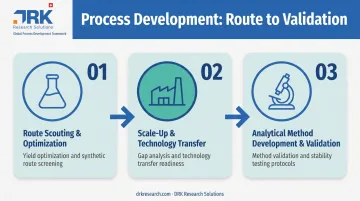
Route Scouting & Process Optimization
Before committing to scale-up, a capable CDMO evaluates multiple reaction pathways against yield, cost, and raw material availability. This isn't a one-time decision. Per ICH Q11 guidance, development should identify potential critical quality attributes and define a control strategy that holds up under commercial conditions, not just in a fume hood.
Route scouting typically examines:
- Number of synthetic steps and their impact on cost of goods
- Availability and stability of key raw materials and intermediates
- Impurity profiles generated at each step
- Scalability of the pathway to plant-size reactors
Scale-Up & Technology Transfer
Scale-up is where laboratory assumptions get tested against reality. Mixing dynamics, heat transfer, and reaction kinetics behave differently at 2,000 liters than they do at 2 liters. An exothermic reaction that's easy to control on a small scale can become a safety issue in a plant vessel with slower heat dissipation.
The WHO defines technology transfer as a controlled, logical procedure for moving a product, its process knowledge, and documentation between sites. That means:
- An authorized transfer plan covering scope, phases, and acceptance criteria
- Gap analysis comparing origin and receiving site equipment
- A transfer report documenting deviations, investigations, and corrective actions
Skipping this rigor is one of the most common reasons engineering batches fail.
Analytical Method Development & Validation
Reliable analytical methods confirm that critical quality attributes, meaning identity, potency, purity, and stability, hold steady across every batch. ICH Q2(R2) requires that validated methods demonstrate fitness for their intended purpose, including the ability to detect degradation over time (a stability-indicating method).
Without this foundation, a sponsor can produce material that looks fine on paper but fails release testing or, worse, degrades faster than labeled shelf life predicts.
Why Sponsors Rely on CDMO Process Development
A strong process development partner delivers benefits that compound across the entire program:
- Reduced time-to-clinic: Fewer process iterations mean faster movement into GMP manufacturing
- Improved yield, lower COGS: Optimization work directly cuts material waste and rework
- Built-in regulatory compliance: Documentation generated during development feeds directly into submission packages
- Mitigated batch-failure risk: Scale-up studies catch problems before they hit commercial-scale equipment
The financial upside of optimization is well documented. One published case involving a third-party API purification process showed the original method delivering only 51% overall crystallization yield across four crystallization steps. A reworked two-step process detailed by American Pharmaceutical Review hit the same purity target at 87% yield, nearly doubling output from the same raw material input.
This is the kind of gain sponsors leave on the table when process development gets treated as an afterthought rather than a core evaluation criterion.
What to Consider When Choosing a CDMO for Process Development
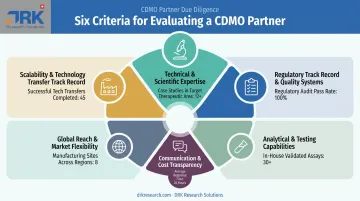
Evaluation priorities shift depending on molecule complexity, development phase, and target markets. A generics program aiming for a regulated LMIC launch has different needs than a novel biologic headed for FDA approval. The six factors below connect technical capability to measurable outcomes: timeline, cost, and approval success rate.
Technical & Scientific Expertise Across Modalities
Depth in the sponsor's specific modality, whether small molecule, biologic, or generic/hybrid, reduces trial-and-error and shortens development cycles. A CDMO that has run dozens of similar projects will recognize failure modes faster than one encountering them for the first time.
This expertise influences:
- Number of process iterations required before lock-in
- Yield improvement percentage achieved during optimization
- Root-cause resolution speed when deviations occur
Scalability & Technology Transfer Track Record
Proven experience moving from lab to pilot to commercial scale matters more than a slick pitch deck. Ask for specifics: how many engineering batches has this CDMO run for similar chemistry? What happened when things didn't go as planned?
KPIs this affects:
- Batch success rate at scale-up
- Tech transfer completion time from protocol approval to first commercial batch
- Number of deviations reported during scale-up runs
Regulatory Track Record & Quality Systems
GMP compliance history and inspection outcomes directly affect a sponsor's ability to file and defend regulatory submissions. FDA's own inspection data offers useful context here.
In FY2025, the FDA conducted 1,309 pharmaceutical inspections. Final classifications broke down to 22% No Action Indicated, 60% Voluntary Action Indicated, and 18% Official Action Indicated, according to the FDA's Report on the State of Pharmaceutical Quality. An OAI finding at a manufacturing partner can delay or derail an entire submission timeline.
Sponsors should ask potential partners directly about inspection history, not just certifications. A quality agreement matters too, since regulatory responsibility for the finished product legally stays with the sponsor even when manufacturing is outsourced.
KPIs this affects:
- Inspection findings and classification history
- Submission acceptance rate
- Audit readiness
Analytical & Testing Capabilities
In-house analytical development avoids costly delays from third-party testing dependencies. If a CDMO has to ship samples out for every stability pull or impurity check, timelines stretch and communication gaps multiply.
KPIs this affects:
- Method validation turnaround time
- CQA testing accuracy across identity, potency, purity, and stability
- Out-of-specification investigation closure time
Global Reach & Regulatory Market Flexibility
A CDMO's ability to support multiple regulatory jurisdictions matters for sponsors planning global launches, especially those targeting underserved or LMIC markets. WHO Prequalification remains the primary pathway for procurement eligibility in many of these regions, and it's a different evidence package than a standard FDA or EMA submission.
Beyond WHO PQ, harmonized inspection frameworks add another layer of market flexibility. The Pharmaceutical Inspection Co-operation Scheme (PIC/S) now includes 57 participating authorities worldwide, reflecting how harmonized GMP standards have become across regions.
KPIs this affects:
- Number of markets supported simultaneously
- Regional regulatory approval timelines
- WHO Prequalification dossier acceptance rate
Communication, Project Management & Cost Transparency
Dedicated project management and transparent cost structures prevent scope creep and missed milestones. This sounds obvious, but it's frequently where CDMO relationships break down. A sponsor needs to know, in real time, whether a project is on budget and on schedule, not find out three months later during a status call gone wrong.
KPIs this affects:
- On-time milestone delivery rate
- Budget variance against original scope
- Response time to sponsor queries and change requests
How DRK Research Solutions Can Help
DRK Research Solutions operates as a CRO-CDMO hybrid, built to combine global scale with localized, personalized process development support. The model integrates development and manufacturing functions across regions, built around the sponsor's full journey rather than treating them as separate, bolted-together services.
What sets DRK apart:
- A worldwide network spanning Europe, the Middle East, Asia, Africa, and the Americas, with local regulatory proficiency in each region
- Over a decade of experience and 100+ specialists across clinical and product development functions
- Proven expertise in generics and hybrid product development for regulated markets, including eCTD dossier preparation
- End-to-end capabilities from first-in-human studies through commercial launch
- A strong focus on shortening development timelines while expanding access in underserved and LMIC markets
Beyond regional reach, DRK's GxP compliance team supports sponsors navigating EU GMP, MHRA, PIC/S, WHO PQ, and US FDA frameworks. This cross-jurisdictional expertise matters most when a generics or hybrid product needs to clear more than one regulatory authority.
Technology transfer work includes detailed process documentation and on-site support at manufacturing partner facilities. This keeps formulations consistent as they move from lab scale to commercial volume.
Conclusion
Selecting a CDMO for process development comes down to fit, not brand recognition. The right partner's capabilities need to align with the molecule, the target market, and the timeline priorities driving the program.
The six evaluation factors covered here work together, not in isolation. A CDMO with outstanding technical expertise but a weak regulatory track record can still sink a submission.
CDMO performance shouldn't be a one-time decision either. As programs move from preclinical work into clinical manufacturing and eventually commercial supply, sponsors should reassess whether the original partner still fits the program's evolving needs.
Frequently Asked Questions
What does CDMO stand for?
CDMO stands for Contract Development and Manufacturing Organization. It refers to a company that handles both drug development work, such as process optimization, and the physical manufacturing of pharmaceutical products on a sponsor's behalf.
What are the processes of CDMO?
Core CDMO processes include formulation and process development, scale-up, analytical method development and testing, clinical trial material manufacturing, and commercial-scale production. Some CDMOs also support regulatory dossier preparation.
What are the stages of drug development?
The FDA outlines five stages: discovery and development, preclinical research, clinical research (Phases I–III), FDA review, and post-market safety monitoring. Some industry summaries condense this into four stages by combining review and commercialization.
What is the difference between a CDMO and a CMO?
A CMO (Contract Manufacturing Organization) focuses solely on manufacturing existing, already-developed processes. A CDMO adds development work on top, including process optimization, scale-up studies, and analytical method validation before manufacturing even begins.
How early should a sponsor engage a CDMO for process development?
Most sponsors benefit from engaging a CDMO during preclinical or early development stages. This lets the manufacturing route be designed for scalability from the start, avoiding costly retrofits later.
What is the difference between process development and process validation?
Process development designs and optimizes the manufacturing method, defining the process and its control strategy. Process validation then confirms, through Stage 1–3 documented evidence, that the process consistently meets GMP quality standards.