Introduction
Regulatory teams preparing a Marketing Authorisation Application (MAA) often ask the same question: how much manufacturing detail is actually "enough" for Module 3?
The Guideline on Manufacture of the Finished Dosage Form (EMA/CHMP/QWP/245074/2015) answers that question directly. It replaced the 1996 Note for Guidance and now defines exactly what assessors expect to see in the process description.
This matters for regulatory affairs professionals, CMC/QA teams, sponsors, and CDMO/CRO partners building dossiers for European submission. Get it wrong, and you're looking at deficiency letters, delayed approval timelines, and repeated back-and-forth with assessors.
Despite these stakes, the guideline is widely cited in CMC circles, yet many teams still misapply it at the operational level. This article breaks down what it covers, why it exists, how its requirements function in practice, where it applies, and when its expectations reasonably shift.
Key Takeaways
- Effective 14 February 2018, the guideline replaced the 1996 Note for Guidance with ICH Q8 QbD thinking
- Sets required detail for three dossier areas: process description, critical step controls, and storage/hold time
- Scope covers chemical and herbal dosage forms for human use, extending to biologics and radiopharmaceuticals but excluding ATMPs
- Vague terms like "suitable equipment" or "typical" parameters are rejected by assessors
- Partnering with an experienced CDMO/CRO lowers the risk of non-compliant process descriptions
What Is the Guideline on Manufacture of the Finished Dosage Form?
At its simplest, this is the EMA guideline that clarifies what level of manufacturing information belongs in CTD Module 3 for a medicinal product's finished dosage form. It doesn't tell you how to manufacture a product; it tells you how to document that manufacturing process for regulatory review.
The intended outcome is straightforward: consistent, reproducible product quality built into the process description and control strategy, rather than confirmed only through end-product testing.
This control-strategy emphasis is what sets the guideline apart from broader development frameworks. How it differs from ICH Q8: ICH Q8 focuses on pharmaceutical development principles, including Quality by Design (QbD), design space, and the identification of Critical Process Parameters (CPPs) and Critical Quality Attributes (CQAs). This EMA guideline is narrower and more practical. It specifies exactly what must appear in the dossier's manufacturing process section, regardless of which development philosophy produced it.
Regulatory History and Scope
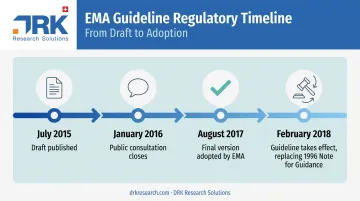
The guideline moved through several milestones before reaching its current form:
- Draft published 9 July 2015, open for consultation through January 2016
- Final version published by EMA on 14 August 2017, taking effect six months later on 14 February 2018
- Replaced the older Note for Guidance, CPMP/QWP/486/95, in force since 1996
Its primary scope covers chemical and herbal finished dosage forms for human use. The principles also apply, where relevant, to biological medicinal products, radiopharmaceuticals, and chemical investigational medicinal products.
By comparison, the FDA's older 1987 Guideline for Submitting Supporting Documentation in Drug Applications for the Manufacture of Drug Products covers similar ground for INDs, NDAs, and ANDAs. Both regions demand detailed CMC documentation, but they differ in format, terminology, and update cadence.
Why This Guideline Matters and Where It Applies
Why It Matters
Global supply chains have become more fragmented. Sponsors routinely rely on contract manufacturing networks spanning multiple sites and countries. This guideline clarifies documentation expectations across that entire network, not just a single manufacturing facility.
As RAPS reported in 2017, the revision arrived precisely as outsourcing and supply chain complexity were increasing, addressing critical steps, intermediates, prolonged holding times, and transportation more explicitly than the 1996 version did.
Without this level of clarity, common problems emerge:
- Vague process descriptions that assessors can't evaluate
- Operating ranges lacking development-data justification
- Control strategies that don't clearly connect CPPs to CQAs
Each of these commonly triggers regulatory queries, additional data requests, or delayed approval timelines.
Sponsors partnering with an experienced CDMO/CRO such as DRK Research Solutions, which specializes in generics and hybrid product development for regulated markets, can build well-justified process descriptions and control strategies from the start. That reduces the costly cycle of deficiency letters and resubmissions later in the process.
Where It Applies
This guideline governs CTD Module 3.2.P.3 in MAAs, post-approval variations, and (where relevant) IMP dossiers. It's most relevant during:
- Initial submission of a new MAA
- Process changes affecting the authorized manufacturing method
- Scale-up from clinical to commercial batch sizes
- Site or CDMO tech transfer, where the process moves to a new facility
Because it applies whenever a sponsor describes, modifies, or transfers a process, this isn't a one-time compliance check. It recurs across the entire product lifecycle.
Notably, the same expected level of detail applies whether a sponsor used the traditional (minimal) or enhanced (QbD) development approach, and regardless of whether continuous manufacturing is involved.
How the Guideline's Requirements Work
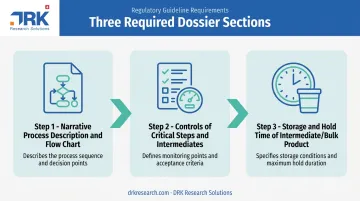
The guideline organizes its requirements into three connected dossier sections: the process description and controls, the controls of critical steps and intermediates, and storage of intermediate/bulk product.
Raw materials and intermediates move through defined unit operations, such as granulation, blending, compression, and coating. Each operation requires stated parameters tied to actual development data. "Typical" or "suitable" placeholders are not acceptable.
Process control happens through a product-specific control strategy linking CPPs to CQAs, and where relevant, a design space or Real Time Release Testing (RTRT) approach. The result: dossiers with enough justified detail to support consistent assessment, minimize future variations, and demonstrate quality built into the process rather than tested in after the fact.
Step 1 – Narrative Process Description and Flow Chart
Manufacturers must provide a full narrative description of the manufacturing process, paired with a flow chart showing every processing step and material entry point. Vague terminology isn't acceptable here either. Any wide operating range needs justification backed by development data, not just an assertion that it works.
Step 2 – Controls of Critical Steps and Intermediates
Every critical step and intermediate needs a listed in-process control (IPC), test method, and acceptance criterion. For complex control strategies, such as model-based control or continuous manufacturing, the dossier must clearly state how release decisions get made and how deviations get managed.
Step 3 – Storage and Hold Time of Intermediate/Bulk Product
Sponsors must state storage conditions and justify maximum holding times with stability data. As a general benchmark, storage exceeding 30 days for solid oral dosage forms or 24 hours for sterile products counts as prolonged and requires supporting justification. The bulk container closure system must also be confirmed suitable, including transport considerations referencing GMP Annex 15.
Key Factors That Affect Compliance With the Guideline
Several variables shape how much detail a specific dossier needs:
- Inputs and materials – API characteristics, excipient grade, and formulation complexity (effervescent tablets, for instance, require defined environmental conditions during manufacture)
- Operating conditions – batch size, equipment working capacity, and whether parameters are described as fixed points or normal operating ranges
- Development approach used – traditional versus enhanced (QbD), and whether continuous manufacturing, design space, or RTRT is claimed
- Regulatory constraints on criticality – a parameter controlled within a non-impacting range is not automatically classified as non-critical
This is where early formulation and analytical work pays off. DRK's lab-scale formulation optimization and validated analytical method development generate the data needed to justify these operating ranges later, rather than scrambling to backfill it during dossier compilation.
Common Misconceptions and When the Guideline May Not Fully Apply
A few misunderstandings persist among teams working with this guideline:
- "It introduces new manufacturing requirements." It doesn't. EMA has clarified the guideline adds no new obligations for already-authorized products; it clarifies documentation expectations, not manufacturing itself.
- "Vague terms are still acceptable if the process works." They're not. The guideline explicitly requires specific equipment types and defined parameter ranges, not generic placeholders.
- "Only critical parameters need description." Non-critical parameters that affect process consistency still require appropriate description; you can't omit them simply because they aren't classified as critical.
One clear exception exists: this guideline does not extend to Advanced Therapy Medicinal Products (ATMPs), which follow separate, ATMP-specific guidance.
Beyond that product-type exception, expected detail also shifts with development stage. Early-phase IND/IMP dossiers (Phase 1/2) can reasonably use less exhaustive detail than commercial MAA submissions. Expected depth scales with development stage. Matching documentation detail to development stage, product type, and region-specific expectations matters more than defaulting to maximal detail everywhere.
Frequently Asked Questions
What is the EMA guideline on manufacture of the finished dosage form?
The guideline is EMA/CHMP/QWP/245074/2015, effective 14 February 2018, and clarifies the level of detail required for the manufacturing process description in CTD Module 3 of an MAA dossier.
What is a finished dosage form (FDF) in pharmaceuticals?
An FDF is the final, ready-to-administer form of a medicinal product, such as a tablet, capsule, injectable, or cream, that combines the API and excipients after formulation, manufacturing, and quality control.
Does this guideline apply to biological or ATMP products?
The guideline's principles extend to biological medicinal products, radiopharmaceuticals, and chemical IMPs where relevant, but it does not apply to Advanced Therapy Medicinal Products, which follow separate guidance.
What is the difference between this guideline and ICH Q8?
ICH Q8 covers pharmaceutical development and QbD principles. This EMA guideline specifies what must be documented in the regulatory dossier's manufacturing process section.
What happens if a manufacturing process description lacks sufficient detail?
Vague descriptions or unjustified ranges typically trigger regulatory queries, additional data requests, and potential delays in MAA approval or variation processing.
How can a CDMO help ensure compliance with this guideline?
An experienced CDMO/CRO, such as DRK Research Solutions, helps sponsors build well-justified process descriptions and control strategies from early development onward. This alignment with EMA and ICH Q8 expectations reduces the risk of regulatory queries later.